

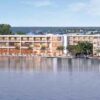




Development on north Perico Island is again generating controversy — eight years after Bradenton officials approved plans for town homes and single-family residences facing the Anna Maria Sound.
However, this controversy isn’t about the Harbour Isle development under construction. It’s about 40 acres of waterfront land on the northwest corner of Perico Island owned through a trust by developer Pat Neal and his family.
Neal plans to build four single-family homes on four of the 40 acres. The homes are for Neal family members, he said. The Bradenton City Council approved the site plan at a public hearing in June.
That didn’t appear to be controversial, but a Southwest Florida Water Management District permit issued in late August to the development — now called Harbor Sound — calls for removal of “exotic vegetation” along the shore by the homes.
That raised the ire of former Manatee County Commissioner Joe McClash, who said mangrove trees also would be removed. He requested the Florida General Counsel office hold an administrative hearing to review the Swiftmud permit and determine if the Harbor Sound site plan complies with the Bradenton comprehensive plan.
McClash asserts that the approval of the site plan and issuance of the permit from Swiftmud “breaks all rules.” The site plan does not fit into the city of Bradenton’s land development code or comprehensive plan, he said, and the Swiftmud permit will allow for the destruction of wetlands — the very thing it should protect.
McClash has been reaching out to organizations that may have an interest in opposing the development, including the Florida Institute for Saltwater Heritage, ManaSota-88 and the regional Sierra Club. McClash also was asking organizations to request a public hearing to review the Swiftmud permit.
“This sets a precedent for what could happen elsewhere. There are deeper concerns, so I’m trying to bring this to the attention of organizations that protect our interests,” McClash said at a FISH board meeting Sept. 8.
FISH board members were sympathetic to the environmental concerns of the development, but were wary of possible political complications if they publicly oppose the Swiftmud permit.
FISH is restoring its 100-acre preserve with a $250,000 grant from Swiftmud in partnership with the Sarasota Bay Estuary Program. FISH board members voted to file requesting a public hearing pending approval from the Sarasota Bay Estuary Program.
FISH board member Karen Bell said the groups are partners in the project, and she does not think FISH should support something without the Sarasota Bay Estuary Program’s approval.
ManaSota-88 requested a review of the permit alongside McClash.
“We’re looking at this holistically. The issuance of this permit is setting a bad precedent. We’re specifically concerned with Long Bar Pointe and any other development in that area that might come before Swiftmud for a permit,” said ManaSota-88 chair Glenn Compton.
Bradenton officials said there was nothing unusual about the Harbor Sound site plan to build the four single-family homes.
“It was routine,” said Brady Woods of the city planning department. Woods said the area owned by the trust was included in the city’s 2006 approval for residential construction and R-1 zoning on north Perico Island.
If any wetlands are removed by the Harbor Sound project, Swiftmud requires the developers to compensate through environmentally friendly projects or land purchases, Woods said.
McClash challenged what appropriate “mitigation” would mean at the FISH board meeting, saying he didn’t think the required mitigations efforts would be able to compensate for the wetland destruction.
McClash also sent a letter in late June to Bradenton Mayor Wayne Poston asking the city council to review its decision to approve the Harbor Sound site plan, but the council took no action on the request, Poston said.
“The council did not reconsider the approval of Pat Neal’s approval of four housing sites on Perico Island, as requested by Joe McClash and his friends,” Poston said.
“There were two public hearings on this topic, neither of which was attended by Mr. McClash or anyone else objecting to the approval,” the mayor added.
Woods said it’s probable that an administrative hearing on Swiftmud’s permit for the Harbor Sound project would be held.
Neal said he has no plans to further develop the remaining 36 acres of the Harbor Sound property, however the permit would allow for it.
Neal maintains that Harbor Sound was intended all along to be four homes for family members.
Perico development has checkered past
Up until the late 1990s, north Perico Island was farmland owned by the Manatee Fruit Co.
When Arvida Corp., the state’s largest private landowner, decided to develop a condominium complex on Perico Island, it found a way to avoid paying county impact fees.
In 1999, Perico Island and the area along State Road 64 from the mainland to the Anna Maria Island Bridge approach was incorporated into Bradenton.
Shortly thereafter, Arvida announced it had a pending purchase of the Perico farmland and planned an 886-unit condominium project with several 10- and 12-story structures.
The Bradenton City Council approved the Arvida site plan, but that approval was followed by several lawsuits against the city.
The chief complaint was that the site plan did not meet the requirements of the city comprehensive plan.
Manatee County was one of the complainants against the project. McClash was a county commissioner at that time and expressed his disapproval of the plan.
A compromise was reached and Arvida, having changed its name to the St. Joe Corp., agreed to scale back the number of units to 668.
By the mid 2000s, however, the real estate market collapsed, and the demand dropped for condominiums in the $500,000 range. No structure was ever built by St. Joe, although some infrastructure work was completed.
The company sold the property to Minto Communities LLC of Toronto and Fort Lauderdale in 2009 for $8 million. St. Joe had paid $2 million for the land.
Minto submitted a site plan for Harbour Isle, a series of what it called “coach-home” complexes of two units each. No structures were to be more than three-stories high, and Bradenton approved the plan in 2010.
The company began selling units in December 2010. Prices started around $225,000, and Harbour Isle opened its first community, Mangrove Walk, in 2011.