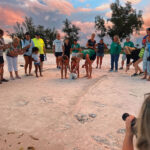





Beachgoers around 64th Street in Holmes Beach got a special treat July 10, when a mating herd of seven manatees cavorted in the Gulf of Mexico just yards from shore.
For the better part of an hour, six male manatees pursued a female to the delight of people who had flocked to the beach to soak up sun and surf. The female eventually came close to beaching herself to evade her paramours and rest, which attracted a crowd of onlookers.
According to the Save the Manatee Club website, a single female manatee in estrus may be followed by a group of a dozen or more males, forming a mating herd. Although breeding and birth may occur at any time during the year, there appears to be a broad spring-summer calving peak.
Cows can breed for up to three weeks and may mate with one or more bulls, making it difficult for scientists to identify the paternity of a calf.
The herd lingered on Holmes Beach long enough for Sheri Barton, senior biologist with Mote Marine Laboratory in Sarasota, to arrive with other Mote scientists. Barton is the coordinator of Mote’s manatee photo identification project.
“We take pictures in order to identify the manatees by their scars, which are unique to each animal,” Barton said.
She added that she and her team also wanted to ensure the safety of the manatees — and the people on the beach.
“People were concerned when the manatees strayed so close to shore and then began flailing,” Barton said. “This is all part of the breeding process. And when a 1,000 pound manatee starts thrashing around, you want to make certain that people are well out of harm’s way.”
Barton noted the possibility that other mating herds would be spotted over the weekend. “It may be the same or a different female tomorrow,” she said.
Michele Lentz of Holmes Beach was floating in the Gulf when the manatees first swam by. “Seeing seven manatees in such close proximity was amazing,” she said. “We were worried at first that they had trapped themselves on the wrong side of the sand bar, but it soon became obvious there was something else going on.”
While Barton and the other Mote scientists lingered to answer questions from onlookers and compare notes, the manatees eventually headed south into deeper water.