






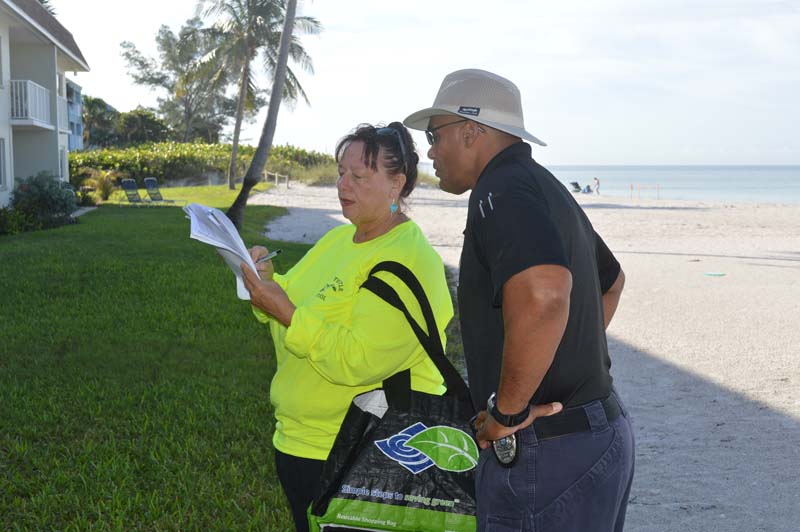
Sea turtle disorientations have been a problem in Holmes Beach this sea turtle nesting and hatchling season, prompting the city code enforcement team to work with Anna Maria Island Turtle Watch and Shorebird Monitoring to resolve the issues on the beach.
The season runs May 1-Oct. 31.
Sea turtles — which usually hatch from their nests on the beach at night — use their instincts to follow the reflection of the moon and stars on the water to find their way to the Gulf.
The tiny hatchlings need water and nourishment in the Gulf to survive.
A disorientation occurs when hatchlings are distracted by artificial lights and head away from the waterline, which can lead to death by predation or dehydration.
Waterfront residences and businesses on Anna Maria Island must have outdoor lights installed low and shielded and use turtle-friendly bulbs. Indoor lights must turned off and curtains closed after dark to prevent disorientations.
There have been repeated disorientations this sea turtle season — May 1-Oct. 31 — on the beach at Nautilus condominiums, 7100 Gulf Drive, Holmes Beach, as well as in other locations in Holmes Beach.
Holmes Beach had the most nests and hatches as of Sept. 11, according to AMITW. This also could contribute to the higher number of disorientations.
Following a disorientation, Fox inspects the area surrounding the hatched nest to determine what may have caused the problem.
In the case of Nautilus condos, Fox said the disorientations were most likely caused by lighting inside of beachfront units which can be seen from the shoreline after dark.
In an inspection Sept. 13 with Holmes Beach code enforcement officer Nate Brown, Fox reported lights visible from some beachfront windows.
“We are not here to be confrontational, we just want to let guests know what they can do,” Fox said.
Recently, AMITW printed window decals to place inside waterfront units reminding people to “turn off outside lights and close curtains and blinds.”
Additionally, AMITW and Holmes Beach code officers are distributing educational materials — informational door hangers, booklets and pamphlets — to properties on the beach.
Code enforcement also is being “pro-active” in supporting AMITW’s educational outreach.
“We are pro-active because we care what our residents and visitors have to say and we want this to be a win-win situation,” said Holmes Beach code enforcement officer JT Thomas.
Thomas has been learning about sea turtles from Fox so he presents proper sea turtle guidelines to the public.
Thomas said instead of sending letters to notify a person or business of a violation, an officer usually visits the location and informs the owner, management or renter of the problem, giving them a chance to fix it before issuing a citation.
“We contact them, educate them about AMITW, tell them what the problem is and what they can do to fix it,” said Brown. “We want to work together to solve problems.”
Fox took Brown Sept. 13 to several beachfront properties where disorientations have occurred to demonstrate a sea turtle safety inspection.
Fox said it is important for code officers to know what constitutes a lighting problem for sea turtles, so they can address the situations that arise.
Fox said often when she sees a lighting violation, she can provide turtle-friendly bulbs at cost and assist with installation.
“Most of these problems are easy to fix,” Fox said. “And working together as a team with code enforcement benefits everyone.”
For more information about sea turtles, contact Fox at suzilfox@gmail.com or 941-778-5638.
Go to the head of the class: Sea Turtle Safety ‘101’
School has resumed and it’s time to hit the books — even Sea Turtle 101.
There won’t be a quiz at the end, just an opportunity to learn more about the sea turtles that nest and hatch on Anna Maria Island beaches.
Five fun facts about sea turtles:
• Sea turtle nesting season in Florida lasts through Oct. 31.
• A female sea turtle can lay more than 100 eggs per nest. And they can lay more than one nest.
• Some sea turtles eat jellyfish.
• Loggerheads are the most abundant sea turtle species nesting on Florida beaches.
• Male sea turtles never return to the shore after hatching, but females return to the beaches close to where they were born, to nest.
The Florida Fish and Wildlife Conservation Commission recommends residents and visitors in Florida’s coastal communities follow these guidelines for sea turtle safety:
Hands off hatchlings! Sea turtle hatchlings are emerging from their nests and crawling into the Gulf of Mexico during the months of September and October.
Remember, ‘hands off’ is the best policy for beachgoers encountering hatchlings. Digging into a nest or picking up a hatchling are against the law.
Turn out the lights, save a life. Turn off or adjust lighting along the beachfront to prevent nesting and hatchling sea turtles from becoming disoriented and going toward land instead of natural light reflecting on the surface of the Gulf where sea turtles belong. Indoor lights should be turned off with curtains closed after dark, and outdoor lighting should be turtle-friendly bulbs both installed on low fixtures and shielded from the view at the shoreline.
Clear the way at the end of the day. Nesting mothers or hatchling sea turtles can become trapped, confused or impeded by gear left on the beach at night. Remove items such as boats, tents, rafts and beach furniture at the end of the day, and fill in holes or level sand castles before dusk.
Report sick, injured, entangled or dead sea turtles to the FWC Wildlife Alert Hotline, 1-888-404-3922, #FWC or *FWC on a cell phone or text Tip@MyFWC.com.
Visit MyFWC.com/Sea Turtle and click on “Sea Turtles and Lights” or “Wildlife Friendly Lighting” for more information on keeping beaches safe for sea turtles.