







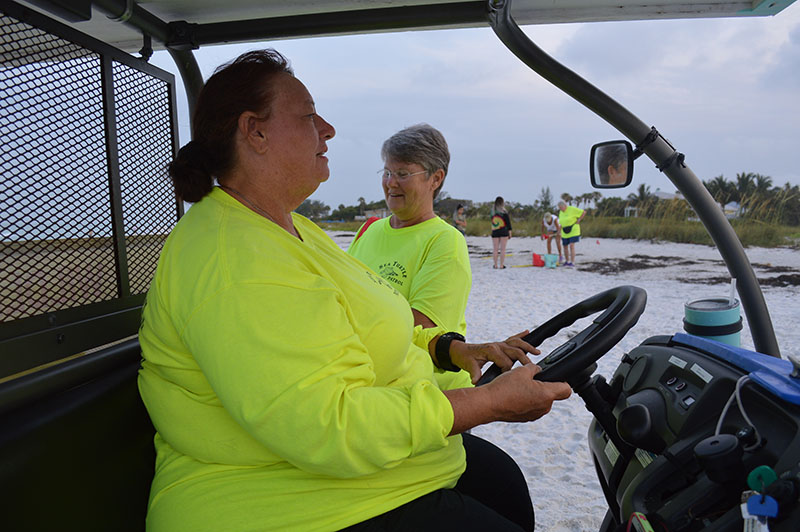

In the 10 years Jeannie Deam has volunteered time to help sea turtles, she has observed the scope of sea turtle nesting activity and the role humans play in a successful nesting season.
From a disoriented nesting female that ended up in the road to an eruption of hatchlings popping out of a sandy nest to make their way to the water, Deam has seen a variety of turtle activity on the island beaches.
“When sea turtles hatch and come out of the sand, it looks like a volcano erupting,” she said. “It’s just amazing to see.”
Deam is one of 85 volunteers who walk the beach for Anna Maria Island Turtle Watch and Shorebird Monitoring during sea turtle nesting season, May 1-Oct. 31.
Deam walks the beach Tuesday mornings in section 3, which extends a mile northward from 66th Street in Holmes Beach to Willow Avenue in Anna Maria. AMITW volunteers take turns conducting daily beach walks to look for the telltale tractor-like tracks indicating a newly laid sea turtle nest or, later in the season, tiny tracks made by hatchlings headed to the Gulf of Mexico.
As of May 28, section 3 had 16 confirmed nests, the most of any section this season. By the end of the 2016 nesting season, section 3 had reported 83 nests.
When asked May 30 if she’s seen much change on the nesting beaches, Deam said, “A lot more nesting and more awareness from visitors to pick up their trash at the end of the day.”
However, she said, according to a Holmes Beach police officer she spoke with on the beach during the Memorial Day weekend, trash was worse than usual.
“It’s better overall, but it does seem to get significantly worse during holidays,” she said.
AMITW executive director Suzi Fox said she organized volunteers to meet May 30 on the beach to join others already there collecting trash after the holiday weekend.
They collected more than 70 pounds of trash.
Fox said day-trippers could be contributing to the problem.
“I think the issue may be that people are leaving in a hurry at the end of a long day and don’t think about the effects of leaving behind broken beach chairs and tents,” Fox said.
Mature female sea turtles, which only leave the water for several hours to nest at night on the beach, can become trapped under abandoned beach furniture, which can be deadly for the turtle.
“By the end of summer, we will have four times the number of nests on the beach,” Fox said. “With each day and, especially during the July Fourth holiday, it becomes more important for people to pick up after themselves.”
For more information about AMITW, contact Suzi Fox at suzilfox@gmail.com or 941-778-5638.