







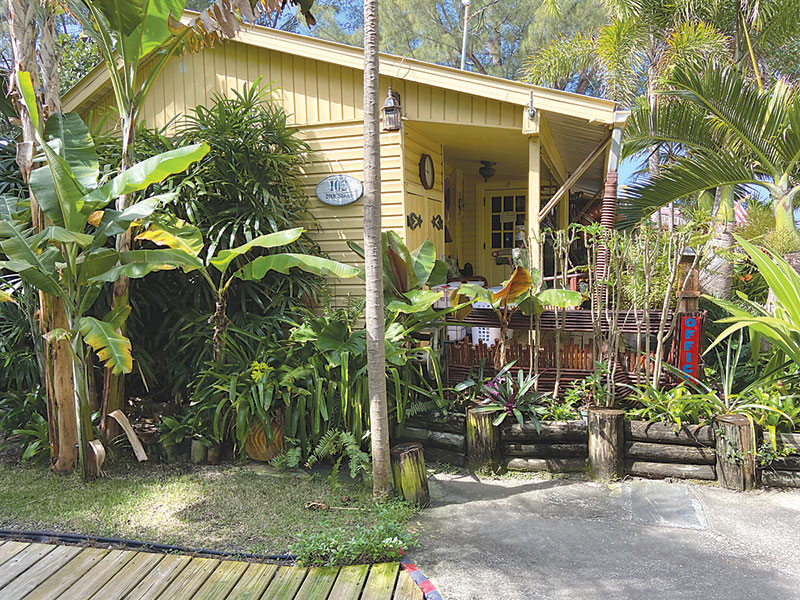
The decade-long legal battle between Holmes Beach and the owners of 103 29th St. has become a war of attrition.
On March 17, Richard and Lynn Tran-Hazen fought city hall to keep their vacation rental units’ revenue.
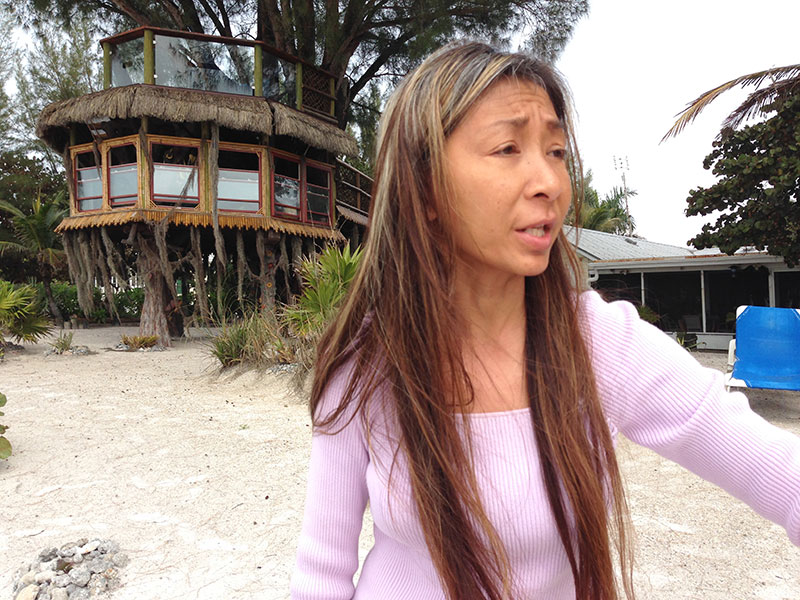
The Hazens reside at the property, where they built a treehouse on the beach and operate Angelinos Sea Lodge.
The city’s special magistrate, Sarasota attorney Michael Connolly, ruled at a March 17 hearing that the pair must stop renting and advertising their vacation units until they acquire a valid vacation rental certificate through the city. And they can’t renew the certificate until they pay — a $127.54 administration fee and accumulating code violation fines.
It’s leaving people to ask, how long can they keep up their fight?
Their case began in 2011, when they built the treehouse in an Australian pine tree on the beachfront at their residence/lodge seaward of the state erosion control line and without a city or Florida Department of Environmental Protection permit.
The city found the treehouse — an elevated two-story structure with windows and solar power — in violation of its land development code and moved for its demolition or removal in 2013, sparking litigation with the owners.
The Hazens have been on the losing end of each ruling after several lawsuits and appeals in the 12th District Circuit Court over the years since.
According to the parties, litigation has so far cost the city $184,955 and the property owners $170,000.
Additionally, the property owners face almost $100,000 in code violation fines levied by the city.
Two circuit court cases between the parties remain open and the property owners petitioned in late December to have a case heard by the U.S. Supreme Court.
The city and the DEP have until March 26 to respond to the writ of certiorari — a request that the Supreme Court order a lower court to send up the record for review — after two extensions on their deadline.
The high court had yet to act on the case as of March 19.
Meanwhile, the city notified the Hazens in December 2020 that their vacation rental license had expired and could not be renewed until they paid the amassed code violation fines — putting the pair’s revenue stream in jeopardy.
Code compliance supervisor JT Thomas said he’s monitored activity at the property and observed several renters enter despite the city’s notification that the activity violates city code.
Thomas recommended leveling a $127.54 administration fee, as well as $250 a day from Dec. 28, 2020, the date the notification letter was sent.
The property owners’ attorney, Bruce Minnick, represented them at the special magistrate hearing but only referred to his March 16 written response, claiming the issue is “a true story about a beautiful Australian pine tree about to be destroyed for no real reason.”
Minnick said he did not prepare more for the hearing because he did not expect he would be able to attend.
Erica Augello, the city’s code compliance attorney, rebutted Minnick’s written response.
“In no way, shape or form has the city ever requested the property owners to remove the tree,” Augello said. “The tree is not at issue.”
“The vacation rentals that they are conducting now are in violation of the city’s code because they do not have a valid vacation rental permit,” she added.
Augello said the city wants the treehouse removed, but has never specified that the property owners must remove the tree.
Minnick said the city codes are unconstitutional and argued that a ruling on the issue shouldn’t be made until the owners’ lawsuits in circuit court are finished or the case is dealt with by the U.S. Supreme Court.
The property owners previously sought a hearing on a constitutional claim with the U.S Supreme Court in 2018, but the court declined to hear the case without comment.
“It is my professional opinion that this proceeding should not have occurred … because the law clearly provides stays of these kinds of things when there is litigation pending,” Minnick said. “My clients are constitutionally permitted to make a living.”
He did not detail what terms of the constitution the city’s actions violated but referred to his clients’ rights to freedom of speech and expression.
“If the city continues on this path, there will be more litigation,” Minnick said.