








“He’s got a snook! Close to 30 inches,” Capt. Scott Moore shouted April 15.
Moore was guiding a fishing trip in Terra Ceia.
His delight that morning diverged from the dismay of April 14, when he had steered his boat to Bishop Harbor to assess conditions after an estimated 215 million gallons of wastewater flowed from the defunct Piney Point phosphorus plant to the Tampa Bay estuary.
Controlled discharges began March 30 and continued until April 9 in an effort to avoid a large-scale breach at the site and the collapse of the phosphogypsum stack system. Some “low-level” seepage from a containment area was observed after authorized discharges ceased and, as of April 14, about 222 million gallons remained in the compartment.
On April 14, Moore observed brown and greenish water at Bishop Harbor. He didn’t find dead fish, but he noticed a lack of fish.
“On the other side of the Skyway, the water’s not so good,” Moore told The Islander April 15.
The Holmes Beach captain, who’s guided charters for four decades and in 2019 was inducted into the Manatee County Agriculture Hall of Fame for his conservation efforts, remains chiefly concerned with a cascading impact from the nutrient-rich wastewater — red tide, fish kills, seagrass destruction, habitat loss.
The pollution in Bishop Harbor isn’t the first from Piney Point. Waste dumped there in 1970 killed fish and about 170 million gallons of polluted water spilled into the harbor and Tampa Bay in 2011.
“We’ve been going through this for years, since the ’60s. There is no excuse. This shouldn’t have happened,” said Moore, who lays blame on Piney Point ownership and the Florida Department of Environmental Protection.
The DEP reported April 14 it was “working rigorously to get innovative technologies up and running as quickly as possible” so “any future necessary discharges are pretreated to minimize any ecological impacts.”
In the political arena, Gov. Ron DeSantis, flanked April 12 by Manatee County commissioners and state lawmakers at Piney Point, announced $15.4 million from the DEP budget would be reallocated to fund pretreatments of wastewater.
The governor also said, “I have requested that DEP’s team of engineers and scientists develop plans for the permanent closure of this site, including identifying the necessary resources to do so.” The cost could be $100 million or more.
On the water that day and throughout the week ending April 18, the DEP, institutions and environmental organizations sampled water quality.
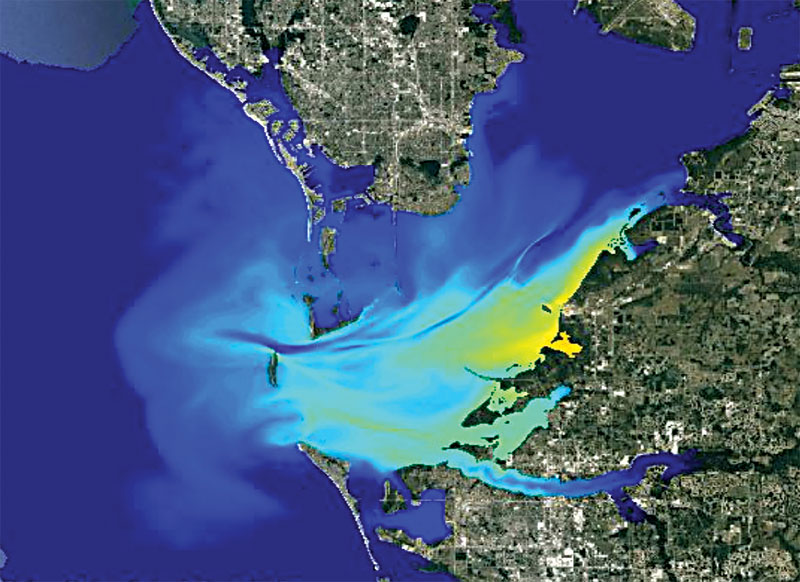
Modeling for the area also occurred, as researchers with the University of South Florida used computer simulation to forecast the trajectory of the wastewater contaminants.
The USF team said April 15 that the highest nutrient concentrations occurred along Tampa Bay’s lower east coast and that the Piney Point plume had spread north to the Little Manatee River and south to the Manatee River.
Researcher Bob Weisberg described the wastewater as sloshing back and forth with the tides, moving south from Port Manatee, diluting and making its way to the Gulf of Mexico.
USF College of Marine Science dean Tom Frazer said, “We’re starting to put together the pieces of the story.”
Moore, on the water April 14 and April 15, observed the monitors and modelers.
“I’ve never seen so many different boats taking water samples,” he said. “So we are going to know whether things are right or wrong.”