







Interesting, to say the lease.
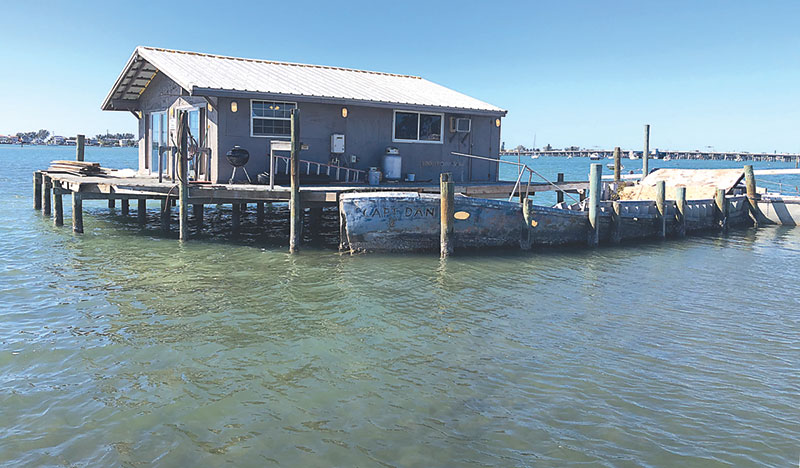
Robert Schermer — an attorney representing Raymond “Junior” Guthrie in his legal battle against the Florida Department of Environmental Protection over the stilt-house constructed over state-owned submerged land yards off the Cortez fishing docks in Sarasota Bay in 2017 — filed a motion May 11 for a 90-day stay of enforcement on 12th Circuit Judge Edward Nicholas’ final order that the structure be torn down or moved.
The motion would be an extension of the initial 60-day stay of enforcement that expired May 8. As of May 13, Nicholas had not ruled on the motion.
The court document outlines the plan to save the structure:
“Defendant Guthrie and all his siblings are providing a bill of sale for the structure to a not-for-profit entity that will then apply for a lease from DEP of the submerged land upon which it sits.”
The document also states that funds are being raised to remodel the stilt-house to make it look historic.
Regardless of who owns the structure, the stilt-house does not qualify for a lease from the state, according to DEP public information manager Shannon Herbon.
All structures built on state-owned submerged lands after 1984 must adhere to criteria set forth in the Florida Administrative Code, including a requirement that “activities on sovereignty lands shall only be limited to water-dependent activities and minimal secondary non-water dependent uses,” Herbon said in a May 7 email to The Islander.
“The Guthrie house does not meet the criteria of the rule. Whether the owner is a private individual or a nonprofit organization is irrelevant,” she said.
A “water-dependent activity” is an activity conducted on, in, over or adjacent to water areas because the activity requires direct access to the water body, according to state code.
Herbon declined to comment on how the DEP determined the Guthrie stilt-house failed to meet the requirement.
The DEP leases state-owned submerged land beneath 24 stilt-houses in Lee, Pasco and Indian River counties.
A.P. Bell Fish Co. owner Karen Bell, assisting Guthrie with his legal defense, has said Guthrie’s stilt-house should enjoy the same privilege.
Since the other stilt-houses were built prior to 1984, they are exempt from the “water-dependent activity” requirement, and some have been used as “rustic getaways” for decades, according to a March 7, 2005, Sarasota Herald-Tribune report.
Most of the structures are on or eligible for the National Register of Historic Places and received special authorization from the DEP for preservation, Herbon said.
Guthrie maintains his stilt-house is a historic net camp built on pilings his ancestors drove into the bay bottom generations ago.
The structure is located on the waterfront of the fishing village of Cortez, which has been listed on the National Register of Historic Places since 1995.
Guthrie’s stilt-house is not mentioned in the Cortez listing, though there is a section about net camps in general.
Since the stilt-house was constructed in 2017, it is not old enough to be eligible for a listing on the National Register, Herbon said.
According to the National Park Service website, nps.gov, reconstructed properties are not usually considered for listing in the National Register but can be eligible if they meet special requirements.
On April 29, Manatee County state legislators sent a letter of support for the Guthrie stilt-house to DEP Secretary Noah Valenstein.
Schermer said May 13 that he was of the belief that the state legislators are in discussions with the DEP to relax their leasing standards or find another way to allow the structure to remain standing.