




House lights, flashlights, holes and furniture on the beach can cause disorientation for sea turtle hatchlings as they try to go from nest to water.
Anna Maria Island Turtle Watch and Shorebird Monitoring volunteers Birgit Kremer and Hans Duerr told The Islander Aug. 9 that they located two hatched sea turtle nests in the 1100 and 1300 blocks of Gulf Drive South and one near the 2300 block of Gulf Drive North in Bradenton Beach but tracks indicated the turtles wandered toward land, away from the Gulf of Mexico.
It is likely that artificial lights — from houses, flashlights or cellphones — created confusion for the hatchlings as they tried to make their way to the water, according to the AMITW volunteers.
Nesting sea turtles and their hatchlings are drawn by instinct to the brightest light source. If artificial lights are brighter than the moon’s reflection on the water, sea turtles can be lead in the direction of the artificial light, which could result in death.
The AMITW volunteers located five hatchlings in the dunes and released them at the water’s edge. However, loggerhead turtle nests contain 100 to 126 eggs on average so the discovery of only five was disheartening.
Lights are not the only factor contributing to disorientation. Chairs, cabanas and holes in the sand can interfere with nesting and hatching.
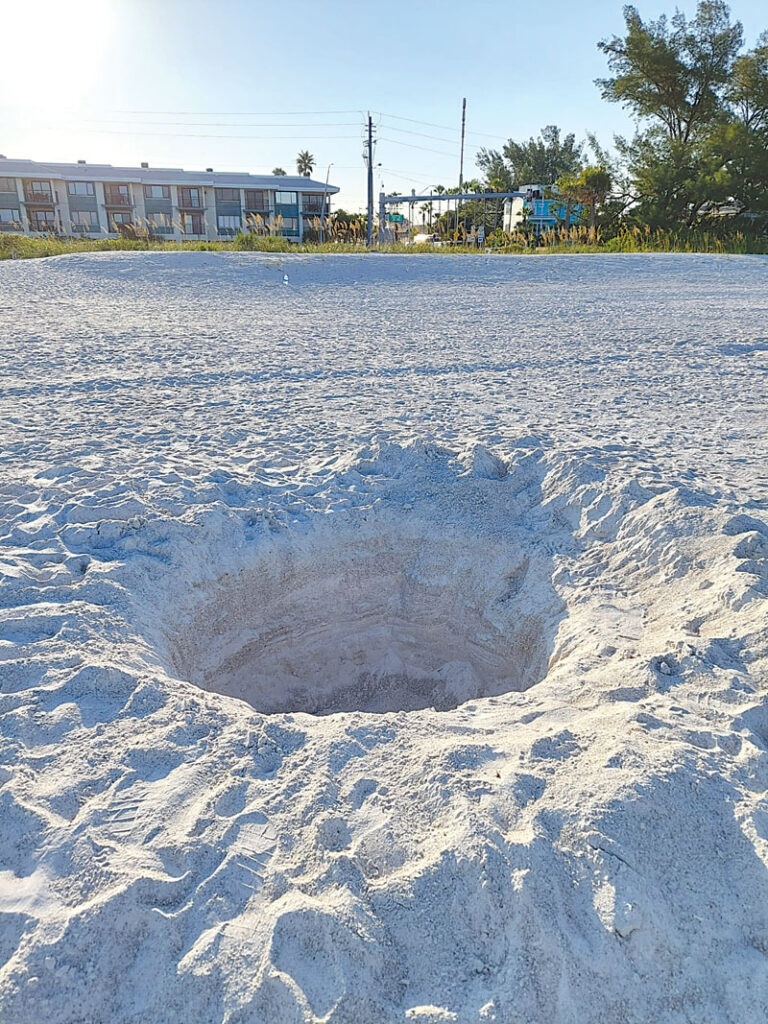
AMITW volunteers Kathy Doddridge and Carla Boehme discovered a hole Aug. 8 near the 600 block of Gulf Drive North in Bradenton Beach. The hole — between the nest and the Gulf — was nearly 4 feet deep.
Newly hatched sea turtles would not be capable of climbing out of a hole that deep and neither are the adult females that only come ashore to deposit their eggs in the sand.
So, the AMITW volunteers called for people to help by filling in holes, covering windows, turning off outside lights or using turtle-friendly lighting, avoiding the use of flashlights on the beach and removing beach furniture and trash.
About AMITW
AMITW is a nonprofit focused on preserving sea turtles and their habitat on AMI. The group also monitors shorebird nesting.
For more information, call Suzi Fox, executive director, 941-232-1405, or go to islandturtlewatch.com.
Feeding shorebirds: A losing proposition
The shorebird breeding season is all but over on Anna Maria Island.
Now the focus turns to education.
Anna Maria Island Turtle Watch and Shorebird Monitoring volunteer Kathy Doddridge told The Islander Aug. 9 that a concern for the nonprofit is people harming shorebirds by feeding them food meant for human consumption.
The “people food” does not provide birds with proper nutritional value. Also, feeding birds contributes to them creating a nuisance for beachgoers.
Doddridge recommended letting birds forage for themselves. They must learn how to survive and search for food at the water’s edge.
For more information on shorebirds, visit the Florida Fish and Wildlife Conservation Commission website at www.myfwc.com.