




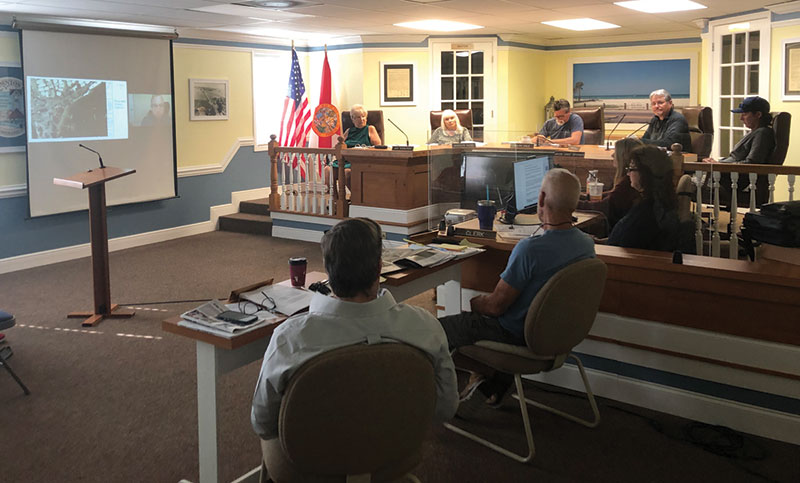
Environmental Science Associates went before the Bradenton Beach Community Redevelopment Agency Jan. 5 and city commission Jan. 6 to discuss a 30% plan for a living shoreline. The ESA presented proposals for resiliency in the face of rising sea levels and future storms.
The environmental consulting firm was hired by the city to analyze coastal conditions for living shorelines about 1,200 feet in length on Sarasota Bay, along a section of Bay Drive South from Bridge Street to Fifth Street South.
ESA proposed installing a vertical wall in the uplands — seawalls with planters, precast concrete structures and tier walls that hold oyster bags.
ESA is projecting rising sea levels based on benchmarks from the Tampa Bay Climate Science Advisory Panel, a group of scientists researching the impact of climate change.
“Right now, 2-foot plus 2 is our natural ground evaluation at our lowest form. North, more toward the marina, we’re talking about 6-7 feet elevation. We want to work on those lower areas. New seawalls would be at elevation plus 5 and bring areas of around 2- or 3-foot natural grade to about 5,” ESA coastal engineer and program manager Bryan Flynn said Jan. 5, addressing the CRA.
The height for a seawall is calculated using rising sea level projections and statistical analysis of wave heights in 10-year to 25-year wind events.
Several CRA members disapproved of installing a concrete seawall where natural barriers — mangroves and reef balls, for example — could protect the shoreline and preserve natural aesthetics.
CRA members Jan Vosburgh, Marilyn Maro and Jake Spooner, all city commissioners, said a seawall could impact views from properties near the shoreline. Also, seawalls could cut into commercial parking areas along Bay Drive South.
But reef balls, oysters, black and red mangroves and buttonwood trees could mitigate wave action without impeding aesthetics or sealife.
ESA’s materials indicated reef balls could dissipate waves away from the shore and oyster shells and trees could provide a barrier to those weakened waves. The reef balls would be placed to allow manatees passage.
“We’ve renourished beaches near the shoreline. More of a natural slope with mangroves and plants that absorb the inertia better than a wall and they’re more accessible,” CRA Chair Ralph Cole, also a commissioner, said Jan. 5.
ESA representatives pointed to constraints where sea level rise may be more prominent.
“We’re absolutely supportive of a natural solution if we can be but as we go south, we may be constrained,” Flynn said. “We will have to refine as we reach the 60% design.”
“I think we’re in an inflection point here,” CRA member Ed Chiles said Jan. 5. “The point of climate change, sea rise, coastal resiliency. That’s a lot to take in. I think this is phased and gradual. It’s a daunting task but it’s a chance to get it as right as we can get it.”
ESA also presented options Jan. 6 at the commission meeting, including a planted terrace or earthen berm, an excavated channel or ridge sloping to direct water away from or around an area.
ESA and commissioners said they want to hear from the public as they proceed.
Bruce Herard, Old Bridge Village resident and condo association board member, told commissioners he’d like to learn more.
“I sat there in front of my window for 12 hours watching the water come up on Bay Drive and watched the waves,” he said about a storm in 2020. “It was the waves that were really frightening in terms of what might ultimately happen to our property. The water came right up to the lip of the foundation of our garage.”
“I can tell you that I don’t want my view to be screwed up. But on the other hand, I don’t want my home to be flooded,” Herard added.
A motion to accept the plan at 30%, incorporating commission comments, passed unanimously.
The deadline for 60% plans is Feb. 8 and completion of the design project is anticipated around April.
The CRA agreed by consensus for city clerk Terri Sanclemente to set up neighborhood workshops on the project.
The project is funded with a Florida Department of Environmental Protection grant of just under $93,000. ESA has billed $18,315 and allocated around $30,000 for the 30% plan. The entirety of design, permitting, public outreach and surveying is estimated to cost $92,433.75.
The next city commission meeting will be at noon, Thursday, Jan. 20, at city hall, 107 Gulf Drive N.