




Anna Maria Island anglers are bracing for the heat of summer as they glide into July.
Typically, mangrove snapper capture the spotlight in July. The fish can be found in the Gulf of Mexico around artificial reefs and throughout Tampa Bay and the waters to the south, as they school up around bridges, fishing piers and docks.
You might ask what makes the snapper so popular?
The answers are easy.
For one, they make excellent tablefare.
Secondly, in July they become very targetable, which makes them accessible to most anglers.
And they are fierce adversaries on medium to light spinning gear.
If you can find a fish that’s excellent to eat, caught readily and is super fun to catch, it’s the perfect recipe for an angler.
When targeting snapper, a variety of baits will bring the fish to the hook. The abundance of hatch bait —young shiners — is a good option, as mangrove snapper love the small, bite-size morsels.
If you’re not skilled at throwing a cast net to collect the shiners, don’t fret — mangrove snapper will take other offerings.
Live shrimp are a good option. Just plan on carrying a lot of shrimp, as there are many other species — such as pinfish and grunts— that are skilled at nibbling your bait off the hook in seconds.
If you’re fishing nearshore or offshore structure, frozen bait will work. Small pieces of frozen sardines or threadfin herring will attract the snapper to the hook, especially if you add a lot of chum to the water.
As far as rigging goes, you’ll want to experiment with leader and hook sizes to see which will bring on the best action. Mangrove snapper have excellent eyesight and are quite curious. So stealth and rigging is imperative.
This is especially important when fishing in the clear shallow waters of the bays and Intracoastal Waterway. You may find instances where you’re scaling down your fluorocarbon leader size as low as 10-pound test. This may seem really light, but sometimes that’s what it takes to properly present a bait without spooking the fish. Combine this with a No. 4 or No. 6 hook when getting down to the nitty-gritty.
If you’re fishing deeper water in the Gulf of Mexico, you’ll probably want to start with fluorocarbon leader in the 20-pound class, as you may encounter other species, such as juvenile grouper and mackerel.
Also, remember, mangrove snapper must be a minimum of 10 inches in total length to harvest and each angler is allowed a daily bag limit of five fish.
On my Just Reel charters, I’m enjoying targeting catch-and-release snook in the back country. On average, I’m seeing 20-30 snook caught per morning charter.
While targeting the snook, I’m seeing redfish go into the cooler.
Fishing deeper grass flats in the bays is yielding spotted seatrout up to 20 inches, as well as catches of mackerel and jack crevalle. And, finally, we’re picking up a handful of mangrove snapper on our trips.
Capt. David White says he’s catching plenty of mangrove snapper inshore and some larger fish are being caught on the offshore trips.
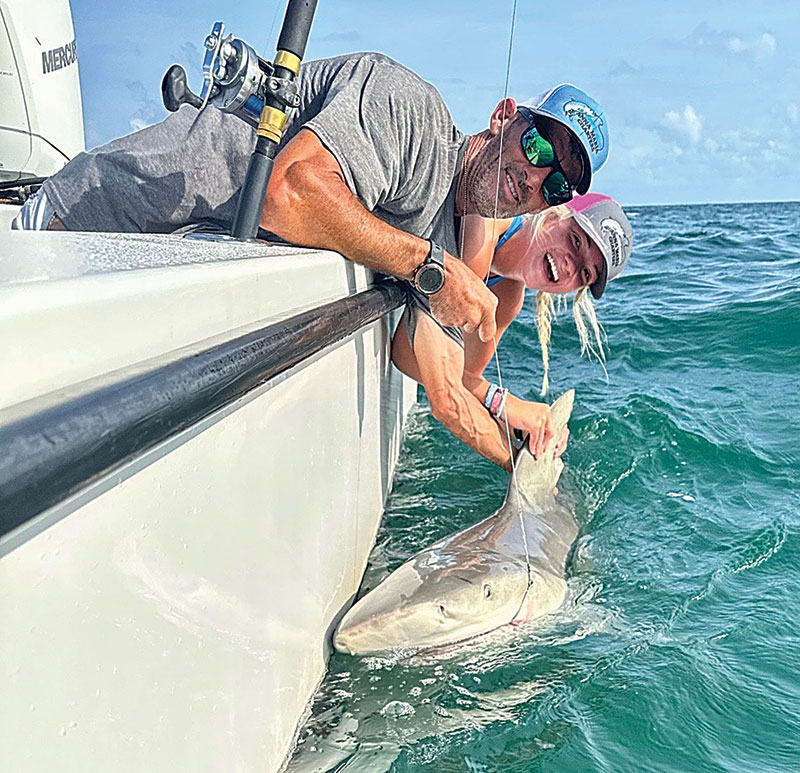
Targeting catch-and-release snook remains consistent while working in Tampa Bay, where White says casting live shiners along mangroves and sandy beaches is attracting the fish to the hook. Fishing along the beaches also is producing action on sharks — the most frequently caught species being bull sharks. They are being caught on fresh-cut chunks of mackerel.
Lastly, White is seeing action on wahoo while working offshore in the Gulf of Mexico. And he is seeing plenty of American red snapper and mangrove snapper while offshore.
Jim Malfese at the Rod & Reel Pier in Anna Maria says he’s seeing numerous catch-and-release snook being caught. Baits are varied, although live shrimp, pinfish or mojarras are working. He says it all depends on the day and Tampa Bay.
Mangrove snapper are being caught by anglers using live shrimp as bait.
Finally, Spanish mackerel and jack crevalle are being caught on live shiners and silver spoons at the northernmost pier on Anna Maria Island.
Send high-resolution photos and fishing reports to fish@islander.org.