






Whether you’ve been fishing since you were a child or you’re an adult just getting into the sport, you should realize the importance of having the right bait.
It is the most important step in any fishing trip, as having the right bait can determine success.
And don’t forget to have enough bait, because you don’t want to run out if the fish are biting.
Bait, as important as it is, can be all-consuming to an angler.
Whether acquisition requires hiking through mangroves to a hidden sandy spot for fiddler crabs, venturing to the beach for sand fleas or traveling afar to cast net for shiners, an experienced angler is willing to go the extra mile or hour for the perfect bait. It has to be done or the fishing would never begin.
I am well schooled in the art of catching bait, as it was instilled in me at a young age by my father, who was quite skillful in all aspects of fishing.
My first encounter with the bait search consisted of collecting grasshoppers for a trip to catch bluegills. The ritual occurred each weekend when my father mowed the lawn. I would find myself trailing him, carrying a half-gallon milk jug with holes punched to let air flow so the grasshoppers would stay alive.
I’d be on the lookout for grasshoppers jumping away from the lawnmower as they gave up their hiding places. Once caught, it was time to fish.
We also hunted fiddler crabs. They were fast and skilled at their escape — and you had to be quick and brave, because they could pinch.
We had many fiddler spots back in the day, but a favorite was on Palma Sola Bay. I remember my dad driving down old Palma Sola Boulevard, where the road —part dirt and part tar — was not drivable above 10 mph. But it was worth it. The fiddlers were always abundant on the shoreline.
Same goes for catching sand fleas. Back in the 1980s, we loaded up on sand fleas on the beaches of Anna Maria Island. It was before beach renourishment began, which dumped tons of sand on the shore, burying the sand fleas habitat, wiping out the ecosystem.
My father and I walked right out on the beach. He carried a shovel, and I carried a homemade sand-sifter — a frame made of scrap lumber to which we stapled hard wire cloth. It was just as good as one of those expensive sand flea rakes.
We would be out there in the shore break, my dad shoveling sand and placing it into the sifter, as I shook it back-and-forth, revealing all the beautiful, squirming sand fleas.
When I was older, it was time to learn to throw a cast net. The nets then were made of nylon twine and heavy and throwing a 6-footer was hard, especially being all of 10 years old.
But I learned.
I practiced in the backyard until I could open the net into a pancake. Once skilled, I took that net with me everywhere there was water, polishing my skills at netting pinfish and shiners.
At the old Anna Maria City Pier, the height made it easy to open the net over a school of bait. It became my favorite place to catch shiners and fish for Spanish mackerel.
The shiners went in a 5-gallon bucket with an aerator and as much water as I could carry to the T-end of the pier as quickly as I could from the lead line — the yellow line painted on the walkway that marked where we could cast. My dad would be waiting for me as I scurried up, net in one hand and bucket in the other, huffing and puffing from the load.
We fished our bait and I gladly did it over again.
Bait is all important.
Whether it’s catching golden shiners to go bass fishing, or my dad teaching me to place a net behind a crayfish and poke it in front with a stick to spook it into the net, or dipping grass shrimp for crappie and shell crunchers to my bait-catching excursions nowadays — dipping a net for pass crabs to hunt tarpon, setting pinfish traps for grouper bait or just hauling shiners in the cast net for snook fishing — the significance of bait is engrained in me.
Catching and baiting are skills, and let’s be honest, it’s also an obsession that never goes away.
Now I find myself on a peaceful grass flat at 5 a.m., waiting to see shiners dimpling in the water among the chum behind the boat as I load my 10-foot cast net.
And I consider the real importance of catching bait. Spending time with my father as he nurtured the passion for fishing that has turned into my career.
My father is now catching bait in the sky, as he passed away one year ago on July 25, 2022.
I miss you, dad, and you can be proud — I’m still out catching bait.
On my Just Reel charters, my clients are keeping busy, reeling up limits of mangrove snapper.
While targeting snapper they are hooking into Key West grunts, porgies, triggerfish and plenty of juvenile red grouper.
Spanish mackerel are present in these areas and are being hooked on a free-lined shiner swimming on the surface.
When the tide is moving, I’m seeing spotted seatrout turn on. Some times as many as 30 or 40 trout are being caught by clients.
Capt. David White is enjoying success for his clients on American red snapper and red grouper offshore in the Gulf of Mexico. A variety of baits, including live pinfish and shiners or frozen bait — sardines and threadfins — work on those species. When baiting with live shiners, White is putting anglers into mangrove snapper of considerable size.
Moving inshore, mangrove snapper 12-15 inches are the highlight for anglers looking for dinner.
After catching snapper, White is putting clients on catch-and-release snook along the beaches, as well as sharks.
James Malfese at the Rod & Reel Pier says anglers braving the heat are hooking into mangrove snapper when using live shrimp as bait. And, for the hottest days, the Rod & Reel has an ample supply of cold beer and other beverages within reach of the fishing spots on the deck.
Pier fishers using live shrimp as bait are hooking into an occasional catch-and-release snook or redfish.
Lastly, casting live shiners out from the pier is yielding mackerel, says Malfese.
Capt. Warren Girle is back on the water after a holiday to celebrate his 30th wedding anniversary.
He got busy hooking clients up with respectable numbers of spotted seatrout. Frequent chumming with live shiners is keeping the fish interested, resulting in limits of trout. Mixed in are macks and ladyfish.
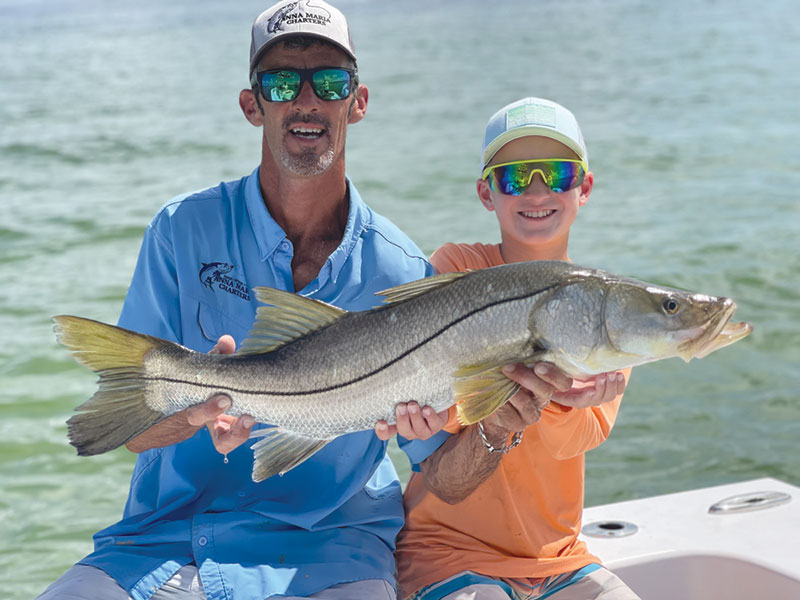
Catch-and-release snook are taking free-lined live shiners in areas where mangroves exist.
Lastly, Girle reports fishing structure in the Gulf of Mexico is yielding catches of mangrove snapper and juvenile grouper for his anglers.
Send high-resolution photos and fishing reports to fish@islander.org.