






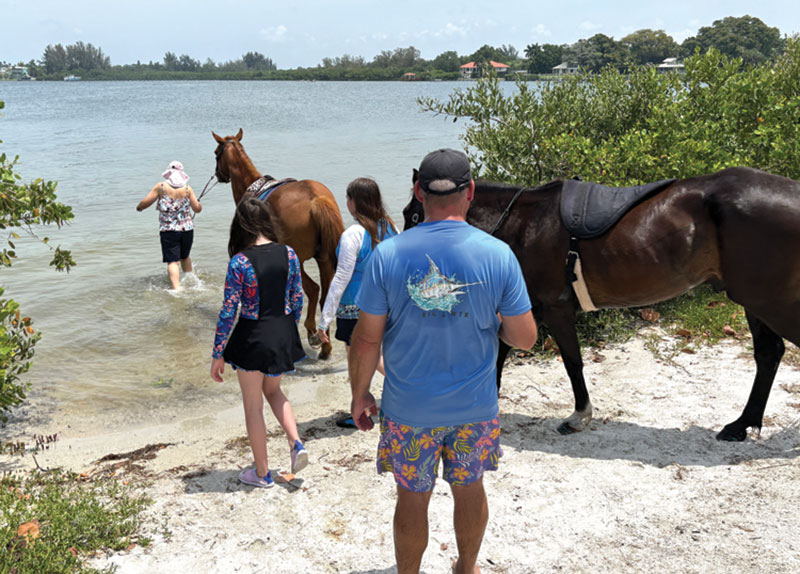
The Bradenton City Council Sept. 10 was briefed on water quality and bacteria sources in Palma Sola Bay, with a focus on whether horseback riding in the bay contributes to health risks.
Dave Tomasko, executive director of the Sarasota Bay Estuary Program, presented the briefing. He said the bay remains in “fairly good” condition but with localized issues, including higher bacteria readings on the north side, where horse tours operate.
Palma Sola Bay is one of five bodies of water within the Sarasota Bay estuary system, along with Sarasota Bay, Roberts Bay, Little Sarasota Bay and Blackburn Bay.
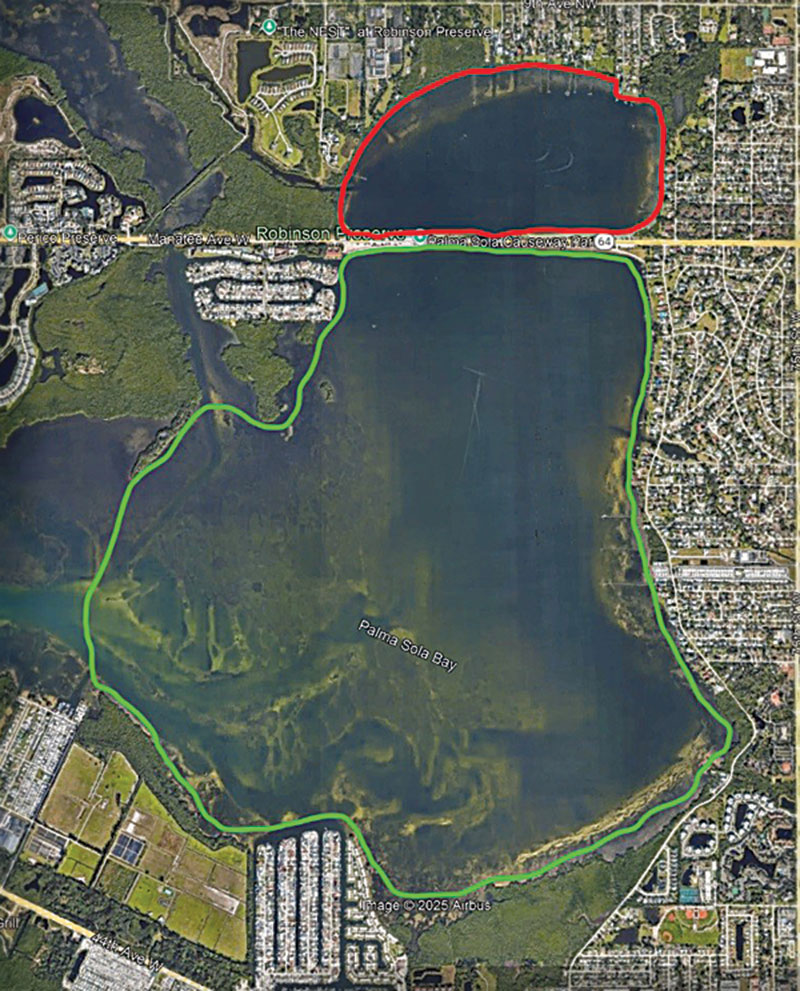
Tomasko said localized impacts persist in Palma Sola, including trampling scars in seagrass meadows where horse tours operate north of the causeway.
“The seagrass meadows are damaged by horses,” Tomasko said, showing an aerial view. “Horses are causing damage. So are canals. So are seawalls. So are boats. Everything is causing damage to the bay to some degree.”
Reviewing bacteria indicators — E. coli, fecal coliform and enterococci — he said thresholds differ depending on whether waters are designated as bathing beaches or Class III marine waters.
The bacteria don’t usually harm fish or plants directly, but high levels signal fecal waste or decaying organic matter that can fuel algae growth, lower oxygen levels and pose health risks to swimmers.
Under Florida Department of Health standards, water is considered “good” at 0-35 colony-forming units per 100 milliliters, “moderate” at 36–70 and “poor” above 70, which can trigger health advisories. These thresholds apply at designated bathing beaches, such as Palma Sola South.
The north side of the bay is not classified as a bathing beach and is generally considered Class III marine waters, which allows up to 130 CFU per 100 mL.
Consequently, the bacteria reading could be acceptable on the north side but unacceptable on the south beach.
DOH testing on the south side generally meets standards, though Tomasko said roughly one in five samples registers as moderate or poor. Meanwhile, community sampling by nonprofits such as Suncoast Waterkeeper on the north side shows more frequent exceedances. A Sept. 9 test for north Palma Sola recorded 333 CFU per 100 mL.
To pinpoint sources, SBEP initiated a genetic “microbial source tracking” study at four sites. Microbial source tracking uses genetic markers to identify whether contamination comes from humans, horses, birds or decaying vegetation.
According to Tomasko, initial lab results found no human markers, suggesting it’s not sewage driving the high readings. Bird markers appeared at the south beach and horse markers were detected at three of four sites, but only at “detected, not quantifiable” levels. One north-side site exceeded both bathing-beach and Class III criteria.
As a next step, in coordination with the city, horse tour operators agreed to put a pause on operations Sept. 8-Oct. 6 for SBEP to conduct comparative sampling.
“If levels drop during the pause and rebound afterward, horses would likely be a significant source,” Tomasko said.
But not everyone agreed with the approach. Abbey Tyrna, executive director of Suncoast Waterkeeper, said the meeting left her concerned that the narrative is being framed as “for or against horses.”
“We are not anti-horse tour — we are pro-bay,” Tyrna said in a Sept. 11 interview with The Islander. “There’s a way forward where everybody wins.”
She suggested best practices such as requiring horses to wear diapers to reduce waste in the water and creating a permit system to limit the number of vendors.
Tyrna also criticized the one-month suspension experiment.
“Unfortunately, I do think that what has been done is really irresponsible, using the pretense of science to say that if we remove the horses for a month that we will then know definitively whether or not the horses are contributing to the problem. That’s just not how it works,” she said.
Instead, she called for a stakeholder workshop with horse tour operators, scientists, city officials, residents and others to find common ground and pursue comprehensive solutions.
Don’t get me started on the sewage that gets released in Palma Sola and the Manatee River! When is that going to stop!