





With winter nipping at their heels, Anna Maria Island anglers are focusing their fishing plans on the warmer days between the cold fronts and pursuing the variety of species that inhabit inshore and nearshore waters.
Fishing in the Gulf of Mexico around nearshore structure is providing a consistent bite on migratory species. Spanish mackerel, ladyfish, jack crevalle and blue runners can all be had, depending on the structure.
Some reefs can be non-stop action, while others seem slow. Best scenarios are occurring on structure where bait schools are present. Free-lined live shiners are working best on these fish, although all of them will eat shrimp if shiners are hard to get.
Speaking of shrimp, don’t hesitate to drop a line over the side on a knocker rig as fish like sheepshead, mangrove snapper and grunts are lurking below, hiding within the structure and waiting for an easy meal.
In slightly deeper depths, hogfish, lane snappers and numerous juvenile groups can be found — just remember to bring plenty of bait because this bite can result in a hookup on every drop.
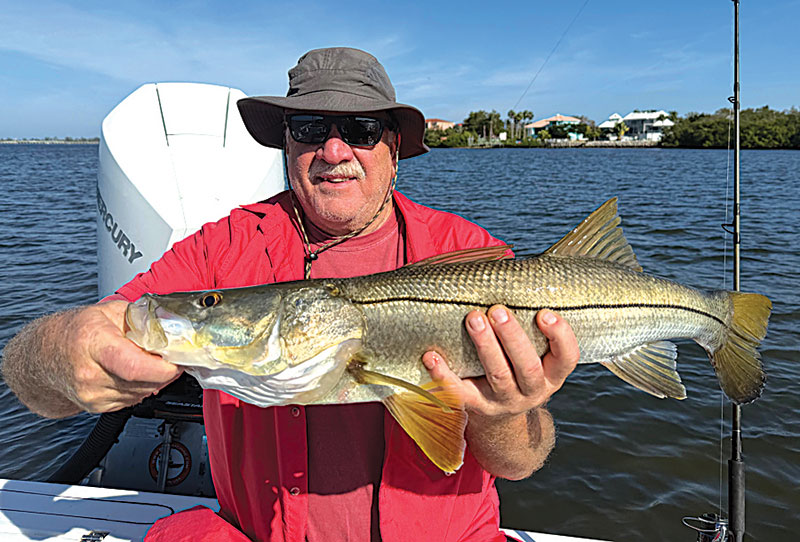
Moving inshore, the situation is similar. Fishing on warmer days is proving advantageous, especially if you’re trying to get in a few more days of snook fishing before water temps really drop, triggering the fish to migrate to their wintertime haunts in the far reaches of the Manatee River.
Spotted seatrout are still taking shiners during the warmer days and, in many instances, are being caught with the snook bite. And seeing these trout are willing to rub shoulders with the snook to compete for a meal suggests they are big, with many measuring 20-24 inches — an exciting catch in shallow water.
On cooler days, many anglers are switching to live shrimp as bait, which is a worthy option as water temps are slowly creeping downward.
Species like sheepshead, black drum and pompano are susceptible to offerings of live shrimp. Another species that adores a tasty shrimp is the redfish and although redfish are known to be caught on a wide variety of baits, it seems as if they hold a special taste for a fat shrimp.
Casting shrimp around rocks and docks, sandy potholes and grass flat edges yields numerous redfish in our inshore waters. In fact, in the past several weeks, many anglers are reporting small redfish or “puppy reds” measuring 12-14 inches are plentiful.
Seeing sustainable numbers of the small reds is encouraging as it ensures the future of our fishery. This warrants a big shout-out to the Coastal Conservation Association as the release of 30,000 redfish in Terra Ceia Bay in September 2024 seems to be working.
As our population continues to grow and development continues to expand, measures by the CCA and other organizations are paramount to sustaining natural resources. Let’s give it up for these folks.
And congrats to CCA on its 40th anniversary.
Getting back to fishing, it’s time it get out on the water and cash in on the mild temperatures before winter settles in.
On my Just Reel charters, I’m seeing plenty of Spanish mackerel around deep grass flats and especially around nearshore structure in the Gulf of Mexico. Free-lined live shiners are quickly being slashed by the sharp teeth of the macks seconds after hitting the water. Drag-screaming runs and a fight to the end make these high-speed toothy fish a favorite hookup for those who appreciate non-stop action. Mixed in are ladyfish, blue runners and jack crevalle, and, while on the deep grass, some hefty spotted seatrout are available.
On warmer days at higher tides, catch-and-release snook fishing is quite good. Many catches are 20-24 inches, but the volume of catches makes up for the size. Redfish are being found on the flats, although many are on the small side. Slot-size reds are being caught by some lucky anglers.
Finally, casting shrimp around rocks and docks is resulting in a mixed bag of mangrove snapper, sheepshead, black drum and redfish.
Capt. David White is working inshore between the coldest days of the fronts, which is yielding his clients some good action on catch-and-release snook. Higher stages of the tide during late morning and early afternoon are producing numerous snook on the flats when casting free-lined live shiners as bait.
White says fishing deeper grass flats is resulting in a variety of fish, including spotted seatrout, mackerel and jack crevalle. In many instances, numerous fish are quickly being caught, leaving anglers busy with multiple hookups.
Lastly, White says redfish are being found in numerous areas, including on the flats, under docks and along the beaches.
Your input is welcome! Send high-resolution photos and fishing reports to fish@islander.org.