






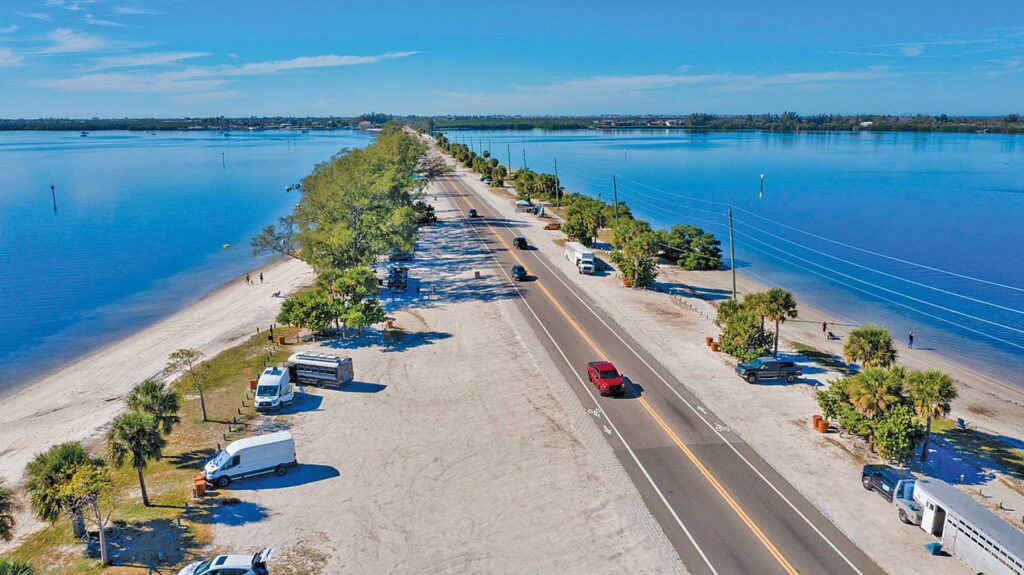
Commercial activity on the Palma Sola Causeway is booming, but it appears that oversight is not keeping pace.
Vendors are using public property to conduct business in a narrow corridor on a busy state road where authority includes the state, Manatee County and the city of Bradenton.
Recreational areas for fishing, picnics and family gatherings are frequently lined with commercial trailers, signage and watercraft displayed for rent. Mobile vendors offer horseback rides, jet skis and paddle craft excursions that attract customers to the right of way.
The issue was discussed in mid-February during a meeting of the Palma Sola Scenic Highway Corridor Management Entity in Bradenton, with members sharing concerns about commercial activity in the state-designated scenic corridor.
Scenic highway chair Ingrid McClellan during the Feb. 11 meeting cited a state law prohibiting the “sale, display or free distribution of any merchandise, goods, property or services” on state rights of way.
While that statute exists, PSSH members said enforcement is inconsistent on the causeway, a state road in Bradenton city limits, with Manatee County maintaining landscaping under a 2024 interlocal agreement and the Florida Fish and Wildlife Conservation Commission regulating boating and livery permits on the water.
The situation troubles marina-based business owners.
“What gives them the right to use public property to run their business?” John Cadmus of Cortez Watersports said of mobile vendors. “We’re paying rent, insurance, taxes and complying with every regulation and they’re just pulling up on the side of the road.”
John DeLeon, who formerly operated Bradenton Beach Marina for more than 30 years, added, “There’s nothing wrong with competition. But it has to be fair competition. What’s to stop me from buying 20 skis and operating there instead?”
Bill Diggens, who operates Anna Maria Jet Ski from Parrot Cove Marina, said storefront businesses carry expenses that mobile vendors might not face.
“In order to have a brick-and-mortar location, you have to have a signed lease with a marina and we’re required to have full liability insurance,” he said. “The added expenses make it really difficult to compete with those guys.”
But Austin Nicholson, owner of Seaside Island Adventures, said his company, which operates from the causeway, meets state livery requirements, invests in training and carries insurance.
“Every one of my employees were trained by me for an entire month,” Nicholson said Feb. 14. “We abide by all the laws. We have the insurance. We keep the policy. We have a livery. We keep it up to date.”
FWC rules require companies renting personal watercraft to hold a livery permit, and that permit requires commercial insurance coverage of $500,000 per person and $1 million per occurrence, along with documented safety briefings for renters.
Nicholson said responsible operators go beyond the minimum for compliance.
“We’re not just plopping people on (personal watercraft) and saying, ‘Have a good day. We’ll see you in an hour,’ I hope,” he said. “There are people doing things the wrong way, but there’s absolutely people doing it the right way and they deserve to be out there.”
“Some people are running a business. Some people are operating a side hustle,” he added.
Chuck Dort, manager of Freedom Jet Ski Rentals, said the longest-tenured operators on the causeway work together to maintain safety.
“We know each other’s skis. We know each other’s customers,” he said. “If I’m going out to check on my rentals, I’m checking on his, too. If he’s going out, he’s looking at mine. We communicate constantly.”
Jeffrey Burns owns Little Philly Sea Adventures, which operates on the causeway. He said safety protocols and documentation are central to his operation.
Burns also said he carries more insurance than the state minimum. “I carry $1 million to $2 million on everything,” he said. “That’s protecting myself, my business and the customer.”
He and other vendors acknowledged that regulatory enforcement on the causeway can be uneven.
Burns said some vendors obtain insurance but later drop coverage.
“That’s been the trend that I’ve seen,” he said.
FWC officers conduct compliance checks, according to vendors, particularly when customers are stopped on the water for an alleged infraction. However, vendors said they have not routinely seen the FWC conduct compliance checks onshore.
“I follow the rules and safety comes first,” Burns said. “I think there needs to be more accountability to make sure we’re all on the same page.”
A central question raised by brick-and-mortar businesses and some mobile vendors is how frequently insurance compliance is verified after a livery permit is issued.
In addition to the state responsibility, Manatee County and Bradenton have rules and authority on the causeway.
The county, in a Feb. 3 email to The Islander, said that under a 2024 interlocal agreement with Bradenton, it handles maintenance, landscaping and trash removal.
Bradenton has said it can regulate what occurs within city limits and city officials work to ensure people using public property safely and meet permitting and insurance requirements.
“Bradenton supports small businesses and waterfront recreation,” a Jan. 27 statement to The Islander read. “But we also have a responsibility to apply these standards consistently. Businesses that follow the rules should not be placed at a disadvantage, and our focus is on making sure everyone is held to the same expectations, so the community, visitors and legitimate operators are protected.”
However, the statement did not detail standards or enforcement procedures.
And businesspeople and PSSH members say consistency has been difficult to achieve given the fragmented oversight.
Adrian Mays, owner of the causeway-based Freedom Jet Ski Rentals, said she and other operators have discussed structured solutions, including a vendor-permit system.
“We don’t want it shut down,” Mays said. “We just want it regulated.”