







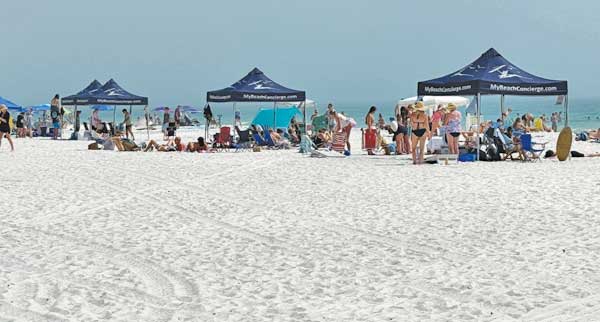
A registration process may be in store for rental cabanas on Anna Maria shores.
City commissioners voted March 26 on a pair of ordinances regulating rental cabanas and other commercial activities.
City code previously prohibited all commercial activity on the beaches, but the municipality did not enforce the rule.
However, concerns about the rise of cabana rental services last year led to new regulations as commissioners in February adopted an ordinance establishing rules for the beach.
Most of the city’s shores are zoned for coastal conservation, but there are two stretches zoned for recreation/open space: Gulffront Park on the Gulf of Mexico and Bayfront Park at Tampa Bay.
The ordinance prohibits temporary shade structures, such as cabanas, from exceeding 169 square feet of ground coverage in total of 13 by 13 feet and 13 linear feet in any direction. It also permitted preordered “commercial rental areas” like rental cabanas in Gulffront Park, with several conditions.
That ordinance was set to take effect March 15, but commissioners had held a first reading to amend the newly adopted code before it was enacted.
Commissioners unanimously voted March 26 to amend the ordinance, adding language to clarify that commercial rental areas are “for purposes of renting temporary shade structures.”
They also unanimously voted to approve a first reading for an ordinance to establish an annual registration system for the commercial rental of beach equipment and the operation of organized “passive recreation activities” like yoga.
Operators would be required to pay an annual fee, maintain insurance and provide a list of individuals and entities owning 25% or more of a business.
The proposed ordinance would allow the city to limit the number of operators permitted on the beaches and establish new regulations for shade structures on beach areas zoned for coastal conservation, which is mostly private property.
That includes limiting rental activities to people “in control” of upland property — such as owners or renters — adjacent to the coastal conservation zone.
City attorney Becky Vose said property controllers would not be permitted to allow others to rent temporary shade structures on beach adjacent to their properties.
On the small amount of public beach zoned for coastal conservation, no commercial activity would be allowed.
The proposed ordinance would also require operators to provide the city with written notice 18 hours before placing rentals in the coastal conservation zone.
The proposed consequences for violations of the new code are aimed at preventing repeat offenses.
If a special magistrate determines an operator has violated the code within 12 months of their first offense, they would be suspended for three months.
If a magistrate determines an operator has committed a third violation within the same 12 months of the first offense, or operated while suspended, they would be suspended for 24 months.
The proposed ordinance was met with pushback at the meeting.
Anna Maria Island Turtle Watch and Shorebird Monitoring volunteers Chuck and Karen Anderson spoke in support of rental cabana companies.
They said they know companies that know how to avoid impacting sea turtle nesting.
Perry Heldreth, owner of cabana rental company My Beach Concierge, said requiring photo ID to prove control of a property in the coastal conservation zone could be an issue for potential renters, since that ID would become public record.
Kevin Crump, co-owner of CabanUp, another beach cabana rental company, said providing 18-hour written notice for rental activities was unrealistic.
Mayor Mark Short said the previous code restricted such activity, which the city could have enforced but instead tried to find an “amicable” middle ground.
“We took steps to try to work with all of you to allow you a place to conduct your business,” he said.
The city commission will meet next at 1 p.m. Thursday, April 9, at city hall, 10005 Gulf Drive.