






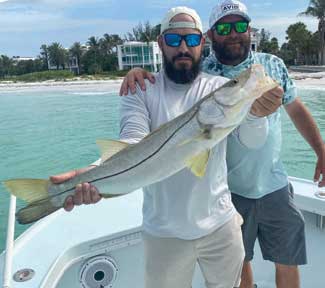
Settling into the third week of June, anglers planning to fish the beaches are being rewarded with respectable numbers of snook gathering in the shallows in preparation for their spawn.
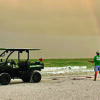
Walking casually along the beach and sight-casting to snook can be entertaining. This also presents opportunities to target larger snook as they slowly cruise the shoreline, followed by a half dozen or so smaller male snook.
If your timing is right, the fish are susceptible to a variety of baits, including artificials. Of course, we all know live bait can yield the best results, but if there’s no bait to be netted along the beach, you’ll need a Plan B. Plus, trying to keep shiners alive in a bucket with an aerator can become tedious as you’re frequently having to refresh the water.
Snook are apt to take lures and will actually hit quite a variety of them. When beach fishing for snook, I like to use lures with the same coloring as what’s available for live bait.
Shiners are a good bait to mimic. So lures that are silver on the sides and green on the back are a good bet. Lipped plugs or crank baits like the Yo-Zuri Pins and Crystal minnows can be deadly on snook. The red and white versions of these lures also perform well, especially in low-light conditions or at night.
Soft plastics also are a good option. The DOA TerrorEyz and CAL jigs will get the job done. Again, you want to start with the silver side-green back color patterns.
Pearl white in these lures is a good bet, and, for the purist, the good-old bucktail jig is effective. Ask the guys at your local tackle shop for a “red-tailed hawk” and cast it in front of a snook and see what happens.
Beach fishing isn’t limited to snook. Be prepared to encounter other species along the way. Ladyfish and jack crevalle patrol the beaches during the summer and will definitely hit all the lures mentioned. You also might hook into a trout along the beaches, especially on the soft plastics, and don’t rule out an occasional flounder.
Finally, keep in mind that snook season is closed, so it’s solely a catch-and-release fishery until Sept. 1. Handle fish with care, please, as they are the key to our future stocks.
On my Just Reel charters, I’m seeing a pretty good catch-and-release snook bite. Fishing the backcountry during swift parts of the tide is producing good numbers of fish. On the slower tides, I’m migrating to the beaches and passes to hook up with larger examples of linesiders of 20-26 inches.
Redfish are lurking in the backcountry around mangrove shorelines and oyster bars, although most catches are mixed in while we’re targeting snook.
Fishing deeper grass where water is clean and clear provides action on spotted seatrout. Sizes of the trout vary depending on location. Some flats will be loaded with fish that run 13-15 inches, while others may not hold as many fish but they are larger — 18-22 inches.
Lastly, there are plenty of small blacktip and sandbar sharks throughout our waters right now, making them quite easy to target.
Capt. Johnny Mattay of Anna Maria Charters is impressed with the offshore bite. Running out to depths of 60-80 feet is providing action on mangrove snapper and grouper. Live pinfish or shiners as bait are being devoured by these reef predators.
In deeper waters in excess of 100 feet or more, Mattay is limiting out on American red snapper, as well as boating plenty of mangrove and yellowtails. Red grouper are being caught at these depths, too.
Moving inshore, Mattay is focusing his efforts on redfish, trout and catch-and-release snook. Early morning, swift moving tides yield the best results.
Capt. David White is on dawn patrol mornings along the Gulf beaches in search of tarpon. After taking a midday break, he’s back out in the passes for the evening outgoing tide.
Both scenarios are yielding results with tarpon in the 80- to 120-pound class being hooked and released, after a trophy photo. Larger fish are mixed in for lucky anglers, resulting in battles lasting upward of 30 minutes or more.
Send high-resolution photos and fishing reports to fish@islander.org.