


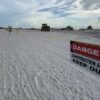




After eight years of waiting for beach renourishment, Anna Maria resident Joan Dickinson of North Shore Drive may be waiting another eight years — or longer — for renourishment her bayfront property.
Manatee County natural resources director Charlie Hunsicker said that the time it would take the U.S. Army Corps of Engineers to properly survey the bayside of Anna Maria and some portions of Bean Point for inclusion in the next full beach renourishment “requires more extensive study than we are prepared to wait for.”
Hunsicker explained that if the next Islandwide beach renourishment project is going to begin in 2014-15 as planned, it will exclude the northeast coast of Anna Maria and some portions of Bean Point.
Dickinson began complaining to authorities in 2002 that the beach at her North Shore Drive residence, and at other houses along the Tampa Bay shore, was disappearing.
Seven years later, she and Anna Maria Mayor Fran Barford obtained about $300,000 in federal funds to pay for the salaries of engineers to perform a renourishment impact study.
Dickinson said then she was “crossing my fingers” in hopes the northeast Anna Maria coast beaches would be in the next Islandwide renourishment project.
But the Corps never did a complete survey of many of Anna Maria’s beach areas, including the northeast beaches that face Tampa Bay. A full Corps survey is more than just an impact study and costs a lot more than $300,000, Hunsicker said.
“That only covers salaries, not the cost of the extensive study,” he said.
The Corps told Hunsicker it would take about six to seven years to fund, prepare and complete the Anna Maria survey, and a Corps survey is required for federal funding.
“We would need a lot more time to do (Anna Maria),” he said, and other Island beaches can’t wait another decade for renourishment. Additionally, it takes years to get state and federal permits, and the county does not have the money to pay for all the costs of beach renourishment.
Without a Corps survey and accompanying authority for federal funds, there’s no way the county can afford funding for the renourishment of those portions of Anna Maria beaches, Hunsicker said.
And the survey will be expensive as well as time-consuming.
“I doubt if there is enough (federal) funding in the next 15 years for the survey,” he said.
The 2014-15 Islandwide beach renourishment will include Holmes Beach, Bradenton Beach, a .6 mile portion of Anna Maria and some of the Bean Point area that the Corps surveyed in the late 1980s, Hunsicker said.
Two years ago, Hunsicker announced a bold plan to renourish nearly all of Anna Maria’s shoreline after the Florida Department of Environmental Protection changed its designation of the waters north of the Rod & Reel Pier to the tip of Bean Point to be “critically eroded by wave action from the Gulf of Mexico.” That placed the area that includes Dickinson on the Gulf of Mexico, according to DEP standards.
The change was critical to obtain state and federal funding. At that time, Hunsicker estimated the next beach renourishment, not including Anna Maria’s northeast shore beaches, would cost about $16 million.
He said he was planning to include the northeast beaches in the next renourishment project by installing about six or seven groins along that shoreline. Recently, however, he learned from the Corps that those Anna Maria beaches had never been surveyed.
That’s because in the mid-1980s, when the beach renourishment project that began putting sand on the shore in late 1992, was first proposed for the Island, Anna Maria city commissioners opted out of the plan, Hunsicker said.
The Corps surveyed all Island beaches except those in Anna Maria. The Islandwide beach nourishment project that began in 1992 included federal and state funding, along with revenue from Manatee County’s bed tax.
Hunsicker said he knew all along that most Anna Maria beaches had never been surveyed, but originally thought the impact study would cover the Corps requirements.
Dickinson said it’s a question of money, not surveys.
“Each groin would cost about $900,000 and the county has not allotted money (for the groins) and state and federal money is not enough,” she said.
“I know Charlie had hoped to include the whole Island in the next renourishment plan, and I had thought this was a ‘done deal.’ But he’s changed the plan. It’s going to take political action, now,” Dickinson said.
She’s asked that the issue be placed on a commission agenda, and that the city invite Hunsicker and county commissioners to discuss strategies to obtain funding to include the city’s northeast beaches in the 2014 Islandwide renourishment project.
Hunsicker said the planned beach renourishment of Coquina Beach should start in about three to four months. This project is to complete the ill-fated emergency renourishment project begun by Goodloe Marine of Apollo Beach in 2005. That project was halted by the Corps in mid-2006 before Coquina Beach or the .6 mile of Anna Maria beaches were renourished.
I also emphatically agree we desperately need renourishment to our beautiful beach for the protection and enjoyment for all people! No beach no future for Anna Maria! Renourish or fade away! The Sand bar’s beach is always renourished but not our beach by Bean Point up to the Rod and Reel Pier!!
I agree, what a disappointment for residents and visitors alike. Hopefully something can be done to bring Anna Maria in to the project as this is so crucial to the reason many live on the Island and for the many who visit. Visitors are the lifeblood of Anna Maria and the beach replenishment is a key part of maintaining the popularity of the Island (and the tax base).
This is a real blow to previous efforts to have the bayside renourished. Having a nice beach to enjoy is invaluable for the City of Anna Maria, its residents and guests. Not having it will force those who frequent Bean Point to search for other more accommodating destinations which obviously affects property values, not only for those on the beach, but citywide. This of course has a depressive effect on Anna Maria’s tax base and consequently revenues. Walking the beach at sunset is a favorite passtime for many and currently it requires, depending on the tides, carefully climbing over the existing groins which all too often results in injury. Not having funding for the next fifteen years for the survey and groins costing $900,000 each sounds like gross overstatements to me. Surely we can do better than that! We should all support the City’s request to accelerate this project’s completion.