







James H. McCartney, 85, an award-winning Washington correspondent and columnist who specialized in foreign affairs and defense policy for the Knight Ridder newspaper chain, died May 6 at his home in Holmes Beach following a brief battle with cancer.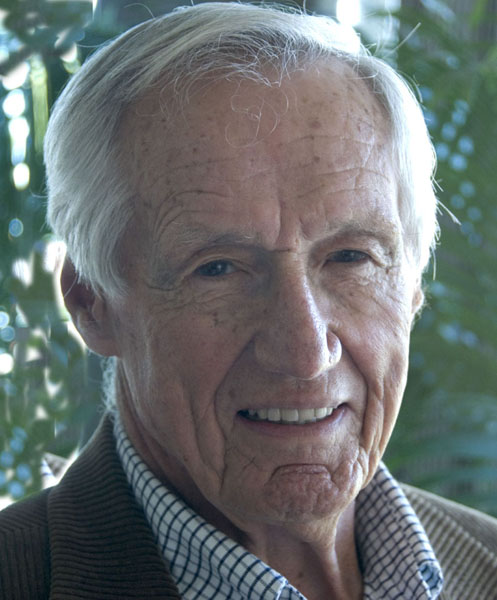
In 33 years as a Washington journalist, McCartney wrote extensively about nuclear weapons policy, the Israeli-Arab conflict and the Vietnam War, among other issues.
As senior national security reporter for Knight Ridder, then the nation’s second-largest newspaper chain, McCartney’s coverage was read in 31 papers, including the Philadelphia Inquirer, Miami Herald and Detroit Free Press.
McCartney’s career included trips to cover the Paris Peace Talks (1968-1973), the historic 1977 speech by Egyptian President Anwar Sadat before the Israeli parliament and the1986 Reykjavik summit between President Ronald Reagan and Soviet leader Mikhail Gorbachev. His stories were datelined from more than 30 countries. He also wrote regularly about national politics and presidential campaigns, and covered presidents from Eisenhower to Clinton.
In 1989, McCartney received the Edward Weintal Award for Diplomatic Reporting from Georgetown University’s School of Foreign Service. He was a longtime member and past president of the Gridiron Club, where he was celebrated for his gyrating “witch doctor” dance in a humorous skit at one of the club’s annual dinners.
McCartney often said his interest in issues of war and peace was driven in part by his horrific experiences as a teenaged front-line infantryman in France and Germany during World War II. He was wounded in combat shortly before the end of the war.
Soon after he arrived in Washington as a reporter for the now-defunct Chicago Daily News, McCartney became one of the first journalists to focus on the rise of the military-industrial complex. He did so after covering President Dwight Eisenhower’s famous farewell address on the subject in 1961, an assignment he got because the bureau’s senior reporters preferred to cover president-elect John F. Kennedy.
McCartney’s follow-up series on the military-industrial complex helped him win a 1963-64 Nieman Fellowship for journalists at Harvard University.
McCartney remained active in journalism in his retirement, giving speeches to local groups and writing a monthly column for the Bradenton Herald. His final column, published March 27, stated current U.S. policy in the Middle East was sacrificing America’s democratic ideals because of the country’s need for oil.
McCartney was known for his relentless, skeptical questioning at White House, State Department and Pentagon press conferences. One of the officials with whom he tangled, former State Department spokesman Hodding Carter, said of McCartney, “You knew, if you were a government spokesman, that you’d better have it straight and you’d better have the facts, because he’d keep coming at you. He could be the belligerent antagonist when he knew he was being lied to.”
Carter also said of McCartney: “He was not there to enhance the government. He was there to inform the people. I didn’t know anyone I respected more than Jim.”
McCartney was born July 20, 1925, in St. Paul, Minn., and grew up in Detroit and East Lansing, Mich. After receiving an honorable discharge from the Army with rank of corporal, he attended Michigan State University on the GI bill. He graduated in 1949 with a degree in political science after spending most of his time working on the college newspaper, where he rose to be editor.
After graduation, he worked for the South Bend (Ind.) Tribune, obtained a master’s degree in journalism from the Medill School at Northwestern University and then joined the Chicago Daily News as a reporter.
McCartney moved to Washington as a correspondent in 1959 and worked there in the newspaper’s bureau until returning to Chicago as city editor in 1965.
In 1968, McCartney joined Knight Ridder and returned to Washington. From then until his retirement, he devoted his work to probing underlying issues affecting American foreign policy. He was particularly interested in the roles of the Defense Department and the armaments industry, and liked to say that the Pentagon had more influence on American diplomacy than the State Department.
Another of his themes was the failure of arms control negotiations before the collapse of the Soviet Union to actually shrink U.S. and Soviet nuclear arsenals.
McCartney retired as a reporter in 1990 but continued writing his column, distributed by Knight Ridder, until 1995.
He was an adjunct professor at Georgetown University for 13 years, where he taught courses in the media and foreign policy, and the media and politics. He enjoyed golf, travel, chess and was an avid baseball fan.
Details of memorial events in Florida and Washington, D.C., will be announced later.
Memorial donations may be made to either WETA Public Television in Washington, D.C., to support the NewsHour online at www.weta.org, (click “Support WETA,” then “More Ways to Give,” then “Tribute and Memorial Gifts;” the Committee of Concerned Journalists, in care of Mark Carter, executive director, National Press Building, suite 425, 14th and F Streets N.W., Washington DC 20045; or mcarter@concernedjournalists.org, phone 202-662-7155.
McCartney is survived by his wife of 26 years, Molly Sinclair; twin sister Kathryn Boucher of East Lansing, Mich.; son Robert of Bethesda, Md.; daughter Sharon Allexsaht of Minneapolis; step-daughter Kathleen Muckleroy of Baytown, Texas; and four grandchildren.