
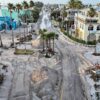






Looking back over a century of images taken of and on Anna Maria City Pier, what stands out is — apart from fashion apparel — how little has changed.
Scratched black-and-white prints from the 1930s and instant Polaroids from the 1950s show families strolling, hand-in-hand down the 678-foot boardwalk.
Saturated color postcards from the 1950s and digital documentaries from the 2000s show aerial views of the pier jutting into the clean blue Tampa Bay.
Browning celluloid images of the 1920s and yellowed Kodachrome snapshots of the 1970s show fishers beaming at mullet and mackerel catches.
It’s a rare situation, but now is like then at the city pier.
Some history of the structure:
Ten years before there was a bridge to Anna Maria Island, tourists reached its sandy beaches and lush gardens by boat. And those boats docked at the pier at the east end of Pine Avenue in Anna Maria.
Island pioneer Will Bean and his Anna Maria Beach Company commissioned construction of the pier to accommodate steamboats. He predicated — accurately — the boats would bring from Tampa and St. Petersburg day-trippers wanting to stroll Pine Avenue, picnic on the bayfront, sunbath on the beach, fish and browse Bean’s shop for souvenirs of an Island paradise.
Other stores, a hotel, a church, a school, a post office, a bathhouse and about 60 homes existed on the Island.
With the construction of the dock, tourists came by the hundreds. Author Carolyne Norwood, in “The Early Days,” wrote that Bean’s daughter dressed in a bathing costume and greeted visitors arriving via the steamers. His sister dressed in “gypsy” garb and told fortunes on the boardwalk.
Over the years, the pier has been rebuilt, refashioned, restored and replanked because the elements — much more than the foot traffic — take a toll. The structure has weathered multiple storms and been damaged by several — in 1918, 1935, 1974 and 1988.
In the 1920s, two structures were built on the wharf — a four-bedroom residence that was named Lotus Cottage and an ice house that became a fish canning plant, and then a cottage, which fell into the bay but was salvaged and is now a feature at the Anna Maria Island Historical Society.
The city acquired the pier in 1928 and has held ownership since, in more recent decades through partnerships with several restaurants — Fast Eddie’s, the Anna Maria Oyster Bar and now, the City Pier Restaurant.
Steamboats don’t cast a shadow on the restaurant these days, but the tourists still arrive, hundreds a day, to stroll, to fish, to sun, to dine. Now is then.