


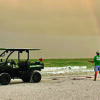



It’s been so long since the groins at Cortez Beach in Bradenton Beach — sometimes called “Three Piers” — were constructed, nobody is exactly sure of the date.
The best guess Manatee County parks and natural resources director Charlie Hunsicker has is “sometime in the 1960s.”
That’s what Hunsicker told county commissioners at a Dec. 9 work session on 2015 plans for Anna Maria Island’s continuing beach renourishment project and the dredging of Longboat Pass.
What Hunsicker and marine engineer Tom Pierro of Coastal Planning and Engineering do know is that the groins have outlived their life span.
“They were only supposed to last about 30 years,” Pierro said. “And they were built with the technology of 50 years ago.”
In 2015, high-tech groins will replace the three groins at Cortez Beach.
“These will be permeable, adjustable groins, allowing us to control the flow of sand and water through the groins,” Pierro said. Gears will be mounted in 10-yard sections on top of the groins, allowing for manual adjustments.
The beachfront Islander condominium on Longboat Key has had a permeable, adjustable groin constructed, Hunsicker said, and, so far, it’s working fine. If the first groin does its job and keeps the beach sand in place, they plan to build two more.
That’s exactly the way Manatee County plans to build its permeable, adjustable groins, Hunsicker said.
Cayo Construction of Fort Worth, Texas, has been awarded the $4.7 million contract for the Bradenton Beach groins and construction should begin in late January. Each groin will be built one after the other to avoid confusion on the beach and ensure the groins work, Hunsicker said.
The groins will be built alongside as the old ones are torn down and removed. Each groin will be 300-400 feet long, Pierro said.
The project is estimated to take 285 days to complete, according to the contract.
While new groins are a great idea for erosion control, the first thing anyone will want to do is walk on them, Commissioner Carol Whitmore said. Then the surfers and anglers will come, she added.
Pierro, who is a former surfer, understands that surfers will walk to the end of the groin with their boards to avoid paddling through the on-shore waves.
But the groins can’t be built as piers.
Hunsicker said if handrails or benches are added, that’s a pier, according to the Florida Department of Environmental Protection. Piers are constructed under a different set of DEP rules, he said.
Even if a handrail was built on each side of the groin, the DEP would say it’s a pier, Hunsicker said.
“They would make us follow the rules for a pier and it would cost a lot more than $4.7 million,” he said.
A public pier must be built at least 15 feet above sea level, be Americans with Disabilities Act compliant, have handrails, be built to withstand a 500-year wave event and meet other criteria, Hunsicker said.
The groins will have a smooth surface and be walkable. Hunsicker said he expects people will walk on the groins, even if they are fenced and chained, and no-trespassing signs are posted.
“Many communities solve this problem by putting up a sign that says ‘Danger. Proceed at your own risk,’” Hunsicker said.
Whether to allow pedestrians or anglers will be up to the Bradenton Beach City Commission, as that city will have the liability.
Regarding the dredging of Longboat Pass, that won’t begin until probably mid or late 2015, Hunsicker said.
Longboat Key is paying to dredge the channel on the condition it can use the dredged sand to renourish its beaches.
That’s fine with Hunsicker and other county staff.
“We just finished renourishment and our beaches have no need for more sand,” he said.
For Manatee County and Longboat Key to obtain federal funding to dredge the pass, it would have to be declared a navigational hazard.
“If we relied on the federal government to do anything, that might take some time. So, we have to take this up on our own,” Hunsicker said.
Longboat Key officials, the West Coast Inland Navigation District and the U.S. Army Corps of Engineers will work with Hunsicker and Pierro on the specifications for dredging the channel.
Hunsicker said the estimated cost to dredge the pass is $2.5 million.
As a family from far away but tied to a local family I still find it amusing that Floridians insist on using the term “Beach Re-nourishment” for sand “replenishment” that term “re-nourishment” should be reserved for the likes of “having another Beer” or “more Food” at the Beach.