




Sea turtle nesting in past years has often held off as late as Mother’s Day.
Not so this year.
It’s already time to pull in the beach gear and turn out the lights.
The first Anna Maria Island loggerhead nest of the season was found April 25, days before the official May 1 start of sea turtle nesting season.
Timing could not have been better.
Suzi Fox, executive director of Anna Maria Island Turtle Watch and Shorebird Monitoring organized a gathering for volunteers that morning at the Anna Maria Island Beach Cafe, 4000 Gulf Drive, Holmes Beach. But plans quickly changed when Fox learned a nest had been laid the night before.
Volunteers were directed to the nesting site in the 3000 block of Gulf Drive where the nest and crawl already were marked.
The crowd got a firsthand look at what they would be monitoring, and watched as seasoned volunteers John Schimkaitis and Debbie Basilius carefully dug into the sand to verify the nest.
A false crawl also was spotted April 25, and Fox speculated it may have been made by the same turtle.
Fox said volunteers already are on early morning walks on the lookout for more nests.
May 1 officially marks the beginning of sea turtle nesting season.
According to Fox, sea turtles nests were found to the north and south of Anna Maria Island on the Gulf Coast prior to finding the April 25 nest.
The temperature of the Gulf off St. Petersburg is 83.7 degrees, according to the National Oceanic and Atmospheric Administration. Fox said when the water hits 80 degrees, sea turtles receive an internal cue to head to the shores to nest.
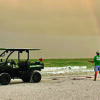
AMITW volunteers will be combing the beaches looking for nests in the first morning light.
Meanwhile, the shorebirds have been more active, drawn to the warm sands.
Fox said more than 10 shorebird nests have been spotted on the island. AMITW volunteers marked off the first least tern nest of the season April 19. Within a week, the lone nester attracted a colony of 30 other least terns and six more nests.
“Least terns are very rare on our beaches and it should be celebrated,” she said.
Five nests were laid by snowy plovers. However, Fox said, “the good, the bad and the ugly” of the nests are that three of the five were taken by predators.
She said nests are taken every year, but trash left on the beach, near the nesting sites, encourages gulls and crows to pillage the fragile sites. Trash was found near one of the taken sites.
Black skimmers will soon join their feathered friends protecting their eggs. Fox said the skimmers have been on the beaches in large numbers, congregating in a colony of nearly 300. The birds have been observed exhibiting courting behaviors.
Black skimmer males bring fish to their prospective mates.
Nesting season runs through the end of October although mid-way it transitions from nesting to hatching. According to the Florida Fish and Wildlife Conservation Commission, thousands of sea turtles will crawl upon Florida’s Atlantic and Gulf beaches to lay their eggs.
In 2014, 260 sea turtle nests were marked on Anna Maria Island and 18,387 hatchlings made it to the Gulf. The first nest was found May 11.
Florida hosts one of the largest loggerhead nesting aggregations in the world, according to the FWC. In 2014, 86,870 nests were recorded statewide.
Leatherback, green and Kemp’s Ridley turtles also nest in Florida.
Friendly tips for beachgoers
For birds…
• Stay back. A general rule is to stay at least 300 feet from a nest. Calling out loudly and dive-bombing are signals a person is too close.
• Do not chase the birds. They use up energy they need for nesting, and eggs and chicks may be left vulnerable to the sun’s heat or predators.
• Avoid posted nesting sites and use designated walkways when possible.
• Pick up trash and do not feed wildlife.
• Sightings of nesting shorebird harassment can be reported to the FWC’s Wildlife Alert Hotline at 888-404-3922.
For turtles…
• Remain at a distance from nesting sea turtles and hatchlings.
• Remove chairs, canopies, boats, rafts and other items from the beach at night. They can block the movement of turtles and hatchings.
• Turn off or shield lights along the beach. Sea turtles and their hatchlings can become confused and go landward toward lights instead of to the water.
• Use red LED flashlights on the beach at night, adjust cell phone screens to dark mode and don’t take flash photos.
• Fill in holes in the sand so nesting sea turtles and hatchlings don’t fall in and get stuck.
• Correctly dispose of fishing line, so it won’t entangle sea turtles and other animals.
It is illegal to harm, harass or take shorebirds and sea turtles, their eggs and hatchlings, including getting too close to a nesting female.
To report sick, injured, entangled or dead sea turtles to the FWC’s Wildlife Alert Hotline call 888-404-3922.
Unmarked sea turtle or shorebird nests can be reported to AMITW at 941-778-5638.
Turtle shirts on sale at ‘Old IGA’
T-shirts! Get your T-shirts!
This year’s Anna Maria Island Turtle Watch and Shorebird Monitoring T-shirts are being sold at Ginny’s and Jane E’s at the Old IGA, 9807 Gulf Drive, Anna Maria.
The shirts are offered for $20 with the proceeds going to AMITW.
Joan Carter of J&J Graphics created this year’s design and imprinted the shirts — pastel blue with sea turtle hatchlings on the front.
“I’m just so happy our local people are putting something into this program,” said Suzi Fox, AMITW executive director.