




Head out early or late to find fish, avoid heat
The name of the game: Beat the heat.
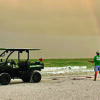
With temps in the mid 90s and the heat index topping out at 110 degrees, smart anglers are heading out early in the morning to fish the waters around Anna Maria Island.
Leaving at sunrise and returning to the dock before noon will help you remain cooler, and you may find fish more readily and more receptive, too, especially on the flats.
When summertime temperatures rise, the heat affects the anglers and the fish, too. Try fishing early when air and water temps are cooler.
A couple of other things to keep in mind for summertime fishing are to find shade occasionally and take plenty of water. Fishing in direct sun for hours at a time can be tiring and shade always is a welcome sight. If you’re on a boat where shade is scarce, make sure you have a hat, sunglasses and sunscreen and wear a long-sleeved shirt to protect yourself from the harmful rays. Also bring plenty of water to drink. The last thing you want to do is get dehydrated during the heat of the day. Once you’re dehydrated, fishing doesn’t seem to mean as much anymore, nor does anything else except getting indoors to some AC and sipping water the rest of the day.
Lastly, if you’re not used to the heat, small doses are recommended. I don’t know how many charters I’ve run where the clients wanted to stay out all day, but by noon they’d had enough. Fishing in the heat for four-five hours is enough. If you need more fishing time to get your fix, try breaking up the day. Fish the early morning for a few hours and then go back out just before sunset. It’ll be easier on you and you may notice the fishing to be a little a better.
On my Southernaire Fishing Charters, I’m trying to beat the heat. I leave the dock around sunrise and usually head back around noon. This way we are off the water before the sun and temperatures peak. On these morning trips, we’re catching mangrove snapper, flounder and cobia on nearshore structure. After putting some snapper in the cooler, we’re moving inshore to deep grass flats to hook up with spotted seatrout, Spanish mackerel and bluefish. Despite the heat, the bites are decent, although sometimes a little moving around is required.
As a reminder, Gulf recreational red snapper season closed July 11. The season will reopen Fridays, Saturdays and Sundays in September and October and on Labor Day. For more information on the closure, visit myfwc.com/fishing and click on “saltwater,” “recreational regulations” and “snappers.”
Capt. Rick Gross of Fishy Business Charters is putting anglers on mangrove snapper around nearshore structure and inshore on deeper grass flats. For the snapper on nearshore structure, Gross is using small live shiners as bait. Due to the bait size, Gross is using a size-4 hook connected to 20-pound fluorocarbon leader. To get baits to the bottom, Gross adds a small split shot to complete the rig. He’s seeing success on nearshore snapper around ledges and small rock piles.
As for the snapper on the deep grass flats, Gross is using the same small shiners as bait, only here he free-lines the bait. The inshore snapper are being found in depths of 6-8 feet where grass is present and especially on the edges of channels and ditches. While targeting snapper, Gross is hooking up with macks, spotted seatrout and flounder.
After snapper fishing, Gross is moving to shallower flats or along the Gulf beaches to do some catch-and-release snook fishing. Again, the small shiners are working as bait. Here Gross likes to add a popping cork to the rig to keep the bait up in the water column and to aid in casting. Snook catches are running 20-30 inches.
Capt. Jason Stock is working offshore with good results. On days where wind is light and the seas are calm, Stock is putting clients on permit around the offshore wrecks and reefs. On those calm days, Stock’s anglers are finding success from sight casting live pass crabs to schooling fish on the surface. Sometimes when the fish are not visible, Stock anchors and drifts crabs back toward the structure to attract a bite. Permit up to 20 pounds are coming to the hook.
Other species taking the bite around offshore structure include mangrove snapper, cobia and the occasional goliath grouper. For the mangoes and cobia, Stock is bottom fishing with live shiners as bait. For the goliath grouper, baits include whole jack crevalle and mackerel.
Capt. Warren Girle is fishing inshore during early morning tides to target spotted seatrout. By using live shiners as bait, Girle is attracting numerous trout in the 12-20 inch range. Deeper grass flats with 6-8 feet of water are producing the best catch. Mixed in with the trout bite are macks, bluefish and jack crevalle.
Moving offshore, Girle’s clients are putting their share of mangrove snapper in the cooler. Small shiners on a knocker rig are resulting in snapper catches up to 18 inches. Reefs, rock piles and ledges are home to these hungry snapper. Flounder and juvenile grouper also are being caught in these same areas.
Capt. Aaron Lowman is targeting spotted seatrout around deep grass flats and channel edges in southern Tampa Bay. By drifting over these deep flats and casting free-lined shiners to edges where grass and sand meet, Lowman is finding trout 10-20 inches. Mixed in are Spanish mackerel, bluefish and an occasional snapper.
Moving out to deeper water, Lowman is working nearshore structure for mangrove snapper and flounder. Both are being taken on live shiners or fresh-cut dead ones on a knocker rig.
Lastly, Lowman is targeting catch-and-release snook along the beaches and passes, where live free-lined shiners are almost guaranteed to result in a bite. Lowman is using 15-pound fluorocarbon and No. 4 hooks to trick these fish into biting.
Jim Malfese at the Rod & Reel Pier says water clarity is about as good as it’s going to get in the days to come. Looking under the pier, Malfese can see mangrove snapper, big snook, sheepshead and black drum. Amongst the dense schools of hatch bait are Spanish mackerel, blue runners and skip jacks.
To catch the snapper, most pier anglers are free-lining small shiners under the pier. Light leaders and small hooks are key if you expect to catch anything. Most snapper catches are 8-12 inches.
Snook, although catch-and-release, are a popular bite at the R&R. Slightly heavier leader and larger hooks combined with a pinfish or mojarra are attracting the attention of mostly schooley-sized snook — in the 18- to 22-inch range — although every now and again that big 36-inch female will come out for a snack. That’s when the pier angler is put to the test — and, Malfese says, the snook usually wins.
Lastly, the macks and jacks are being taken with artificials such as Clark spoons and Gotcha plugs. Free-lined live shiners will do the trick.
Send high-resolution photos and fishing reports to fish@islander.org.