







It’s been a short reprieve for Sarasota Bay environmentalists.
Long Bar Pointe LLLP has filed a second mitigation bank permit application with the Florida Department of Environmental Protection on the heels of withdrawing its first plan.
Both the DEP — with its conditional wetlands permit approval to the Long Bar partnership of Carlos Beruff and Larry Lieberman after almost two years of review — and the Department of Administrative Hearings — set to hear a permit challenge in October — closed their files with Long Bar Pointe’s Sept. 2 withdrawal notice.
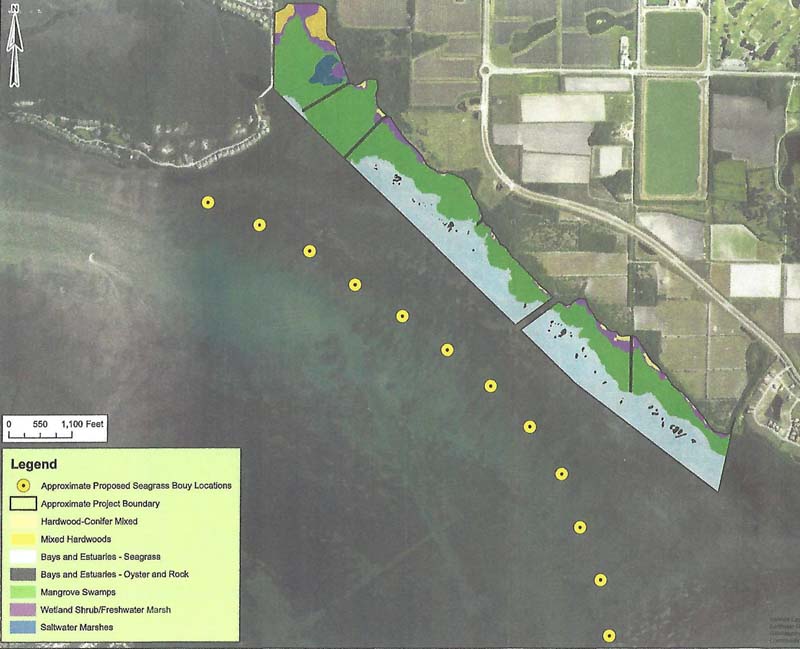
Stamped received Sept. 9, the new Long Bar application brings back for another DEP review the proposed 260-acre mitigation bank on the Beruff-Lieberman submerged lands in Sarasota Bay a few miles south of Cortez.
In addition to the DEP wetlands permit, the required U.S. Corps of Engineers review was noticed Sept. 14, announcing that the Long Bar federal proposal rated an “unfavorable” determination.
A Sept. 14 letter from the Corps regulatory division chief, Donald W. Kinard, advised Long Bar Pointe developers the compensatory mitigation project failed to meet federal standards for seagrasses and planned mangrove trimming would result in an ecological loss.
The Corps determined the project “as proposed does not have the potential to provide sufficient compensatory mitigation” to make up for “unavoidable impacts to waters of the United States.”
“We regret that the determination is unfavorable regarding utilization of the property as a mitigation bank,” he wrote.
The federal regulator predicted adverse effects from boat traffic from a proposed lagoon and commercial and residential development as well as the 100-foot gap between the bank’s two parcels in an oyster reef restoration area.
The mitigation bank is part of a 529-acre proposed development under review by Manatee County planners for the past several years. Now called Aqua by the Bay, Long Bar Pointe is seeking approvals for about 3,000 homes and 78,000 square feet of commercial space.
McClash and other environmentalists believe the gap would allow Long Bar Pointe to dredge a boat channel through seagrasses for access to the planned hotel-marina-basin for the same site — plans turned down by Manatee County in August 2013.
While Long Bar Pointe is expected to resubmit, and the Corps invited a new prospectus, at press time for The Islander, there’d been no news of a new federal application.
New vs. old mitigation bank plans
Scientist Alec Hoffner filed both the first and second DEP mitigation bank permit applications for Long Bar Pointe.
In a letter dated Sept. 9 to DEP project administrator Timothy Rach, Hoffner wrote the proposed project would preserve 110.2 acres of seagrasses, oyster reef and sands, 4.3 acres of saltwater marsh and 119.2 acres of mangroves, and enhance 17.5 acres of wetland vegetation and 9.8 acres of uplands.
The new plan registers small changes from the prior bank application filed in September 2015, seeking to preserve 110.5 acres of seagrasses and 120.9 acres of mangroves.
Enhancement, with removal of exotic vegetation and native plantings, was proposed on 18 acres of wetland vegetation and 9.6 acres of uplands. No changes to the 4.3 acres of saltwater marsh are proposed.
Both proposals call for 30 percent mangroves — about 36 acres — trimmed to a minimum 12-foot height.
Still part of the second bank permit is a controversial separation between the two areas of shoreline where speculation is that a boating channel would be added.
New drawings indicate three 30-foot-wide strips of land were eliminated from the bank — land owned by adjacent developer, Manatee Fruit Co. and Lake Flores I LLC, that allows stormwater discharge through the Long Bar property. The drainage land could be important in the planned 6,500-home build-out of Lake Flores on 1,300 acres between El Conquistador Boulevard and Long Bar Pointe.
Mitigation banks and credits
Hoffner points to the need for the Long Bar bank because “there are no private mitigation banks” in the 60-mile Southern Coastal Watershed Basin.
If the bank is permitted, developers allowed by municipalities to fill and dredge wetlands from Terra Ceia to Charlotte Harbor will be directed to purchase credits assigned to Long Bar Pointe.
Regulators, including the DEP, assign the banks credits to conduct specific mitigation.
The new Long Bar application seeks 18.6 credits — the same number approved in the DEP permit that was taken off the table.
Each credit translates to $100,000-$200,000 paid to the bank operator.
McClash criticizes the developer’s use of credits.
“Long Bar Pointe’s attempt to use a mitigation bank to obtain credits to destroy important habitat create a fraudulent approach to environmental permitting,” he wrote in an email.
“We have a developer who has decided one person’s profit should sneak in and ruin what so many of us value.”
Calls to Beruff and Lieberman for comment were not returned.
McClash, Florida Institute of Saltwater Heritage and Suncoast Waterkeeper initially challenged the DEP permit based on erroneous credit calculation — now dropped, but re-filed.
“It was too good to be true,” said former Manatee County Commissioner Jane von Hahmann, now a board member with the Cortez-based Florida Institute of Saltwater Heritage, about the withdrawal and re-application.