





The stench is evident as soon the door opens to the outside.
Christina and Jimmie Robbs, who traveled from Greeley, Colorado, arrived Sept. 24 to find area beaches cluttered with dead fish. They were lingering near the Coquina Beach concession area when asked for a comment about the red tide.
“It’s Mother Nature. There’s nothing we can do about it,” Jimmie Robbs said. The couple packed up and left the island later in search of a better beach.
A rank odor of dead fish and sea life continued to permeate on much of Anna Maria Island Sept. 29 as a heavy concentration of red tide persisted.
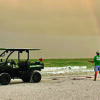
Parking lots at public beaches were virtually empty. Lifeguards were displaying warnings and the Manatee County public works tractor continued raking and removing fish carcasses from the shore.
The bloom of the microscopic organism Karenia brevis, though common in the Gulf of Mexico and ocean waters, was experiencing a particularly heavy outbreak. The algae bloom, which discolors the water and sometimes appears red — hence the name — is associated with the production of neurotoxins and depletes dissolved oxygen. It can prove deadly for fish and other marine life and dangerous for those on land.
People with asthma and other respiratory conditions are strongly advised to stay away from areas of red tide or be prepared with inhalers. Residents near the coast are advised to stay indoors and are warned against swimming in red tide waters as skin irritations are commonplace.
The Florida Fish and Wildlife Conservation Commission first reported a high concentration of red tide the week of Sept. 19 off Longboat Key at Longboat Pass, but fishers suspected the bloom began days before.
John Cannon, a fishing enthusiast who grew up in the area, found himself with dead bait fish moments after running through what he termed a patch of “bad water” off Whitney Beach the morning of Sept. 15.
“I thought, uh-oh, red tide, as soon as I saw what had happened. They died fast. I was just about 100 yards off Whitney. Sure enough, the next several days the dead fish started washing up in the pass around the other side of Longboat,” Cannon said.
By Sept. 26, Sarasota’s Mote Marine Laboratory, which tracks beach conditions, showed heavy concentrations at Coquina Beach and dead fish were beginning to accumulate on area beaches. Red tide generally develops 10-40 miles offshore. Where the bloom travels depends on ocean currents, the tides and local weather conditions.
The effects of red tide on marine mammals is well documented, being blamed as a killer of endangered manatees year after year. In a severe bloom in 2013, 276 manatees died off the Gulf coast in a relatively small area affected by the toxin.
Local sea turtles, still being impacted by the Labor Day passage in the Gulf of Hurricane Hermine, also may find surviving hatchlings affected or killed.
The red tide was more concentrated on the southern tip of the island in Bradenton Beach and northward through Holmes Beach, while Anna Maria seemed to be spared the initial brunt of the bloom.
But Anna Maria did not escape the red tide effects altogether. George McKay, city public works director, said Sept. 30 that fish were washing up on the beaches.
“There are spotty dead fish on the bay and the Gulf sides in Anna Maria. The county is taking care of Bayfront Park and the public area, but mostly it is private property,” McKay said.
Manatee County crews were responsible for the cleanup at public beaches, according to Amy Pilson, public affairs liaison for the Manatee County Public Utilities Department.
“The county cleans the public beach areas, such as Manatee Public Beach and Coquina, but private beaches we don’t do,” she said.
According to Pilson, Manatee County Parks and Natural Resources is responsible for the crews that remove the dead sea life and transport it inland to landfills.
“If private citizens want to clean their beaches, they will need to collect and then double-bag the debris for garbage pickup,” Pilson said.
In Bradenton Beach, Beach House Restaurant assistant manager Jim Harwood said beach cleaning was ongoing for days, sometimes more than once a day, the week of Sept. 26.
“They have put a ton of effort into the cleanup,” Harwood said, referring to the county crews.
Harwood said the restaurant was not adversely affected because of the large indoor dining area, but outside, the red tide was definitely a factor.
“It’s from the north all the way to the south of this island, that’s for sure,” Harwood said. “But there doesn’t seem to be as many fish washing up today as there were over last weekend.”
Bradenton Beach Police Detective Sgt. Lenard Diaz offered his observation. “It’s bad. It stinks. I don’t remember red tide being this bad since the ’90s,” Diaz said, complaining of the odor at police headquarters, which is alongside the Cortez Bridge.
In the FWC’s midweek update issued Sept. 28, high concentrations were present in nine water samples taken from Manatee County. Fish kills continue to be reported.
Experts advised that some blooms last only weeks while others persist for more than a year. Factors influencing the duration include sunlight, nutrients and salinity, wind speed and directions and water currents.
To monitor red tide and for updates, visit the Florida Fish and Wildlife Conservation Commission website at myfwc.com or the Mote Marine Laboratory and Aquarium beach conditions reporting system information at mote.org/beaches.
Is red tide linked to sewage spills?
By Sandy Ambrogi
Islander Reporter
Mote researchers say not likely.
Could sewage fuel red tide? Yes. Cause red tide? Unlikely.
On Aug. 22-23, Mote Marine Laboratory & Aquarium was conducting a routine offshore survey. The study found low but consistent levels of Karenia brevis, red tide algae, in the Gulf.
That was days before the onset of Hurricane Hermine’s torrential rains and flooding and the well-documented release of partially treated sewage into Tampa and Boca Ceiga bays by the city of St. Petersburg to the north and a release near Siesta Key to the south.
In a statement from Kaitlyn Fusco, public relations manager for Mote, only this much is considered a link between the current severe red tide outbreak and sewage dumps in the waters off our coastline.
Fusco said, “It is possible that the discharge provided some nutrients to the bloom once it had developed and moved to the coast, but the exact significance of the discharge — in context of many other potential nutrient sources in the area — is unclear.”
It may have simply been the so-called “perfect storm.”
Blooms of red tide are common in late summer and early fall. They usually start far offshore — 10-40 miles from the coast— away from sources of human-made and natural nutrients derived from land.
Red tide requires nutrients released from sediment, other alga and decaying fish, long known to be an unpleasant by-product of the red tide toxin, to flourish.
Conditions in August were not optimal for other diatoms, the algae that competes with Karenia brevis and rainfall was plentiful. The wet summer provided even more nutrients from freshwater and stormwater runoff.
The question remains.
Did purposeful sewage dumps “cause” the current red tide bloom fouling area beaches and aggravating humans?
Mote scientists say no, not likely, based on the evidence.
But it might have provided an additional nutrient kick to help support multiple species of marine algae, both beneficial and harmful.
The Mote researchers also reported, “To date, scientists have not found a direct link between the formation of these (red tide) blooms and nutrients present in coastal runoff. — Sandy Ambrogi