







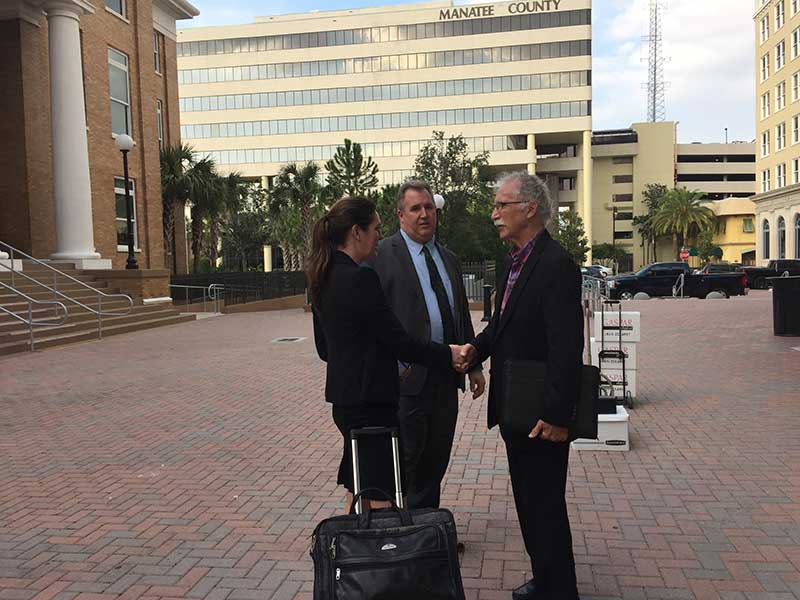
Twelfth Circuit Judge Gilbert A. Smith Jr. reserved judgment in the first Bert J. Harris Jr. Private Property Rights Protection Act case to make it to court involving a municipal entity on Anna Maria Island.
After a week-long trial, including 15 witnesses and about 75 exhibits, the judge postponed ruling on whether Holmes Beach inordinately burdened the owners of 626 Key Royale Drive.
Leah Marie Enterprises LLC, the corporate owner, and Kathleen Morgan, the corporate manager/owner, filed suit in March 2015 alleging a series of improper Holmes Beach building department decisions on a remodel project at the address. The owners had been working under an October 2013 city-issued building permit.
The plaintiffs were represented by Sarasota attorney David Johnson, Morgan’s husband.
After testimony ended, Clearwater attorneys Jay Daigneault and Erica Augello, assigned by the city’s insurance carrier, argued for dismissal, contending the plaintiffs did not prove their case. Augello said the building decisions were part of a development process to which plaintiffs acquiesced after the owner’s contractor was found working outside the scope of the permit.
With the exception of the Bert Harris claim, Smith agreed and dismissed the plaintiffs’ other alleged actions.
Some of the dismissed actions asked the judge to order a building permit for the remodel and others alleged constitutional claims.
In reserving judgment on the Bert Harris action, the judge said the case presented important issues that typically don’t go to trial.
“I’m going to treat it very seriously,” he said of his decision, expected after the attorneys provide written closing arguments in January.
The Dec. 12-16 trial in Smith’s courtroom represents the first part of a bifurcated proceeding.
If the city is found liable, a jury will be impaneled to determine the plaintiffs’ lost value.
Throughout the litigation, Johnson contended the city acted to burden Morgan’s property by “making up a 30-percent area rule,” basing a stop work order on the rule, and tying it to the Federal Emergency Management Agency 50-percent rule.
In December 2013, the building official Tom O’Brien issued the notice of violation, citing structural damage due to a 30-percent roof and floor-area removal. The January 2014 stop-work order cited the project for exceeding the permitted scope of work.
The contractor, Yfuk Yavalar, of Yavalar Built Inc., testified the city required he retain the old roof and build a new roof under their interpretations.
Former inspector Bob Shaffer testified, “The 30 percent was required and wrongly imposed in my opinion.”
Shaffer also testified Morgan was not allowed to use market value in a calculation of the 50-percent rule.
Plaintiff’s expert engineer Gene Farmer agreed, testifying the city applied the so-called 30-percent rule incorrectly and it had “nothing to do with FEMA.”
In March 2014, the plaintiffs and their attorney, Scott Rudicille, asked the Florida Building Commission to rule on the Holmes Beach building interpretations.
Farmer testified the FBC’s declaratory statement indicated the plaintiffs’ roof work did not amount to substantial structural damage invoking an area rule and did not trigger a violation of the 50-percent rule.
Former building clerk Robyn Kinkopf testified that Yavalar and Shaffer visited then-building official Tom O’Brien and plans examiner David Greene at least five times.
Each time, she said, the Holmes Beach officials refused to meet them because, “either they didn’t have anything to say to them or didn’t want to.”
On cross, Kinkopf agreed her knowledge regarding the 626 Key Royale project came from office gossip and hearsay.
Yavalar testified nobody authorized him to build vaulted ceilings in the kitchen and bedrooms, but “everybody thought it was a good idea,” and the owner knew of the plans.
He testified the city refused to allow him to place drywall to protect the home from the elements.
Yavalar also testified that doing work outside the permit wasn’t “a big deal.” On cross, he agreed drywall had weight.
Defense expert witness Clark Richards of Clark Richards & Associates testified that the state building code prescribes a threshold for roof loading, and if breached, an engineer must be consulted.
The plaintiffs ended their case with Holmes Beach developer Shawn Kaleta, who had a property red tagged the same day as the plaintiffs.
After numerous defense objections as to the relevance of Kaleta’s testimony, he was excused.
In addition to the ruling on the Bert Harris case, also pending in circuit court is another 626 Key Royale Drive case filed by plaintiffs.
Set for a summary judgment hearing in January and a trial in May 2017, that case alleges fraud and negligence against the city, as well as a defamation claim against former Mayor Carmel Monti.
Court proceedings are held at the Manatee County Judicial Center, 1051 Manatee Ave. W., Bradenton.
A look at Bert Harris basics
At last count, pending claims against the cities on Anna Maria Island surpassed the 100 mark.
Ordinances enacted in 2016 governing vacation rental properties spurred 15 owners in Holmes Beach and 85 in Anna Maria to make claims for lost market value.
And beyond the claim stage — on trial the week of Dec. 12 — alleged erroneous building code interpretations applied to 626 Key Royale spurred three-years of litigation against Holmes Beach for devalued property.
The common denominator for the 101 loss claims is the Bert J. Harris Jr. Private Property Rights Protection Act.
How does the state law protect private property?
The law allows a claim against a government entity that “inordinately burdens” an owner’s property rights.
Such a burden must permanently deprive an owner of “a reasonable investment-backed expectation for the existing use.”
The property owner must present a written claim to the government head, accompanied by an appraisal showing a loss in the fair market value.
After the claim is presented, a 150-day notice period begins, during which the government entity must extend a written offer to settle the claim, such as adjusting a land development standard, increasing or modifying density or purchasing the property.
If the offer is rejected, the government entity must issue a statement of allowable uses.
The owner can reject the statement and sue for damages.
If a suit is filed, a judge determines whether the government acted to inordinately burden the owner, considering the settlement offer and statement of allowable uses.
If the judge decides the entity liable under the act, the court impanels a jury to determine the owner’s damages.