








Sea turtle season is slowing down on Anna Maria Island, but it’s not over until the last nest hatches.
And, sometimes, that nest is a surprise.
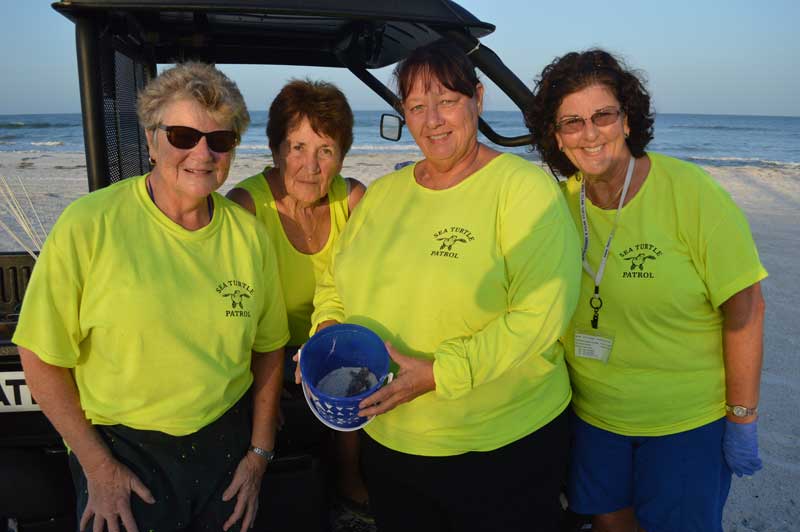
Anna Maria Island Turtle Watch and Shorebird Monitoring volunteers take turns each morning during nesting and hatchling season — May 1-Oct. 31 — conducting daily beach-walks to look for the tell-tale tracks indicating sea turtle nests laid the night before, or hatched nests.
New nests are few and far between, but hatches are happening daily.
When a nest is discovered, it is marked with stakes and ribbon, for its protection.
According to AMITW executive director Suzi Fox, sometimes circumstances can cause nests to be missed or misidentified by volunteers, leading to an unexpected hatched nest later in the season.
Since “surprise nests” are not marked, the identifying factors are a hole in the sand with sets of hatchling tracks leading away from it.
Fox said there are several factors that could lead to an unexpected “surprise” hatch.
She said heavy rainfall can wash away tracks made by nesting females before they are seen by the volunteers the following morning.
Additionally, Fox said sometimes a nest is mistaken for a false crawl — an abandoned nesting attempt.
AMITW volunteers collect data when a nest is discovered, noting its GPS coordinates with tablets which store the data on the cloud. The tablets are provided to turtle watch volunteers by Manatee County.
Turtle Watch section 6 coordinator Anne Camp said Sept. 6 that sometimes a surprise hatch will be spotted in an area where a false crawl was marked, and by looking at the data she can determine the “false” crawl actually was a nest.
“It happens from time to time that we spot a crawl and can’t find the eggs in the clutch when we verify the nest, so it is accidentally marked as a false crawl,” she said.
As of Sept. 8, AMITW reported 315 hatched nests and 78 remaining to hatch. If a track that initially was marked as a false crawl turns out to be a surprise nest, it is treated like a marked nest, and is reported as a nest instead of a false crawl, Fox said.
“We collect data from the surprise nests by excavating them 72 hours after they’ve hatched, just like the marked ones,” Fox said.
Nests are due to hatch through the last week in October, so it is important for people to adhere to regulations regarding turtle-friendly lighting by keeping lights visible from the shoreline low and shielded, said Fox.
“People tend to think that just because the nest they saw marked on the beach near their property has hatched, it’s OK to ignore sea turtle regulations,” Fox said. “The thing is, there may still be some out there that we missed, so people need to stay turtle-friendly until season is done.”
For more information about sea turtles, contact Fox at suzilfox@gmail.com or 941-778-5638.
How did the remaining nests fare after Irma passed thru? Were they washed away or could they still be intact?
We will be reporting on all the affects of Irma on AMI in the coming week.