





A.P. Bell Fish Company hopes to parlay a bit of Cortez history.
With 118 pages of surveys, photographs and research, Bell filed an application for a Butler Act disclaimer with the Florida Department of Environmental Protection.
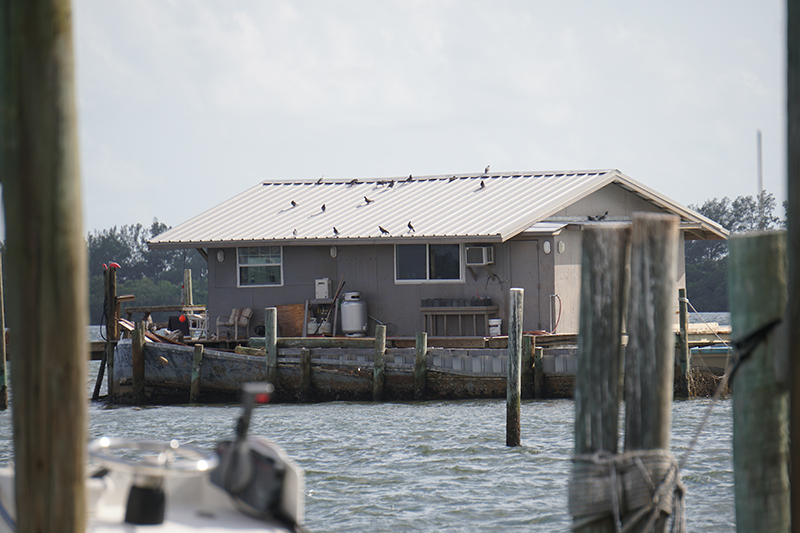
The company wants the state to disclaim interest in submerged land beneath the house Raymond Guthrie Jr. built in Sarasota Bay about 350 feet from the Bell fish house docks at 4539 124th St. W., Cortez.
The board of trustees of the Internal Improvement Trust Fund, comprising Gov. Rick Scott and his cabinet, owns submerged land in trust for the public with few exceptions. The DEP administers the state’s permitting laws and rules.
Guthrie built the 1,200-square-foot structure without state permits between February and May in 2017 with a metal roof, air conditioning and other amenities, and Bell claims the structure was built on the same pilings as a historic fish camp.
Signed by president Karen L. Bell, the disclaimer application includes a letter, 44 exhibits, surveys, photographs and two affidavits that support a pre-1951 Guthrie fish camp connected by a walkway to Bell’s company property.
The disclaimer relates to two pending 12th Circuit Court cases in which Bell claims the company owns title to the bottomland under the camp.
Though the Butler Act was repealed in the 1950s, it is still given legal effect to grandfather waterfront owners’ structures if the land is bulkheaded, filled or permanently improved, and if there is no channel obstruction.
“As the structures were damaged by storms over the last 100 years, the structures were rebuilt with whatever materials were available at the time,” Joanne Semmer, president of Ostego Bay Environmental Inc., wrote on behalf of Bell about the former Cortez net camps in a July 6 application letter.
Numerous photographs show the different types and configurations of net camps and spreads on the Cortez shoreline from the 1920s.
An April 2018 affidavit by Chester H. Bell, Karen Bell’s uncle, identifies a “southernmost walkway” that connected the Bell upland property to a pre-1951 Guthrie fish camp.
The application also includes a drawing and affidavit of Karen Bell’s father, the late Walter T. Bell, dated Aug. 25, 2011, confirming the Cortez shoreline before 1951.
In court papers, the DEP has argued the Guthrie structure is a “standalone structure that is not now, or was not at any relevant point in time, continuously connected to the upland property of the riparian owner.”
Cortez historian Mary Fulford Green agrees with the DEP, saying there never was a walkway to where Guthrie’s new structure sets in the bay and couldn’t have been because boats used the channel to reach the shore.
Green also said the application misrepresents Guthrie’s lineage, attempting to claim Guthrie’s uncle as his father.
Besides, she added, “Everything washed away in 1935. I was there. I was 10 years old. I remember seeing it go down the bay.”
Her opposition also is based on Guthrie’s lack of permits and what she believes is his intended use for the structure.
“No. 1, he didn’t have a permit. No. 2, he built a party house without a permit — it was built strictly as a party house,” Green said.
Guthrie told The Islander in May 2017 he built the structure with the help of Tom Mora for seagrass experiments. Mora said it was built as a workshop.
Cortez artist Linda Molto said while there have been parties at Guthrie’s house over the water in the past, she hasn’t seen any lately.
Cortezian Plum Taylor agrees. “It’s been quiet,” she said.
In 12th Circuit Court, however, litigation has multiplied.
The DEP filed suit in February to enforce a final administrative order when Guthrie failed to reduce the size of the structure and enter into a consent order.
The DEP’s final order requires Guthrie remove the house and pay $6,500 in fines and additional assessments “not to exceed $10,000 per day.”
Bell intervened in the DEP enforcement case, contending the company is the true owner.
Bell also filed a complaint against the DEP seeking title to the submerged land in May.
The DEP pointed to Bell’s lack of a disclaimer in a defense to Bell’s complaint, contending the action is “not ripe” because an application hadn’t been filed.
Guthrie is representing himself pro-se in the DEP enforcement action.
Caselaw supports washed-away structures can give rise to a Butler Act disclaimer, according to Bell’s Cape Coral attorney Joe Beasley.
“Our position is the historical drawings, dates, surveys and testimony support the improvement and connection,” he said, and photographs show “there’s no question they existed.”
The location of the channel may have been different in the 1920s, according to Beasley.
“These were mostly small mullet boats that went in and out of there,” and walkways could’ve connected the shore with the Guthrie camp, Beasley said.
Bell’s attorney also said he is working to arrange a meeting with DEP representatives so he and Bell’s surveyors can explain how a pre-1951 Guthrie camp was connected to Bell’s property onshore.
According to public information officer Shannon Herbon, the DEP is reviewing the Bell’s application for the disclaimer.
publicly available historical aerials from 1940 ,1951 and 1957 show that it was not connected..
http://ufdc.ufl.edu/UF00071767/00010/4?coord=27.471666452215736,-82.69715132006081,27.457254487484178,-82.67297744750977