

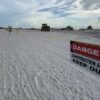




The Florida Department of Health issued a no-swim advisory for a Palma Sola Bay beach after tests July 8 and July 10 confirmed bacteria in the water exceeded safe swimming guidelines.
Every two weeks, the department tests water off statewide beaches — including those on Palma Sola Bay and Anna Maria Island — for enterococci bacteria.
The impacted Palma Sola beach is about 1,000 feet west of 81st Street on the south side of the causeway.
The bacteria can cause gastrointestinal issues, including vomiting and diarrhea, according to Tom Larkin, director of Manatee County Environmental Health.
Until the advisory is lifted, Larkin said people should look to other beaches if they want to swim and never swim in coastal waters with open cuts or wounds. If a cut occurs in the water, he recommends prompt and proper wound care.
Larkin said he hoped to retest the Palma Sola site the week of July 15, “after the rains let up,” and would resume routine testing the week of July 22.
The DOH website at www.floridahealth.gov states the no-swim advisory was issued due to tests measuring 70.05 or greater of enterococci in 100 milliliters of water.
Specifically, according to Larkin, samples taken July 8 at Palma Sola showed 24,196 colony-forming units of in 100 milliliters of water. Two days later, he said the enterococci level fell to 422 colony-forming units but remained above the safe swimming guidelines of the U.S. Environmental Protection Agency.
The DOH typically takes a second sample within 24 hours after a first test shows the guidelines were exceeded, he said.
A year ago in July, tests from the same beach showed 988 colony forming units growing together in 100 milliliters of water and a second test found 75 colony-forming units in the same amount of water.
Larkin said July 12 he suspects the high bacteria counts this July are due to heavy rainfall amounts.
“We know untreated stormwater runoff can negatively impact the bacteria counts… when rains sweep across lawns and streets and into the bay,” he said.
Another reason for high bacteria levels can be sewage spills.
As far as recent sewage discharges into the bay, Larkin said he’s not heard of any from the state Department of Environmental Protection, Manatee County Utilities Department or the city of Bradenton.
When high levels of enterococci are discovered, Larkin said his department contacts the state EPA to check a 1-mile radius for sewage outflows.
According to DEP spokeswoman Shannon Herbon, the last sewage spill into Palma Sola Bay occurred Feb. 23, 2018. Between December 2017 and February 2018, more than 6 million gallons of raw sewage found its way into the bay due to contractors rupturing sewer lines.
Regardless of the reason for high bacteria, according to Larkin, beachgoers should heed the sign on the south side of the Manatee Avenue west of 81st
Street and stay out of the water in Palma Sola Bay until testing meets EPA guidelines.
I agree with G. Rahn – who would ever want to swim among horse manure? They are there 7 days every week. Of COURSE there is dangerous bacteria in the water!
Get rid of the horses and dogs for a starter..been living here all my life and this bay is ridiculous and embarrassing. I can’t see anybody even entering this water.
I’m with you GREG! I am both a dog and horse lover. There is a time and a place for everything. Palms Sola Bay is not the place. We need to develop a voice. A loud voice.