





Despite repeated pleas from local officials, the Florida Department of Transportation has no immediate plans to build a roundabout at the intersection of Cortez Road and Gulf Drive, one of the most critical choke points on Anna Maria Island.
In fact, the DOT has no plans to fund construction for any roundabouts that area transportation planners and island officials say are badly needed to solve traffic problems on the barrier islands.
“Some intersection improvements have been brought to our attention (either by the local jurisdiction, the MPO, or identified from previous or current studies), but they need further analysis, further coordination, additional funding, and/or are not currently feasible,” DOT spokesman Brian R. Rick told The Islander in an Oct. 9 email.
Rick identified three intersections:
• Gulf Drive at Manatee Avenue, Holmes Beach.
• East Bay Drive at Manatee Avenue, Holmes Beach.
• Gulf of Mexico Drive at Broadway Street, Longboat Key.
Holmes Beach Police Chief William Tokajer, a member of the Barrier Islands Traffic Study committee, identified two other candidates: Gulf and East Bay drives and Gulf and Marina drives in Holmes Beach.
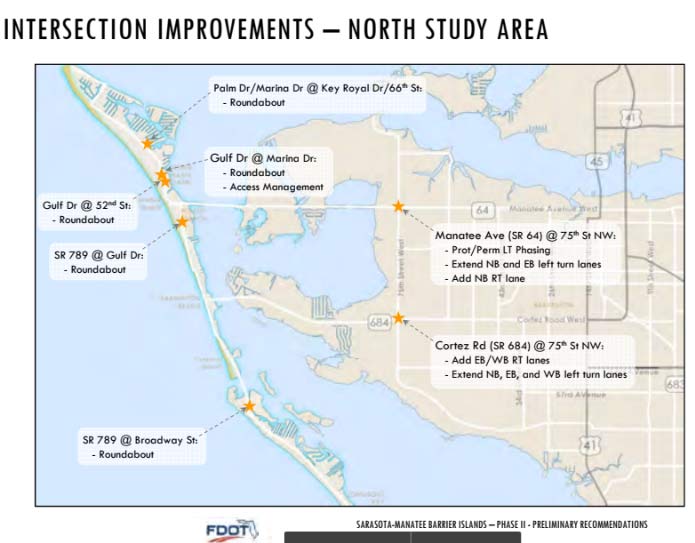
In the past couple of years, state and island officials, as well as transportation planners, have discussed at least eight possible roundabout sites on Anna Maria and Perico islands and on Longboat Key.
Tokajer would like to replace all traffic signals in Holmes Beach with roundabouts.
“I like the idea,” he told The Islander Oct. 18. “It gives us benefits as a city. It allows traffic to continually move as long as there is education for people on how to use the roundabout.”
Studies have shown that traffic flows better with roundabouts, said David Hutchinson, executive director of the Sarasota/Manatee Metropolitan Planning Organization.
“You’re only slowing the speed,” he told The Islander Oct. 18. “What’s counterintuitive about roundabouts is that they’re moving more slowly but the actual delay is less because you are moving for the most part.
“A roundabout will handle more cars.”
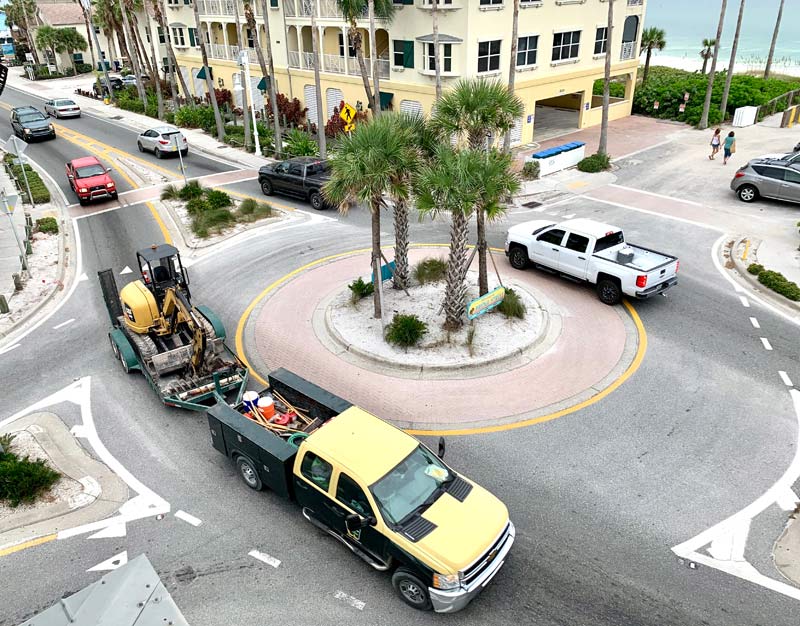
The only roundabouts on the island are located at Bridge Street and Gulf Drive and Bridge Street and Bay Drive South/Church Street in Bradenton Beach.
“The roundabout has done everything we wanted and more than we’d hoped to accommodate traffic flow and for public safety,” Bradenton Beach Mayor John Chappie told The Islander earlier this year, referring to the Bridge Street-Gulf Drive circle.
“I like it,” Hutchinson said. “I think it’s worked out very well. It’s provided good access to Bridge Street. It produces less delay than every car needing to stop.
“From my aspect, it’s been very successful.”
The lack of DOT planning and funding for a roundabout at the intersection of Cortez Road and Gulf Drive, just west of the Cortez Bridge, is one of the most vexing transportation issues for local officials.
The DOT just finished a six-year planning development and environment study that recommended a 65-foot-clearance fixed span to replace the aging Cortez Bridge. But the PD&E did not address the issue of how to improve traffic flow at the adjoining intersection in Bradenton Beach.
“Analysis for the roundabout at Gulf Drive and Cortez was included in the current PD&E study for Cortez Bridge and found not to be feasible at this time,” Rick wrote to The Islander. “We are currently coordinating with Longboat Key, Bradenton Beach and the MPO for inclusion of that roundabout for additional analysis in a future PD&E study that is incorporating other ‘complete streets’ improvements within the Bradenton Beach area.”
An analysis discussed at a meeting of the BITS committee earlier this year concluded a roundabout at the intersection was not feasible due to the high cost of right-of-way land acquisition.
Chappie and Longboat Key Commissioner Jack Daly complained extensively at a BITS meeting in September that the roundabout was not included in the committee’s final proposed list of 20 transportation improvements.
The DOT relented and said it would add the intersection to the list.
A few days later, DOT representatives told local officials that the agency had agreed to study a smaller roundabout than the large-scale more common roundabout it had rejected earlier on.
That project, however, is still years away.
Local officials also would like to see roundabouts for the busy intersections on Manatee Avenue near the Anna Maria Island Bridge.
The DOT is farther along with its plans to replace the Manatee Avenue drawbridge with a 65-foot-clearance fixed span.
The intersection of Manatee Avenue and East Bay Drive is closest to the bridge.
“They’re doing design for the Anna Maria bridge that might encompass a roundabout at the end of the bridge,” Hutchinson said. “They’re looking at the intersection, but haven’t identified what those improvements would be.”
Tokajer said he also would like to see a two-lane-wide roundabout a short distance to the west, at Manatee Avenue and Gulf Drive — at the entrance to the heavily used Manatee Public Beach.
Tokajer and Hutchinson say roundabouts are safer for pedestrians and motorists.
“Motorists are slowing down and the slower traffic makes it better for pedestrians,” the police chief said.
“A roundabout reduces the potential for T-bone collisions,” Hutchinson noted.
The key, both experts noted, lies in educating motorists on how to use the roundabouts.
“Residents will appreciate them once they get used to them,” Tokajer said.
Respectfully, I am one of the folks who is an island resident during most of the year and visits up north for a time in the summer. We have owned our home for many years. I have loved Anna Maria since first coming to visit my grandparents at age 16 – some 50+ years ago. Like Bonner, my family and I plan ahead when trying to move about during season — because we have to. I still love it and am saddened at its slow death – strangled by its own commercial success and the decisions that allowed it. Yes, I understand that things change. Times change. The thing that frustrates me is that the island governments, or at least some of them, allowed their communities to be sold to the highest bidder; to go from residential to transient housing with the attendant problems brought to those who love and call this place home for more than a couple weeks at a time. Until the change in sign ordinances, when driving around it appeared that most of the island was for sale or for rent. It still is and moresoe, but the signs don’t scream it as loudly or as frequently. It doesn’t mean that the commercialization of neighborhoods has gone away. If anything it is worse. Some years ago, my spouse and I visited a southwest town famous in history for its outlaws. I was greatly disappointed to find that no one actually lived there. It was a tourist trap of the highest order. I disliked it and would not return. One can see the island communities heading that direction — it may take a while, but it looks like that is coming because our residential neighborhoods are disappearing in favor of rental units. Homes are torn down to be replaced by ever larger structures (not homes) that shuffle people in and out regularly. The ambiance of our old Florida town and neighborhoods are slowly but surely being replaced by commercial ventures everywhere. I wish that someone, anyone, would stand up for our actual residents rather than for every business venture that wants to change our home town forever. Not their home town. Our home town. Or, at least it used to be our town.
Agree Bonner. I know a lot of people who live up north and are totally frustrated and appalled by our traffic complaining they can’t understand how we can live like this when not on vacation. It is usually lost on them that they are our traffic lol. I’ve lived here as many years as you have – most of my life. I think you can agree, assuming you still live in the island, that driving to the store, dinner, the doctor, church, picking up kids at school, work, the airport, etc. was once something that could be managed without planning too far ahead, packing a lunch, etc. Now we have a year round tourist season that lasts a lot longer and creates a lot more long traffic jams than we have ever had per recent Holmes Beach PD traffic counts. While I haven’t lived in a “big city” up North, I did live in Houston for 10 years and they have a lot of traffic. We didn’t have to stay home from work or anywhere else because they managed a tremendous amount of traffic fairly well. Here’s how. More and bigger roads. If you haven’t been to Houston, they have a lot of land and they just fill it up with roads. Sadly(?) we don’t have that option here and we have run out of solutions for too much traffic at this point. Everything that can be done has been done here and nothing is helping. We are traffic planned and circled to the max but bottom line is: there are too many cars. During the long season and ever increasing volume we have literal gridlock every day in certain locations that lasts a long time. Unlike in Houston, we are restricted from most applicable traffic management solutions for geographic reasons…too many cars…. too little space for them….nowhere to make more roads. Many of us who live in it daily as I do on North Shore Dr. have long since come to realize and accept there is only one solution. Figure out how to limit too many cars (including bikes, trucks, trolleys, golf carts, buses, motor bikes, skate boards, unicycles, pedestrians, baby buggies and other extraneous vehicles) on our very small roads – or get ready to stay home as you suggested I assume humorously. There is only one workable option left…fewer cars. Planning 101.
I don’t think we are in agreement. I still plan ahead during season and the busy beach days of summer. And I welcome everyone — EVERYONE — who comes to love Anna Maria Island. Everything I came to love 45+ years ago is still here. True, there are more people, but they don’t prohibit me from appreciating all the wonderful things about AMI that I love. — Bonner
Modern, slow and go, roundabout intersections have less daily delay than a stop light or stop sign, especially the other 20 hours a day people aren’t driving to or from work (it’s the #2 reason they’re built). Signals take an hour of demand and restrict it to a half hour, at best only half the traffic gets to go at any one time. ‘At best’ because traffic signals must have the yellow and all red portion (6+ seconds per cycle) for safety, and modern roundabouts do not. At a modern roundabout, drivers entering from different directions can all enter at the same time. Don’t try that with a signalized intersection.
https://www.lrrb.org/pdf/200824.pdf
https://link.springer.com/article/10.1007%2Fs12205-013-0338-5
https://www.researchgate.net/publication/311336618_Effect_of_vehicle_composition_and_delay_on_roundabout_capacity_under_mixed_traffic_conditions
Has anyone besides me tried to leave Anna Maria and go to Longboat Key for dinner on a busy day at Coquina Beach? The traffic stops in Bradenton Beach and is gridlock until after the Longboat Bridge! Or have you tried to go to The Beach House Restaurant in Bradenton Beach for lunch and afterwards try to turn left toward to the Cortez Rd. Bridge to go to Anna Maria? I have and it is usually impossible. Instead I turn right toward the traffic circle (roundabout) on Bridge St. as a method to go around and end up headed back the way I want to go. Theortically a good plan, but sadly not a good solution in reality. Once you manage to get onto Gulf Drive the traffic is often clogged before you can even get to the roundabout. Once you wait in line to get on it, you can go slowly around and notice how many cars are lined up coming from Coquina Beach trying to get onto the circle to also go toward the Cortez Bridge. The last time I did this it wasn’t even during season and it was a good 15 minute exercise just to try to get in a position to go north on Gulf Drive and get to the circle and then try to head back toward Anna Maria after going through the Cortez bridge traffic jam. The roundabout itself was solid traffic with more waiting to get on in every direction. If the point of having it is that people can go “slowly and make some progress rather none” then it would be wise to discuss what we mean by “progress”. The real issue here is that DOT and the various agencies like the county who study it don’t want to talk about what is obvious to those of us who endure it in our daily lives with increasing frustration. There are too many cars for a traffic circle to significantly improve extreme and worsening traffic back ups on the island especially at ingress and egress. Once two new 65 foot high span bridges are built (which will close when high winds associated with a hurricane come making egress impossible like the Skyway does) and dump more traffic onto already gridlocked places on the island, you will see a traffic nightmare like never before. I believe the state and the county know like we do but they would rather justify their existence by building big bridges and gathering money from the island in the name of commerce ($) until it’s total destruction. Then they will move on to the next place. I believe the Holmes Beach police chief is a realist and thus knows the real issue is too many cars. When he supports a traffic circle he is only trying to find ways to alleviate even slightly a serious problem that exists now and that he knows will get worse and worse. It used to be a seasonal problem but the more we become an international resort the worse it gets. And traffic isn’t the the only problem. I’m afraid at the current rate of accelerated irresponsible “planning” by the county and state and our own inability to stand our ground and take charge we will be all but obsolete before much longer. You can still live here but it will never be the same place we were all lucky and blessed to have lived our lives and raised our children in.
I find it hard to believe that anyone who’s lived in or visited a big city “up north” has a complaint about our traffic. Plan ahead. If you live here, why would you try to go to Longboat for dinner in season? Duh. Everything I came to love on Anna Maria Island is still here. Traffic and visitors? The best thing you can do, Janet, is stay off the road. — Bonner