


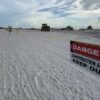




What’s next for a state-approved, developer-run wetland mitigation bank on Sarasota Bay south of Cortez remains up in the air following a legal challenge that ended in August.
The Supreme Court of Florida denied review Aug. 27 of Joe McClash’s appeal, ending his case against the Florida Department of Environmental Protection for issuing a mitigation permit to Long Bar Pointe LLLP. McClash, a former Manatee County commissioner, took on the case without an attorney.
The permit allows the Carlos Beruff-Larry Lieberman partnership to operate a mitigation bank on 260 acres of mostly submerged land in Sarasota Bay adjacent to their Aqua by the Bay mixed-use development. The acreage is southeast of Cortez, where mangrove trimming has occurred based on previously issued DEP permits.
The 1st District Court of Appeal ruled in April that McClash lacked standing and the state’s highest court upheld that ruling.
“Now that those challenges are over, the permittee can begin operating the mitigation bank,” DEP spokeswoman Shannon Herbon wrote in a Sept. 24 email.
Herbon also said a permit from the Army Corps of Engineers is “only required” if the developers want to sell federal credits.
However, the Corps disagrees.
Corps’ public information spokeswoman Nakeir Nobles stated in a Sept. 24 email the federal agency would review the new mitigation bank and that it “maintains full authority” under the Clean Water Act.
The court case
The court sided with the DEP and Long Bar Pointe briefs, which state McClash failed to measure up to the legal criteria allowing a Supreme Court review because he did not cite to conflicting decisions in other appellate districts.
After the Supreme Court ruling, McClash told The Islander he sees a movement afoot that may allow the state to usurp federal dredge-and-fill permitting authority, adding that the developers might be awaiting a change in the law.
“Are the rules softening up? I could see that twist in the Trump era, that if the state says it’s OK, it’s OK,” McClash said.
The DEP issued the permit for mitigation activities, including the placement of buoys in seagrasses in the bay, trimming of mangrove hedges and allowing the sale of 18.01 credits — valued at $100,000-$200,000 per acre — to developers in the region.
The positions defended
The Corps twice turned down Beruff-Lieberman plans for the mitigation bank due to concerns about the proposed adjacent large-scale development, protected seagrasses, mangroves and oyster beds and the project not meeting the fundamental goal of mitigation banks to provide an “ecological lift.”
Herbon conceded a Corps’ dredge-and-fill permit may be required to conduct some DEP-permitted restoration.
Asked about state versus federal regulation, she said the DEP would regulate “such things as mangrove trimming or work taking place in uplands” and deferred any federally regulated activities to the Corps.
Nobles said it has no authority to control the mangrove trimming — and that plans call for removing two-thirds of the mangroves’ height to provide views for the proposed residential development.
“However, if they wanted to place fill or structures in the waters of the U.S., they would need to apply for federal authorization,” she added.
Long Bar representative Pete Logan did not answer emails Sept. 26 and Sept. 27 seeking comment.
The bigger picture
The 260 acres earmarked for the mitigation bank are part of the 529-acre Aqua by the Bay, a county-approved, large scale, mixed-use development.
Aqua was approved by the county board in October 2017, although commissioners were advised by their attorney not to include the mitigation bank.
The commissioners approved the developers’ plan for 2,384 multifamily units, including 19 condo buildings, 95-feet in height and an unknown number of 35- to 75-foot highrises, 510 single-family homes and 78,000 square feet of commercial space.
McClash and the nonprofit Suncoast Waterkeeper along with several residents sued the county over its approval of the development plan — a plan that changed minutes before the unanimous vote.
The suit concluded in January with a 12th Circuit Court decision siding with the county, and reasoning that the nonprofit and residents were not entitled to the same due process as a developer.
Site work for Aqua, near El Conquistador Parkway at 53rd Avenue West, began earlier this year while the mitigation bank on the mangrove-lined shores on the bay was held up by McClash’s appeals.
The mitigation bank back story
McClash and the nonprofits opposed the Beruff-Lieberman mitigation bank in early 2016 after the DEP first published notice of the permit, labeling it a ruse.
Among the developer’s plans at that time were a dredged canal to the development from the Intracoastal Waterway, a boat basin, residential docks canals and a commercial marina.
A petition created by McClash pointed out most mitigation projects include restoration, but the developers’ plan was mainly for preservation of already protected wetlands, mangrove swamps and submerged lands.
McClash took on the appeals after his partners, Suncoast Waterkeeper and the Cortez-based Florida Institute for Saltwater Heritage, dropped the case due to costs.
McClash’s legal standing, most recently affirmed by the state’s high court, began with an administrative law judge, D.R. Alexander, who stated the interest of McClash, a recreational boater and environmentalist, and his regional concerns about trading wetland destruction for the improperly allocated credits were “too speculative.”
The 1st Court of Appeal decision also stated McClash failed to show how the DEP permit order “adversely affected his interest.”
In his brief to the high court, McClash pointed to expert witnesses, photos and his testimony about how the permit would harm him as a fisher, crabber, boater and wildlife observer.
McClash maintained he pursued the appeal to maintain citizen’s rights to access the courts.
State looks to assume federal dredge-and-fill authority
The state of Florida wants to take full control of development in its coastal waterways.
The Army Corps of Engineers regulates the waters of the United States — including Sarasota Bay — and, except for certain farming and forestry, requires permits before dredge or fill material is discharged into Florida’s waters under Section 404 of the Clean Water Act.
The U.S. Environmental Protection Agency allows an assumption of the federal dredge-and-fill permitting authority if a state program is no less stringent than Section 404.
In March 2018, then-Gov. Rick Scott authorized the state DEP takeover — and there’s been slow movement ever since.
DEP’s assumption of the Corps’ authority “cannot be considered complete” until the agencies finalize their agreement, according to a March 26 Florida House staff analysis. The analysis provides a DEP notice of the “rule development” in May 2018.
Katherine Betta, deputy chief of staff for communications for Florida Senate President Bill Galvano, R-21, whose district includes Manatee County, expected the meetings would be held at the federal level.
Despite the state, the EPA can refuse to cede its Section 404 authority.