







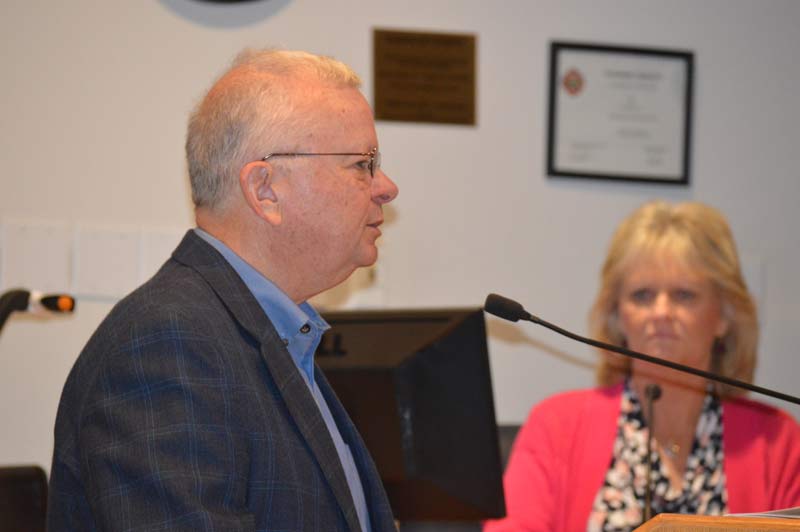
Attorney Jim Dye is heading back to his roots.
With a retirement plan in sight at the end of 2019, Dye, a partner in Dye, Harrison, Kirkland, Petruff, Pratt & St. Paul of Bradenton, said he looks forward to spending time on Anna Maria Island with a fishing pole in hand.
He grew up in Bradenton and, in his younger years, he spent summers fishing on the Rod & Reel and the Anna Maria City piers in Anna Maria.
“We ran all up and down the north side of the island, learning the nuances of fishing,” Dye said Dec. 9. “It was a great kind of Huck Finn way to spend the summers.”
Upon graduating from Manatee High School in 1972, Dye joined the U.S Coast Guard and served in Miami and Alaska, then received his merchant mariner credentials. However, there was a recession at the time and finding a job was difficult.
So Dye returned to Florida and attended college at the University of Tampa, followed by law school at Florida State University.
He said his desire to practice law “was probably genetic,” as his father, grandfather and great uncle also were attorneys.
He said environmental law became his focus in law school. And when Dye returned to Bradenton to practice, he was able to apply that knowledge to his subsequent work with county and city governments.
At about that time, the Florida Legislature enacted the Local Government Comprehensive Planning and Land Development Act of 1985, which required local governments to enact comp plans to ensure consistency with state and regional plans.
Dye worked on elements of the county plan, including land use, transportation, environmental issues and infrastructure.
He said this came at the start of a boom in the state population.
“There was a perception that local governments needed to get prepared to deal with it, since it was inevitable,” he said of the influx of people. “It was a very valuable process to be a part of as a young attorney, because I got to be in the middle of discussions on policy and see a multidisciplinary process taking place. Everybody’s voice was heard.”
Dye carried that experience with him when he started working as city attorney for Anna Maria and contracted counsel for Holmes Beach.
As Anna Maria city attorney, Dye helped guide policy decisions made by the mayor and city commission, as well as land use matters, including the original Anna Maria City Pier lease.
Dye handled code enforcement disputes and lawsuits in Holmes Beach, including the city’s ongoing conflict with a beachfront treehouse that began in 2013 and made it to the U.S. Supreme Court.
JT Thomas, Holmes Beach code compliance supervisor, credited Dye with revising the city’s method of dealing with code violations. Thomas said Dye guided the transition from a code enforcement board to special magistrate hearings in 2015.
“He’s such a sharp and professional individual,” Thomas said Dec. 13. “He educated me on the special magistrate process and we now have an excellent system to follow from now on.”
Starting in the early 1980s, Dye helped guide policy in the two cities, including the preservation of home rule — the power for local governments to make legislative decisions.
He said, through much of his career, he saw the Legislature chipping away at home rule.
“This made it much harder for the local elected officials to solve the problems that occur locally,” he said.
He said the state preemption in 2011 that limited local governments’ ability to regulate short-term rentals was a “punch in the nose,” threatening coastal communities that wanted a quieter way of life.
He said the preemption changed the tone of advice given to Anna Maria and Holmes Beach officials.
“We were forced to see how far we could take ordinances, without violating the preemption law,” Dye said, adding there was no case law yet, as the change was so fresh.
He said the Bert J. Harris Private Property Rights Protection Act, which allows demands for compensation due to government regulations that diminish the value of private property, is an example of how local governments “had some tools taken out of their toolboxes.”
Since Holmes Beach tightened rental regulations in 2016, more than 80 property owners invoked the Bert Harris law against the city.
However, Dye said Bert Harris only addresses property issues, and many of the problems derived from short-term rentals deal with behavior, including trash, noise and occupancy, which is still in the hands of local government, but more difficult to address.
He predicted 30 years from now there will be more short-term rentals on the island, along with a core group of residents that will help determine local regulations through their voting power.
“It will be much the same as it is now, but perhaps more polarized,” he said.
Dye might be retiring, but the law is in his blood.
“It’s hard to turn it off sometimes,” he said, referring to his career. “I can look at a large new house and say, “That’s a nice looking house,” but at the same time, I see all the economic forces driving that kind of construction. And what those economic forces mean for what the island used to be.”