







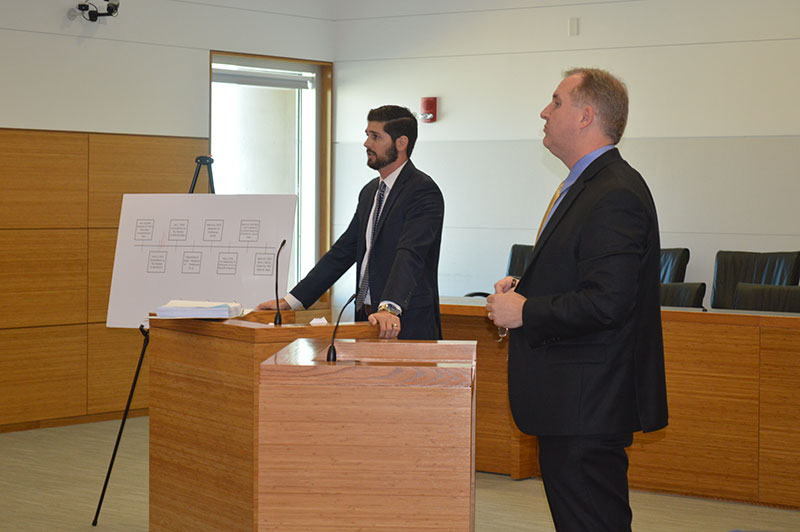
Three lawsuits with similar complaints against the city of Holmes Beach could be decided by the end of the year.
Twelfth Circuit Judge Charles Sniffin heard arguments in the cases Dec. 4, which were filed against the city over the Bert J. Harris Jr. Private Property Rights Protection Act, which allows demands for compensation due to government regulations that diminish the value of private property.
Following a July 30 hearing on a consolidated pretrial motion for summary judgment, Sniffen held his determination to allow 90 days for additional discovery, including depositions and inspections.
In the meantime, the city filed its own motion for summary judgment on the cases Nov. 1.
The owners of three rental properties — Robert and Michelle Carl, Shawn Kaleta and Brian Wein — claim their rights were violated when the city enacted regulations in May 2016 to enforce a two-person per bedroom rule for vacation rentals in an ordinance approved in September 2015.
Prior to the city’s adoption of the ordinance, there was no limit on occupancy in residential rentals. In 2011, the Legislature limited the ability for local governments to regulate vacation rentals. In 2014, the state gave some authority back to local governments, but in a limited capacity.
The city enacted the vacation rental program in 2016 after residents complained of parking, noise, garbage and other quality-of-life issues stemming from high occupancy in short-term rentals.
Since 2016, more than 80 property owners invoked the Bert Harris law against Holmes Beach by filing claims at city hall, and 42 lawsuits resulted from those claims.
As of Dec. 5, 12 cases are pending on similar claims of occupancy limits resulting in losses.
At the Dec. 4 hearing, the plaintiff’s attorney Aaron Thomas of the Najmy Thompson law firm in Bradenton said he’d already stated his clients claims, but asked for rebuttal time following arguments by Holmes Beach’s attorney, Jay Daigneault.
At the July hearing, Thomas said his clients lost investment expectations, including:
- Wien rented his five-bedroom rental home at 111 81st St. to at least 12 occupants until the law restricted him to 10.
- 307 66th LLC and the Carls rented their six-bedroom units at 118 50th St. and 307 66th St. to at least 16 guests, until the law restricted them to no more than 12 guests.
Daigneault argued Dec. 4 the complainants stated they were forced to comply with the regulations by the sunset period of May 1, 2016, because the city’s code prohibits variances contrary to the comprehensive plan. However, Daigneault said the amended code did not state the limits until Oct. 10, 2017.
“Whether the plaintiffs could have obtained a variance ultimately remains in question,” he said. “We’ll never know because they never applied for one.”
In rebuttal, Thomas restated his July 30 argument that the comp plan is not a local ordinance or regulation under the Bert Harris Act, adding that the state preemption precluded the city from regulating vacation rentals without changing the land development code, as changes to the comp plan were not codified prior to the 2011 amendment.
Additionally, Daigneault said plaintiffs’ appraisals for the properties, performed by property appraiser Richard Bass of Bass Fletcher & Associates Inc. of Sarasota, were not completed to industry standards and the best-use analysis was incorrectly conducted.
“The appraisals are invalid,” Daigneault said.
Thomas countered that the appraisals, performed by a qualified appraiser, are “bona fide and valid” and demonstrate losses to the properties’ existing use.
Daigneault also said the property managers tracked the number of nights and dates people stayed, but didn’t account for the actual number of occupants, so they could not know how many people were occupying the rentals at the time of use and they cannot, therefore, claim unknown damages.
Sniffen is expected to issue his order before the end of 2019.