





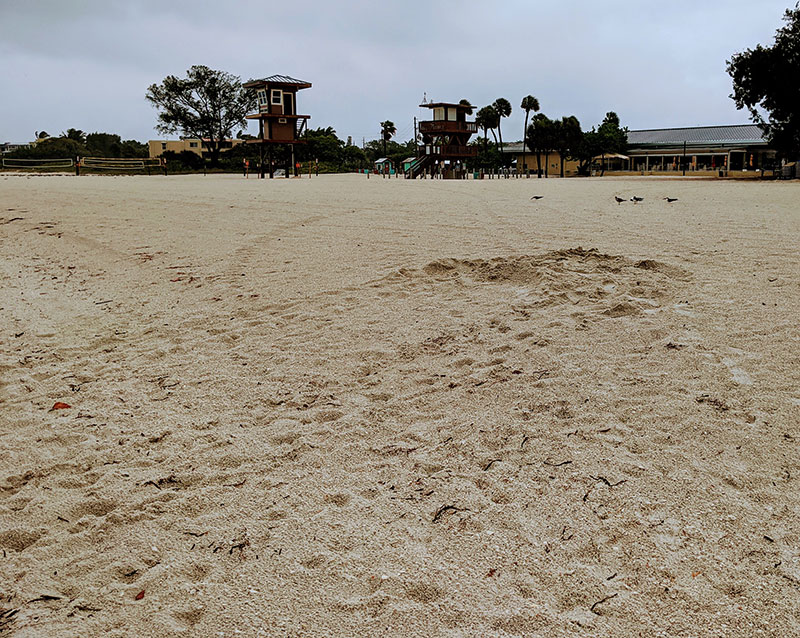
Sea turtle nesting season has begun on Anna Maria Island.
Two nests, both in Holmes Beach, were documented as of April 30.
And Anna Maria Island Turtle Watch and Shorebird Monitoring is operating with new “safer” protocols.
It is up to AMITW to keep future hatchlings — and volunteers — out of harm’s way and collect data for Manatee County government and state and federal agencies.
In 2020, those tasks may present a challenge, but whether the sea turtles know it or not, we’re safer at home, even if home is in the Gulf of Mexico.
In April, Suzi Fox, AMITW executive director, was patrolling the beach with four people on two ATVs, limiting volunteers and contact with people on the beach due to concerns over the spread of COVID-19.
She anticipated nesting could start early due to warmer temperatures in the Gulf of Mexico.
However, Fox already had planned to limit the pool of 67 trained turtle watch volunteers to seven people on four ATVs as of May 1, the official start of nesting season on the island, to speed up and refine the data collection process during a planned beach renourishment project, which may overlap with nesting season.
Nests laid on beaches that are part of the project — from 78th Street in Holmes Beach south to Longboat Pass — must be relocated to avoid being covered with sand pumped from an offshore seabed to restore eroded beaches.
The county had not released a start date for the project as of May 1, although its website stated plans to “begin in May 2020 at the earliest and continue through September 2020.”
Previously, AMITW divided island beaches into nine sections, each about a mile long. Two volunteers would walk each section up and back again every morning during season, which lasts through October.
This year, turtle watch split the beaches into three sections, not including the beaches north of 78th Street in Holmes Beach or the Anna Maria bayfront, which are not part of the renourishment project.
Usually, AMITW documents every nest spotted on the island. This year, nests outside of the project area will not be marked with stakes and tape, but turtle watch will track the dates laid and locations.
The first nest of the season, found April 21, was discovered on the beach near Coconut Avenue in Anna Maria, past the data collection point.
If a sea turtle nests inside the project area, turtle watch volunteers collect data on the nest, including GPS coordinates, while another volunteer digs a replacement nest farther north and landward, where the eggs are placed. The new nest is staked off for protection and data collection.
Fox said the relocated nests will be spread out over about a half-mile to a mile of beach near the north end of the island.
“We don’t put them all in one place because the Florida Fish and Wildlife Conservation Commission does not want us to put all our eggs in one basket, so to speak,” Fox said. She added that fewer nests would be destroyed by a storm or predation if they are not all in the same location.
In 2019, by the end of nesting season Oct. 31, turtle watch reported a record-breaking season, with 535 loggerhead and nine green sea turtle nests.
“We are expecting another busy year,” Fox said. “We must be fast and thorough to safely collect data and relocate nests. But we are up to the challenge.”
For more information, visit islandturtlewatch.com.