





HOLMES BEACH – People assumed parking would reopen once the spread of coronavirus was lessened.
And they were about half right.
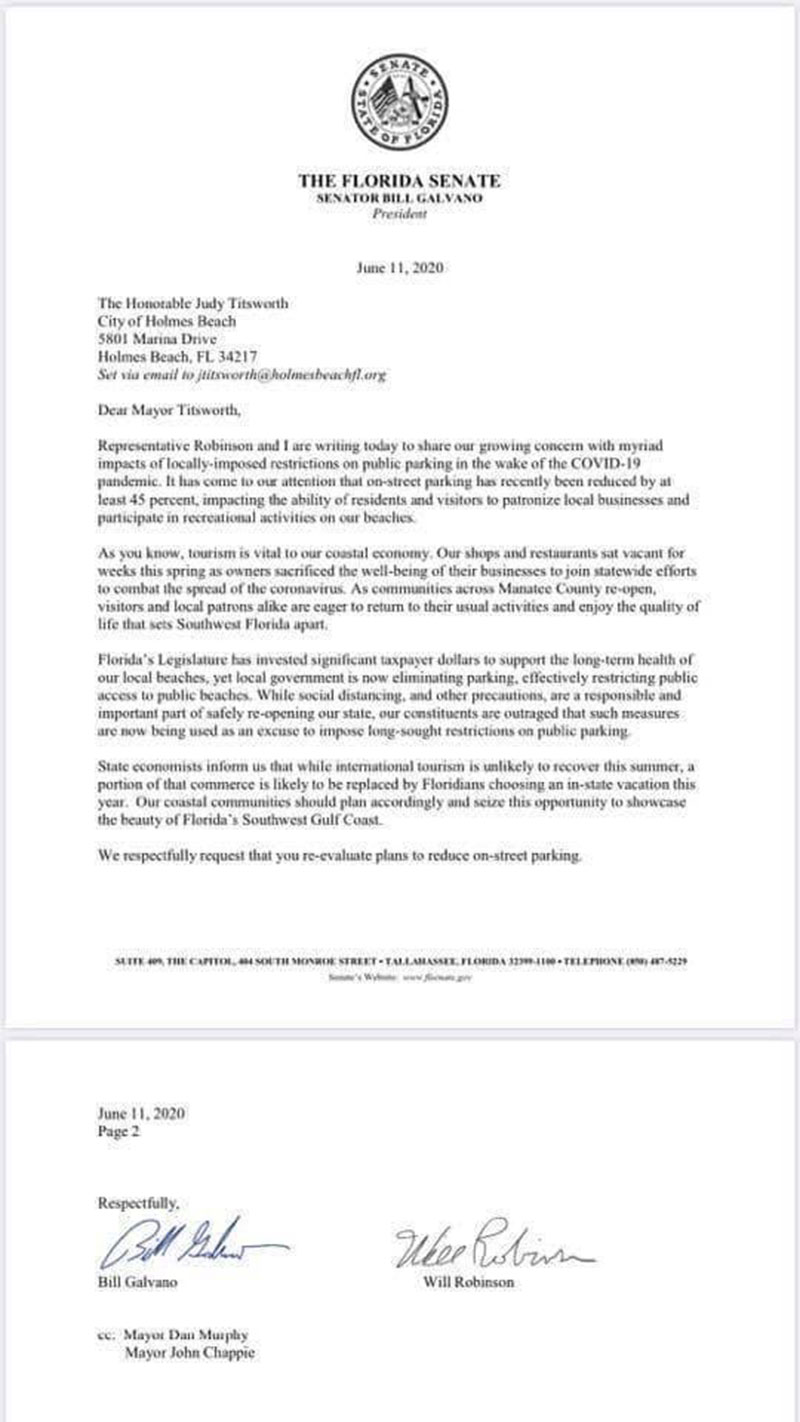
Senate President Bill Galvano and State Rep. Will Robinson, both Bradenton Republicans, shared their “growing concern” for the city’s restrictions June 11 in a joint letter to Holmes Beach Mayor Judy Titsworth.
In late April, city commissioners agreed to a parking plan proposed by Police Chief Bill Tokajer that removed 1,100 parking spaces previously open to the public — a decrease of about 45% of spots within a quarter-mile of the beach.
On-street parking for the remaining spots in Holmes Beach reopened June 5.
The parking plan was never placed on a meeting agenda, as traffic regulations are left to the discretion of the city traffic engineer — the police chief — so long as plans are supported by the commission, according to the city charter.
No vote was taken, but the commission reached a consensus during a public teleconference meeting.
Since then, residents, off-islanders and county and state officials have posted to social media, written letters and called city officials with concerns that parking was removed — without public input — under the veil of COVID-19.
Galvano and Robinson wrote:
“Florida’s Legislature has invested significant taxpayer dollars to support the long-term health of our local beaches, yet local government is now eliminating parking, effectively restricting public access to public beaches. While social distancing and other precautions are a responsible and important part of safely reopening our state, our constituents are outraged that such measures are now being used as an excuse to impose long-sought restrictions on public parking.”
In her June 12 response, Titsworth wrote, “With a population of 400,000+ in the county, 10,000 people moving to the county each year and 700,000+ tourists each year, we cannot, as a small city, allow this unrestricted parking to continue to creep farther and farther into our neighborhoods.”
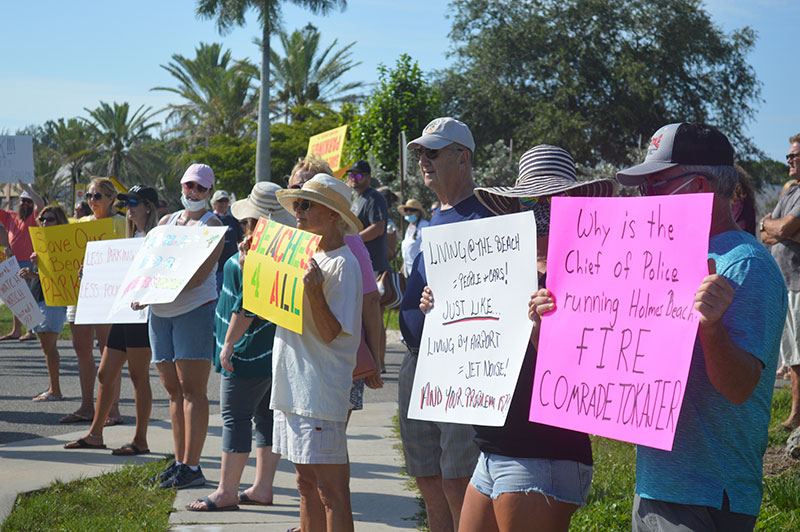
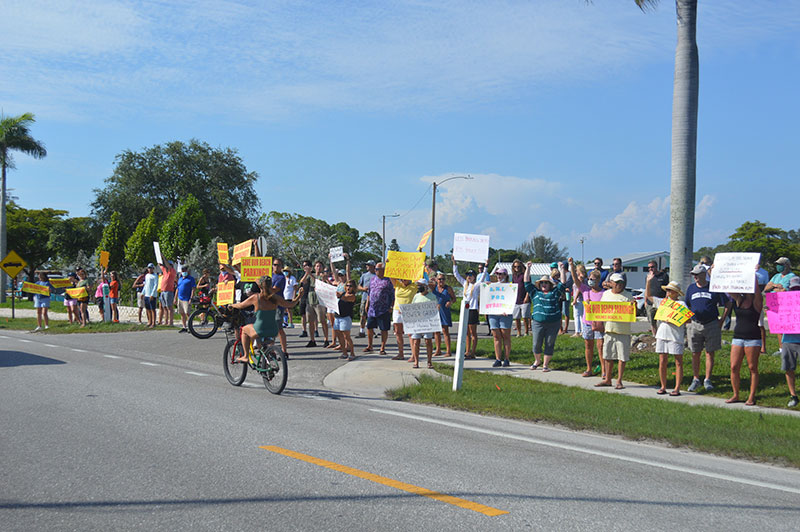
Public unrest over the change led to a June 9 protest outside city hall. About 50 people waved signs that read, “Save our beach parking,” or similar.
Mike O’Connor, who grew up on the island and resides in Bradenton, said he is concerned traffic will become more congested and businesses could suffer.
“This didn’t resolve anything other than a power grab during COVID-19,” he said. “At a time when people have lost income, more support was taken away. And that’s just not right.”
At the teleconferenced city meeting on the heels of the demonstration, more than 100 people tuned in, including Michael Barfield, a consultant on open government lawsuits and president of the Florida chapter of the American Civil Liberties Union.
Barfield said June 12 that he filed a records request for the meeting minutes when the plan was approved to evaluate how the commission reached consensus.
Before people spoke June 9, Tokajer presented the commission with information about the plan.
“Our purpose is to take control of how many people park in our neighborhoods,” he said. “This is a public safety issue and has been ongoing for many years.”
He noted that Bradenton Beach does not permit on-street parking and the city of Anna Maria has limited parking to one side on many beach streets.
Holmes Beach planning commissioner Gale Tedhams asked Tokajer what residents should do if they want to have an event and guest parking.
Tokajer said to call the police department and request a special use. An officer would cover “no parking” signs in the area with a locking bag, so people could park for the interim.
Noelle Conover, a seasonal resident, suggested permits or vehicle stickers for residents.
Tokajer said that is a possibility: “We are going to continue to review every option.”
In a June 10 interview with The Islander, Tokajer said claims of discrimination against off-islanders are unsubstantiated.
“We want guests to come here. We also want them to be respectful while they’re here and we have struggles with that,” he said. “But the anger aimed at Holmes Beach needs to be redirected at the county.”
He said the county funded an island traffic study in 2015, but has not followed the recommendations provided in the analysis.
“The county needs to step up with some viable traffic solutions that do not turn the city’s neighborhoods into a parking lot for more than 400,000 (county) residents,” Tokajer said.
At the June 9 meeting, commissioners reiterated their support for the parking restrictions, but agreed the plan is a work in progress and more public input is warranted.
“I would hope that as we move forward, that we can try to cooperate and find solutions that work mutually for addressing this issue of lack of sufficient parking on the island,” Commission Chair Jim Kihm said. “Not just the city of Holmes Beach. It’s the island.”
County commissioners were expected to address the issue June 16.
As a person who lives on a nearby island, we love respectful visitors. The problem is people forget this is our home. When you come and play and disregard our neigborhoods, clog our streets, add additional noise(noise pollution), and leave mounds of litter we have a right to protect our neighborhoods. You would not like it your neighborhood became like street fair or a fast food parking lot. Additionally, we pay extra fees in our taxes for sand nourishment. Digging deep holes and leaving them as gapping pits for erosion and traps during turtle season, causes problems. Parking on private property is also a problem. Since reopening, I have found people also don’t respect social distancing. I think paid parking is a excellent option, I personally feel that if you visit the beach then you must be willing to pay to support natural beautiful. If you can’t pay, then some type of beach cleanup volunteer program could be instituted to provide credit vouchers. Additionallly, water quality problems have been an issue for our counties – if people cared so much inland they would put in efforts to support Clean, Healthy Beaches and Water. Yes, beaches are public but the lands around them are private – just like a neighborhood park. Sorry, but I support fewer parking spaces.
The resort tax — paid by visitors in accommodations of 6 months or less — pay for beach renourishment, along with state and federal money. We do not pay any property tax for beach renourishment on Anna Maria Island. — Bonner Joy