








Thanks go to Mother Nature.
As instinct yields determination, especially when honed over millennia, the nesting sea turtles on Anna Maria Island find their path.
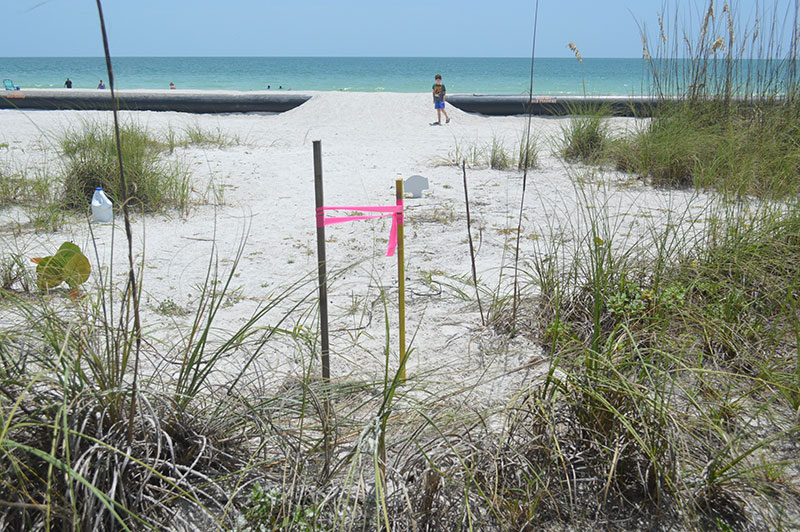
Based on evidence left in the sandy trail, some time after dusk July 27, a female loggerhead sea turtle crawled ashore, across a sandy ramp constructed to help people cross a pipe used to pump sand for beach renourishment, then lumbered up into the dune to lay her eggs.
After nesting, the sea turtle returned on her path to the Gulf of Mexico.
The turtle was the first known to travel across the freshly pumped sand and nest since July 8, when Manatee County started the renourishment project, starting at 78th Street in Holmes Beach. The work to spread the sand and the equipment will move southward on the beach to Longboat Pass.
“Our girls that nest here on Anna Maria Island are very clever,” Suzi Fox, Anna Maria Turtle Watch and Shorebird Monitoring executive director, said July 29.
According to Fox, sea turtles are less likely to nest in wet sand that is freshly pumped onto the beach. So, true to form, the turtle bypassed the new sand and went high into the dune to bury her eggs in dry sand. That also put her clutch farther from a rising tide that could flood the eggs.
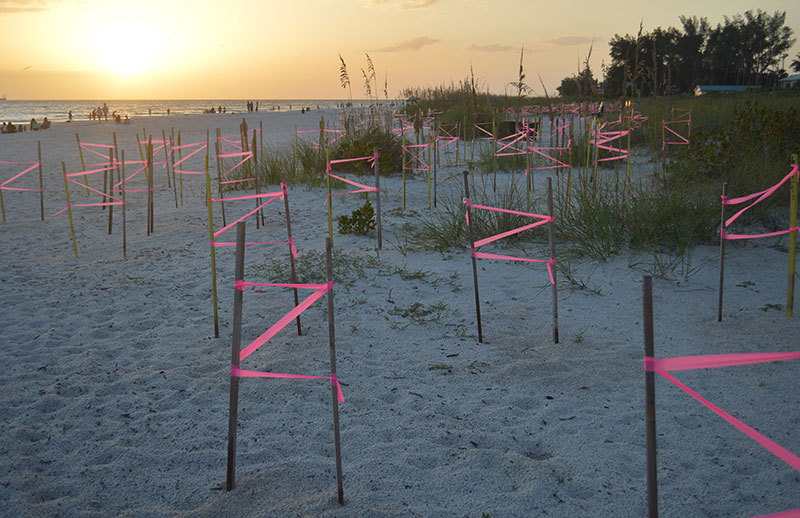
Turtle watch has been relocating nests laid in the path of the project since season started in late April. The nests are dug up from the beaches slated for renourishment and moved to hand-dug nests in a “nursery” in Anna Maria, north of the renourishment area.
As of July 30, AMITW volunteers had relocated 325 nests.
According to AMITW’s contract with the U.S. Army Corps of Engineers, the agency overseeing the renourishment project, nests laid after the project passed were to be left in place and marked with tape and stakes.
However, Fox was concerned the hatchlings — usually about 100 per nest — would be unable to maneuver the renourishment pipe, nearly 3 feet in diameter, running about 30 blocks down the beach near the shoreline.
So after consulting with a representative of the Florida Fish and Wildlife Conservation Commission, a decision was made to relocate any nests laid in sand landward of the pipe.
The nest laid in the dune July 27 must remain, as too much time passed to relocate it had passed.
Fox said in 45-90 days, when the nest nears hatch time, it will be covered with a restraining cage and watched by volunteers, who will assist the hatchlings to the Gulf.
Fox said nesting season is waning on the island and across the state so there should not be many more nests to relocate before nesting, hatching and renourishment wrap up at the end of October.
And hatches have been proceeding as planned.
As of Aug. 2, 58 nests had hatched and about 3,095 hatchlings had journeyed to the Gulf, according to AMITW.
“We are pretty tickled to see that nests are hatching well,” Fox said. “Fingers crossed for minimal flooding, so as many of these little guys as possible can make it out to the water.”
For more information about turtle watch, people can visit the AMITW website at islandturtlewatch.com or contact Fox at 941-778-5638 or suzilfox@gmail.com.
Report sick, injured, entangled or dead sea turtles or birds to the FWC Wildlife Alert Hotline at 1-888-404-3922, #FWC or *FWC on a cell phone or text tip@myfwc.com.