







They knew this year would be different.
Anna Maria Island Turtle Watch and Shorebird Monitoring volunteers have faced
some unusual challenges in 2020.
A $17 million beach renourishment project was slated to possibly begin in April, a month before the official start of the sea turtle nesting season on Anna Maria Island.
The project, which started on the shore at 77th Street in Holmes Beach and will continue south to Longboat Pass, didn’t commence until early July. However, AMITW volunteers had to relocate all nests to Anna Maria, north of the project area, so they were not destroyed or covered with sand piped from offshore to replenish the beach.
“We all knew there were going to be some changes because of beach renourishment,” Kathy Doddridge, a veteran AMITW volunteer, said Aug. 5. “But, when COVID-19 came, we also had to think about how to keep everyone safe.”
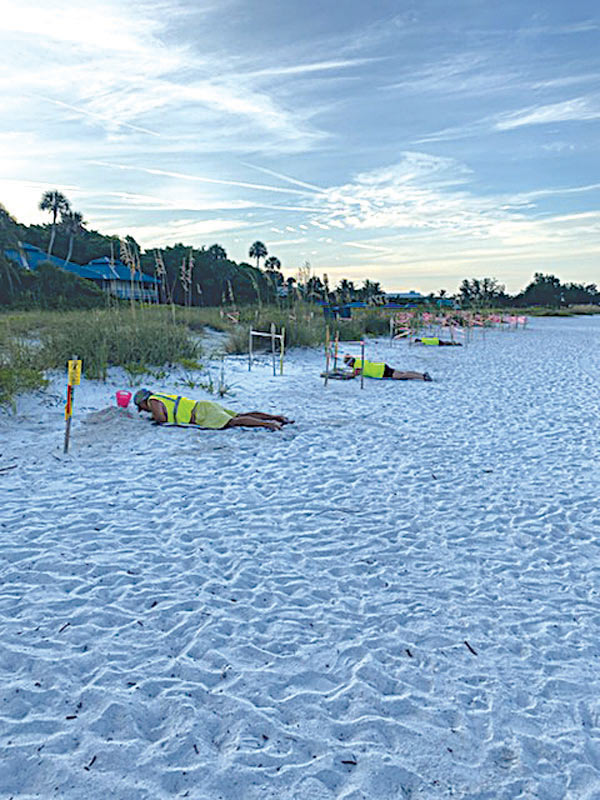
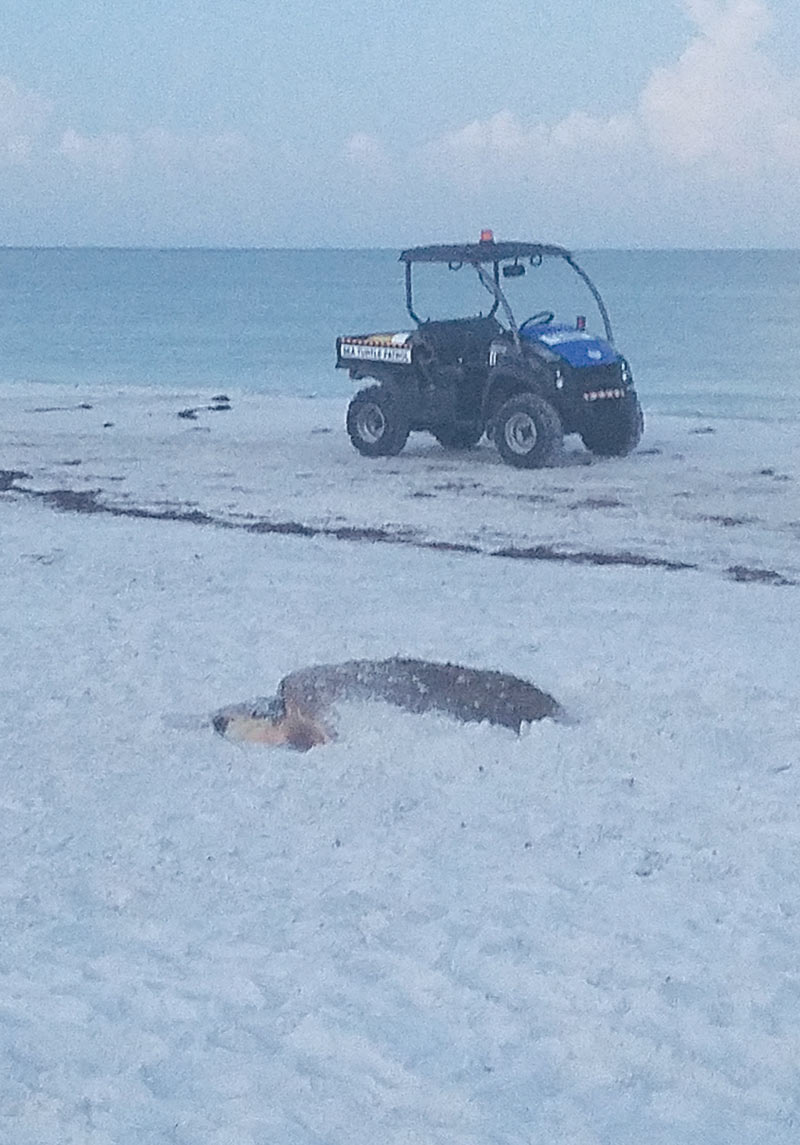
Modifications included beach patrols by a handful of people on ATVs, spotting tracks leading to nests on the beach. The teams removed the eggs for relocation to nests dug by volunteers at the north end, who awaited the nest spotters headed their way with buckets of eggs.
Previously, nearly 100 turtle watch volunteers took turns conducting daily beach walks May-October on nine 1-mile sections of beach to look for the tractor like tracks indicating a newly laid sea turtle nest or, later in the season, tracks made by hatchlings headed to the Gulf of Mexico.
“Taking it from 90 volunteers to less than 20 was hard,” Doddridge said. “But it has been the best thing for us this season because we feel secure in our small group and can work quickly.”
As of Aug. 12, AMITW had relocated 348 nests.
Due to the renourishment project, which runs 24/7, turtle watch also has been running a night patrol with the project crew on the beach. Volunteers would “clear the area” by ensuring no nesting turtles had emerged onto a stretch of shore about to be renourished or traversed by the equipment.
Skip Coyne, leading the night patrol, ran 10-hour night shifts every night for two weeks in July during peak nesting.
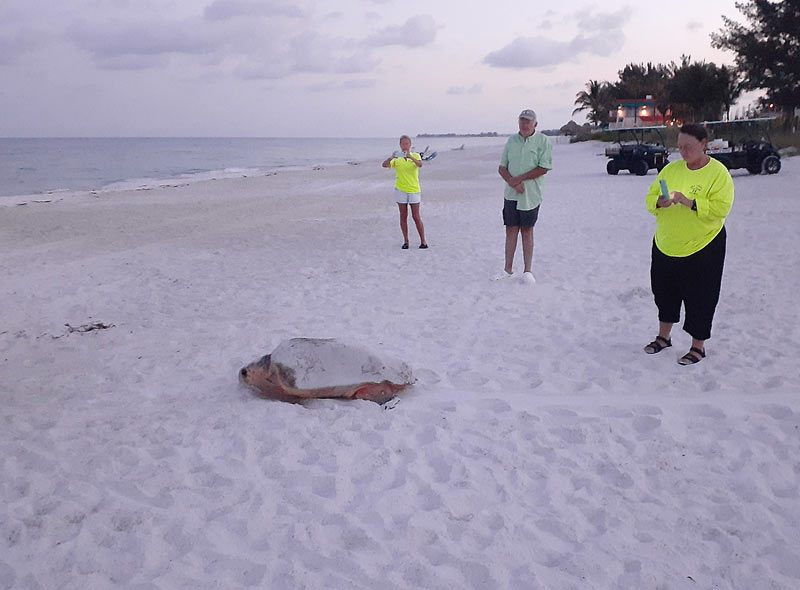
Coyne signaled to the crew by turning his ATV sideways when he spotted a turtle, which prompted a halt in the construction and lights out, while workers waited for the turtle to nest and return to the Gulf.
Coyne then staked the nest, so the crew of turtle watch volunteers could spot it and collect and transfer the clutch of about 100 eggs at dawn.
Eventually, the 10-hour shift was divided into two shifts, with the second time slot ending near sunrise.
“We’ve had to be flexible and figure out how to innovate as we go,” Coyne said. “It’s worked out incredibly well.”
As one of Coyne’s tag-teams on the night shift, which work six mornings a week, AMITW volunteers Hans Duerr and Birgit Kremer tested their skills and had some new experiences.
They relocated about 120 nests, including, on July 3, the only green sea turtle nest on the island.
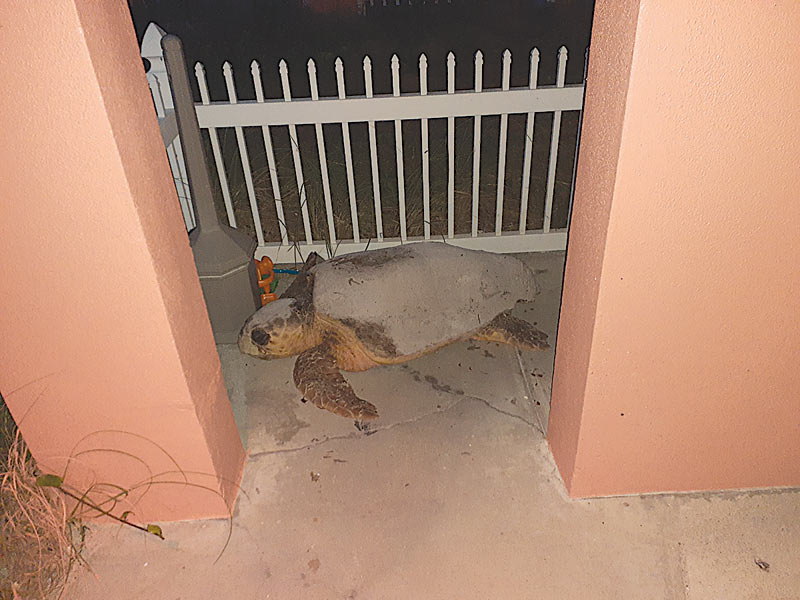
Additionally, Duerr and Kremer helped rescue a turtle they discovered one morning trapped at a building after it nested in Holmes Beach.
“We were able to rescue her and get her headed back to the ocean,” he said. “It was wonderful.”
Kremer said many nests were located high in the dunes where they were hard to spot.
“You have to open your mind and think like a turtle,” she said. “They’ve been especially tricky this year.”
While nests marked with stakes and tape provide some protection for incubating hatchlings, making them visible, the goal is to retrieve data.
Nesting nearly has ended and the relocated nests are hatching nightly.
Turtle watch goes into action 72 hours after a nest hatches, excavating the nest, accounting for hatched eggs, partially formed eggs, those that didn’t hatch and dead hatchlings. The data is shared with the Florida Fish and Wildlife Conservation Commission, as well as other local state and federal agencies.
Turtle watch estimated about 6,657 hatchlings made it to the Gulf of Mexico as of Aug. 12.
Turtle watch volunteer Bill Booher, who previously patrolled a section on the north end of the island, hadn’t planned to work for turtle watch this season.
However, as nesting picked up, AMITW executive director Suzi Fox asked if he could step in to help as needed.
Booher has been working with AMITW volunteers Linda ONeal and Carla Boehme in the “nursery” to dig nests similar to those created by a turtle and fill them with eggs.
Now that nesting has slowed, he’s helping with excavations.
Booher said about 6-10 nests have been hatching daily since Aug. 1.
And he has enjoyed lending a hand to the rest of the crew.
“One thing about change — it’s constant,” he said. “And sometimes it leads to something that can really be better. This season is proof that turtle watch can roll with the tide.”
For more information on the nesting season, contact AMITW executive director Suzi Fox at suzifox@ gmail.com or 941-778-5638.