





WMFR fights fire aboard dry-docked $2.5M yacht in Cortez
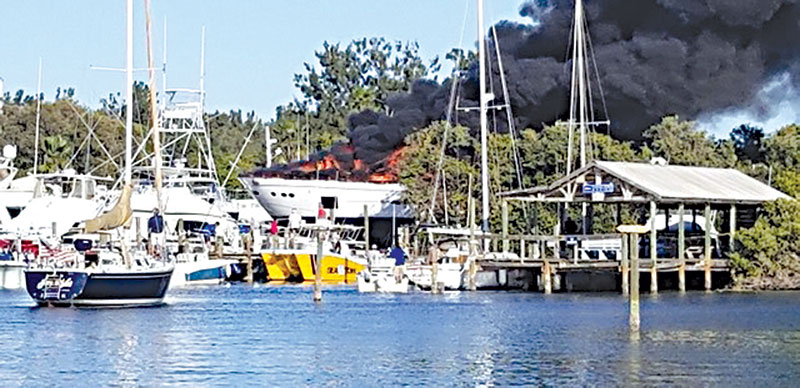
The 911 call for a boat fire at Cortez Cove Marina was made at about 3:45 p.m. Jan. 18.
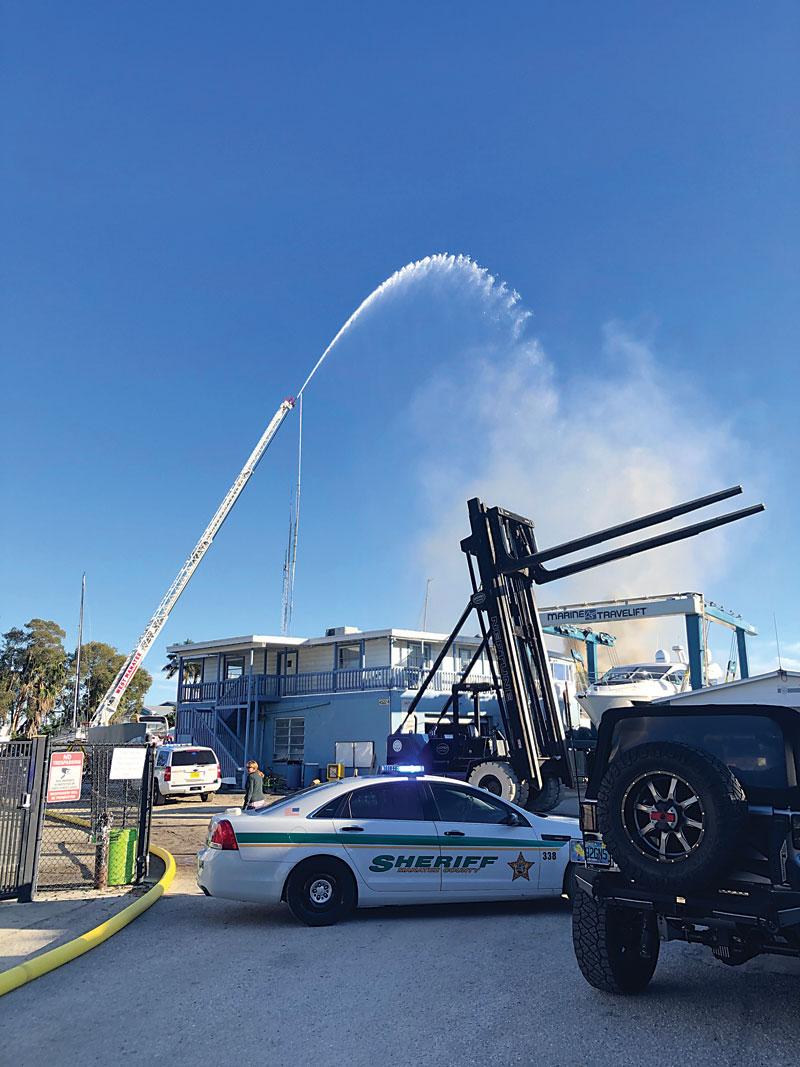
It took 18 hours, but personnel from West Manatee and Cedar Hammock fire rescue departments extinguished the fire on a luxury yacht dry-docked at the marina, 4522 121st St. Court W., Cortez.
There were no injuries.
The cause of the fire had not been determined as of Islander press time Jan. 25.
Marina staff performing maintenance on the boat said the fire was discovered coming from the direction of the electric panels, said WMFR Fire Marshal Rodney Kwiatkowski.
WMFR reported no significant damage to surrounding boats, structures or the environment.
However, the 2014 Princess 72 Motor Yacht valued at $2.5 million was a loss.
Michael Gary, the owner of the boat, could not be reached for comment as of Islander press time. Matthew Gary, Michael’s son and captain of the boat, answered a call from The Islander Jan. 25 and declined to comment. The Gary family are natives of Kansas.
The marina owner is John Lynch, who was not reached. A phone call to the marina Jan. 21 was answered by a worker who said marina leadership likely would not comment.
WFMR fights a few nautical fires a year, but the size of the Cortez blaze was unusual, Kwiatkowski said.
“This is likely the most tenacious fire we’ve gone to war with,” Kwiatkowski said. “We’ve fought structures that were larger over the years, but we have never had a fire so unwilling to go out. We attribute the fire’s tenacity, in large part, to the modern composition of building materials.”
The situation demanded the employment of complex firefighting strategies.
“It takes a large, well-trained crew to take care of something that big safely,” Kwiatkowski said. “Upon arrival, we have to determine if this is an offensive or defensive attack. Can we eliminate the fire in its current stage, or should we focus all our efforts on defending the boats around it? This is the first big decision we had to make.”
In the end, WMFR employed forms of both attacks, setting up a ladder to spray the boat from above, and hand crews around the boat as well as a dedicated crew to protect surrounding structures from radiant heat.
Aside from putting out the fire and protecting property, WMFR leadership had to consider firefighter safety, technical challenges presented by the burning boat on stilts and the integrity of the environment.
One of the dangers of multiple fire crews working at once is tunnel vision.
“Everyone is doing their job, offensive or defensive, and it’s easy to focus on your job alone,” Kwiatkowski said.
To mitigate danger, a crew works under a fire safety officer.
Firefighting tactics required measurement due to the vessel’s weight, as there was the possibility the supports under the yacht could collapse.
“The boat was on jacks prior to it catching fire, and then there was wood cribbing underneath to help stabilize it,” Kwiatkowski said. “When it caught fire, we introduced water. And water is heavy. So, you have a 75-foot vessel weighing itself down. You have the water. And you have to account for the fuel, which we estimated at about 1,500 pounds.”
To minimize stress on the support structure, crews filled the vessel with water and let the boat drain before filling it up again.
No fuel made its way into the cove, but WMFR worked with Sea Tow to set up buoys to contain surface runoff in the water around the perimeter of the dock.
“We are always training for the unknown,” Kwiatkowski said. “And we are constantly sharing information with other departments. It’s our job to be prepared for things people aren’t thinking about.”