







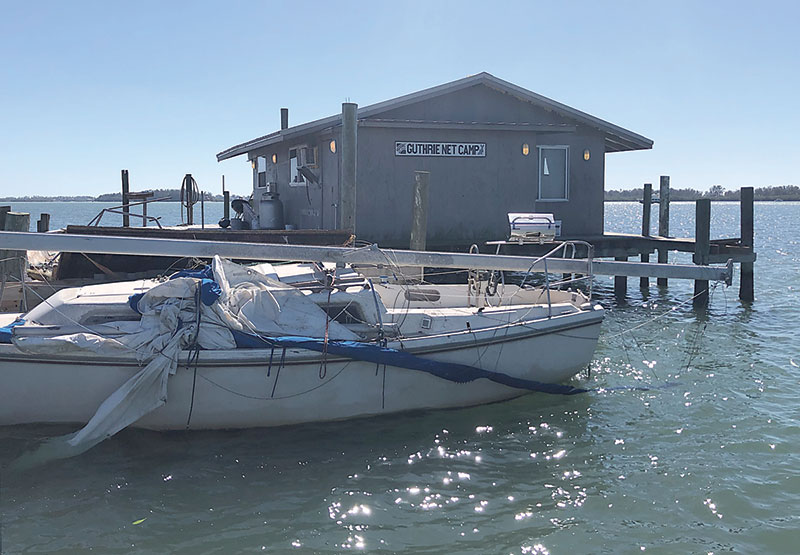
Raymond Guthrie Jr.’s stilt-house saga continues.
Judge Edward Nicholas will preside March 1 over a hearing on a motion for a stay of enforcement Guthrie filed Jan. 14.
If granted, the stay would postpone the execution of Nicholas’ final order to remove the structure — built over the water on pilings just off the commercial docks in Cortez. The 12th Judicial Circuit judge’s deadline for demolition was Jan. 24.
Guthrie built the 1,200-square-foot stilt house — complete with electricity and other amenities — in 2017 in Sarasota Bay near the A.P. Bell Fish Co. docks.
The Florida Department of Environmental Protection sued Guthrie, alleging he erected the structure without permits on state-owned submerged land. The DEP won its case in 2019. However, thanks in part to court-sanctioned extensions on a June 2020 demolition order, the stilt house remains.
Guthrie asserts the structure is a “net camp.”
“I have never lived there,” he said Feb 3. “It’s always been for a camp. You know, we go out there, work on nets.”
In addition to providing space for net mending, Guthrie said the structure could be useful in other ways.
“The state’s using it quite a bit when they go and get derelict boats and before the marina is ready for them, they’ll tie them up there,” Guthrie said. “There’s one out there right now.”
“You know a lot of local people use it. Sometimes they’ll go out there and have a party. Have a barbecue or something like that, but other than that, that’s about all it’s used for,” Guthrie added.
A stay on the demolition order might give Guthrie time to seek legal means of protecting the structure, said Karen Bell, owner of A.P. Bell Fish, Star Fish Co. and a share of Tide Tables Restaurant, all in Cortez. She has been assisting Guthrie in his legal fight.
“If (Nicholas) signs the stay, then we’re going to prepare to go before the state Legislature and seek either a long-term lease or some kind of local ordinance similar to Lee County, Pinellas County, Indian River County. All those counties that have made allowances for their similar historic structures over the water to stay,” Bell said.
Historic net camps were crude buildings erected in the early 19th century over the water that stored fishing nets and other gear. They were a common sight off the coast of Cortez into the 1960s but fell out of use in the 1970s with the advent of nets, which, unlike cotton nets, could be stored anywhere, including on the boats. Cotton fishing nets had to be offloaded after a catch, rinsed with fresh water, dried and stored where they were protected from the weather.
“I know that our local delegation was supportive, and I went and spoke before them on Jan. 6. They said that they just didn’t have the authority to overrule a judge’s ruling. But they said they would certainly help us if we could get the stay in place,” Bell said.
But the DEP is not planning to wait for the March hearing to take legal action with regard to Guthrie’s failure to adhere to the Jan. 24 deadline.
“The department will be filing a second motion for contempt in the coming weeks,” Shannon Herbon, DEP public information manager, wrote in a Feb. 2 email to The Islander.
The DEP filed its first motion for contempt in July 2020, when Guthrie failed to remove the stilt house by a June 3 deadline, which the department extended 30 days.
At an October hearing, the state did not find Guthrie in contempt. Had they done so, Guthrie could have faced jail time and monetary penalties, including civil penalties up to $10,000 per day while the structure remained, $6,500 in other penalties and the cost of DEP attorney fees.
According to Guthrie, the pilings that support the structure have been in his family for three generations.
“This is the third time I’ve built it in my lifetime,” he said.
He said the first two structures, one of which was used to raise clams, were wiped out in storms.
However, the state established its ownership of the submerged land beneath the camp in court.
“Well, I don’t know how you can say you own it or don’t own it. But I know we owned the pilings and everything, the material of course we owned, we bought,” Guthrie said. “But, I mean, it was just a known thing back in the day, every family there had a camp.”