




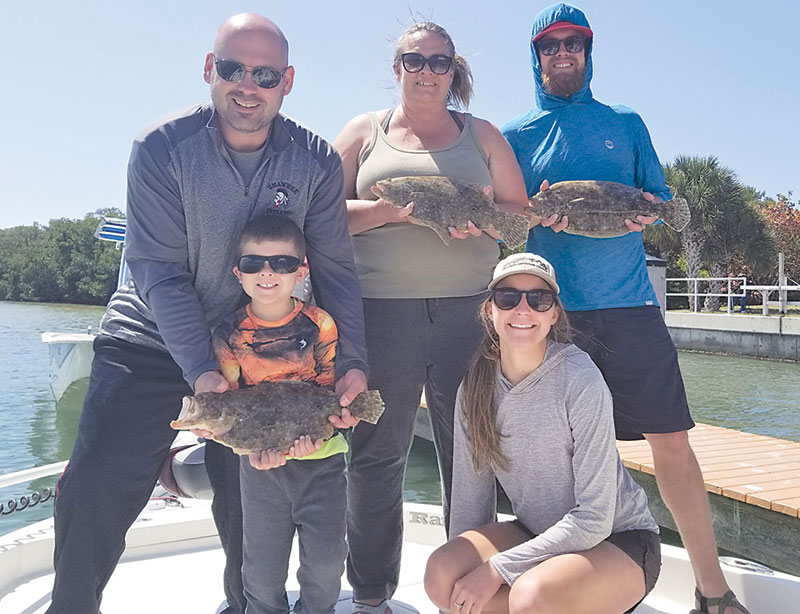
Springtime fishing is in full swing on Anna Maria Island and its surrounding waters, where working nearshore ledges and hard bottom requires strong arms and stamina to bring in the migratory fish foraging on the run of bait.
Large schools of threadfin herring are present within a few miles of shore, attracting many predators.
Kingfish are the most evident, boasting a mouthful of razor-sharp teeth, a smooth torpedo-shaped body, finished with a large tail to propel them at speeds of up to 45 mph.
On medium-heavy spinning gear, these fish are a force to be reckoned with — burning out the drag as they react to the hook.
With all of this activity, you can bet sharks are on alert. Blacktip, spinner and hammerhead sharks often are found slashing through bait schools, showing dorsal and tail fins as they break the surface of the clear Gulf waters.
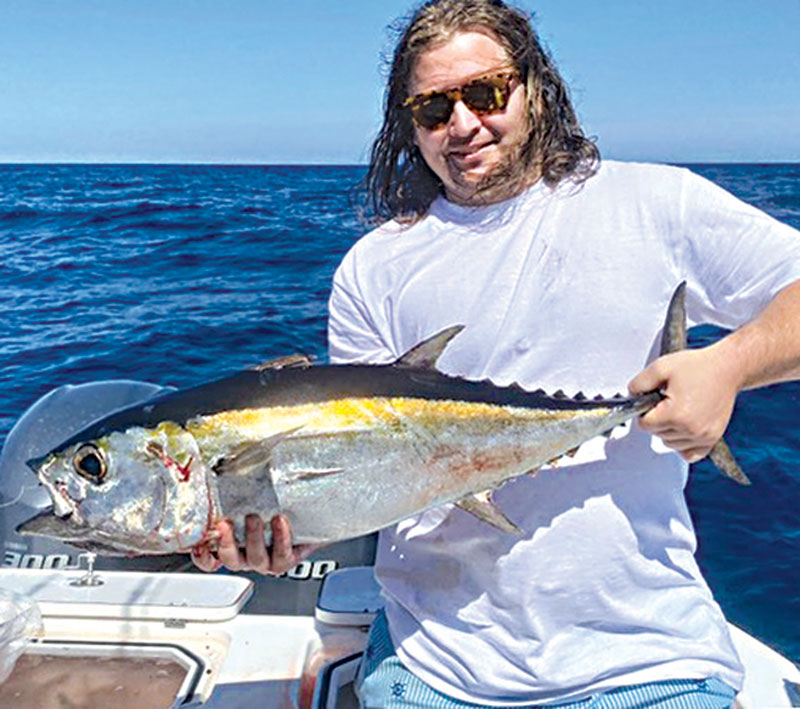
Moving offshore to depths of 60-100 feet, reports of amberjack, blackfin tuna and cobia are at the top of the list, plus a few hookups with sailfish are occurring. Don’t rule out bottom fishing, as red grouper are lurking in areas with a Swiss cheese bottom and mangrove and yellowtail snapper are coming to the party.
Moving inshore, the waters south of the Sunshine Skyway Bridge in Tampa Bay are producing some of the best backcountry action our area has to offer.
On a recent charter, I had just finished boating about 20 trout — at least half of which were 20 inches or bigger — before we rallied on more than a dozen snook in the mangroves.
As we moved on, slowly idling over the lush green waves of turtle grass bending with the tide, we spotted a 6-foot hammerhead shark meandering across a flat.
It looked graceful but it sensed the boat and turned and swam off as we headed toward deeper water.
About 100 yards down the flat, we saw a pod of manatees. In Tampa Bay, the gentle giants float along the edge of the grass flat, grazing innocently on the abundance of seagrasses growing in our waters.
From up in the tower, I saw them from a good distance. So I killed the engine and let the boat coast a little closer.
Wouldn’t you know it?
The manatees crossed ahead of us — three cows and a calf. My clients were in awe as they pulled out their phones for pics and video. They commented on how lucky I am to live here.
“What a great office,” they chuckled.
It was satisfying to share the morning on the water with these folks. I see manatees all the time, but when you’re with a group who has never seen them, you’re reminded of Mother Nature’s beauty. I try to remind myself not to take my life’s work for granted.
And now, with an environmental crisis taking place at Piney Point, I feel that I may have. I guess you just don’t realize what you have until it’s threatened.
I spend a couple hundred days on the water every year and now I wish I spent more. The potential for a large red tide bloom or development of green algae is a real possibility — a strong dose of it, too.
The eastern shoreline of Tampa Bay — as we know it — could rapidly change for the worse and all the work we’ve done as stewards of our environment could be reversed with this incident.
Bear in mind, I’m just a local fishing guide and I don’t claim to be a scientist, chemist or marine biologist.
Here’s what I learned:
The Piney Point fertilizer plant filed bankruptcy and shut down in 2001.
The site stores amounts of phosphogypsum in stacks.
Phosphogypsum is a calcium sulfate hydrate that forms as a byproduct in the mining and production of fertilizer. The large rocks are stacked in excess of 50 feet high for great lengths.
Phosphogypsum can be radioactive due to the presence of uranium and thorium, as well as radium, radon and polonium.
None of us want this stuff stored anywhere near our delicate coastline.
As these stacks are placed, walls are formed that can enclose more than 100 acres of land. To protect the phosphogypsum, a liner is inserted in the pit and eventually, rainfall fills the stack walls, forming a lake. Water levels are then maintained to prevent overflow.
The phosphogypsum stack in question has a perforation in the liner, in turn causing a breach where the wastewater was leaking. To avoid a greater disaster, including a collapse, the stack needed to be drained.
The wastewater is being released and pumped into Tampa Bay. The discharge potentially contains 10 times the amount of nitrogen that would be present in raw sewage. The nitrogen-rich water typically leads to enhancing the toxicity of harmful algal blooms.
The situation raises a serious, if not critical concern, for our local waters. A red tide of this magnitude would devastate the marine life we hold so dear.
If you’d like to learn more on the issue or feel as if you want to help, I suggest visiting www.suncoastwaterkeeper.org. These folks are stepping up to defend our waters. They are putting pressure on regulators, legislators and other lawmakers to ensure the quality of our local waters is maintained.
I’m a proud member.
On a final note, remember this isn’t just affecting the locals. All who love Anna Maria Island need to be educated on the subject, as it directly affects our marine habitat. If you want to enjoy paradise and protect it, get involved. Your opinion matters, too.
Capt. Warren Girle is working Sarasota Bay, which is yielding a variety of species. Fishing around residential docks is producing action on catch-and-release redfish. Casting live shiners or shrimp around these docks is resulting in numerous hookups of reds measuring 18-24 inches.
Girle is working deep grass flats for catch-and-release spotted seatrout, measuring anywhere from 15-22 inches. Mixed in with the trout bite are bluefish, Spanish mackerel and jack crevalle, adding variety to the bite.
Lastly, fishing shallow water toward the mangrove shorelines is producing action on catch-and-release snook.
Jim Malfese at the Rod & Reel Pier says the sheepshead bite is hanging on, although most catches are barely making the minimum size limit of 12 inches. Using live shrimp to target the sheepies works best, plus the shrimp are attracting other species — black drum and catch-and-release redfish. In fact, some catch-and-release snook are taking the shrimp.
Pier fishers casting artificials — jigs or silver spoons — are hooking up with some Spanish mackerel and ladyfish. Tipping jigs with fresh-cut shrimp pieces is a good idea, especially for anglers looking to hook up with a pompano.
Capt. David White says the bite for kingfish and Spanish mackerel is about as good as it gets. Free-lining live shiners over wrecks, reefs and hard bottom is resulting in many hookups. For the macks, some fluorocarbon leader and a long shank hook work great. For the kings, adding a 6-inch wire to the rig will ensure these fish stay on the line.
Moving offshore, red grouper and yellowtail snapper are being caught over hard bottom. Live and frozen baits are working on this bite. Lastly, White says blackfin tuna are being caught around offshore wrecks.
Capt. Jason Stocks says spring break fishing is producing a mixed bag up offshore species. Migratory species — kingfish, blackfin tuna and amberjack — are being caught regularly, as well as some cobia. Free-lining live shiners are working well for these species.
For a thrill, Stock is letting his clients pull on some goliath grouper while wreck fishing in the Gulf.
The highlights of spring break include putting some African pompano in the cooler, as well as a couple of sailfish hookups.
Capt. Aaron Lowman is working nearshore structure in the Gulf of Mexico inside 9 miles, where kingfish, bonito and sharks are getting the adrenaline pumping for his anglers. Free-lined shiners are quickly being eaten by these voracious predators.
Moving inshore, Lowman is enjoying good action on the catch-and-release trio — snook, redfish and trout. All three are responding to live shiners as bait.
Lastly, Lowman is fishing the remainder of the sheepshead bite for anglers who like to put dinner in the cooler. Live shrimp is the bait of choice here.
Send high-resolution photos and fishing reports to fish@islander.org.