





It is happening again.
The fever is settling in. Sleepless nights, long hot days spent on the boat patrolling the shorelines for a flash. Or a roll. Or even a free-jumping fish.
Sunburn and dehydration become commonplace for the weeks to come.
The preoccupation of getting hooked up so consumes that there is disregard for just about everything else — except maybe eating and sleeping.
That’s right.
It’s tarpon season on Anna Maria Island.
Sport anglers from all over the world are converging with hopes of meeting up with the ultimate hookup — the silver king.
These tackle-busting oversized shiners capture the hearts and souls of seasoned and rookie anglers.
Once you have the fever, there’s only one remedy — you fish until one of these shiny metallic giants eats your bait.
And then there’s the rush.
There it is. Fish on.
That shock the first time the flashy fish breaks the surface of the water is unforgettable. An acrobatic display of pure power ending in an eruption of water and the sound of the drag as your line strips off the reel at an alarming speed.
And don’t forget: When the majestic fish jumps, you must “bow to the king.”
As a fish is airborne, you extend your rod forward, causing you to bow. The action puts a slight slackness in the line to absorb the spastic head-shaking of the fish. Failure to do so can result in the line breaking. A sound resembling a shot from a 22-rifle emits through the air as the line breaks and the rod goes straight again. And it’s over.
The fish wins.
But, if you’re lucky enough to stay hooked up after the fish lands, then the fight ensues. Runs of 100 yards or more occur during the early stages of the battle as the large fish swishes its big tail trying in desperation to get away.
It’s been 15 minutes now.
You’ve managed to get back three-fourths of the line on the reel. The fish is close. It’s slowing down, swimming circles under the boat. Finally, you see a flash 10 feet down in the green water. One more pump of the rod and a quick reel and the leader is showing. The fish slowly surfaces and rolls to its side.
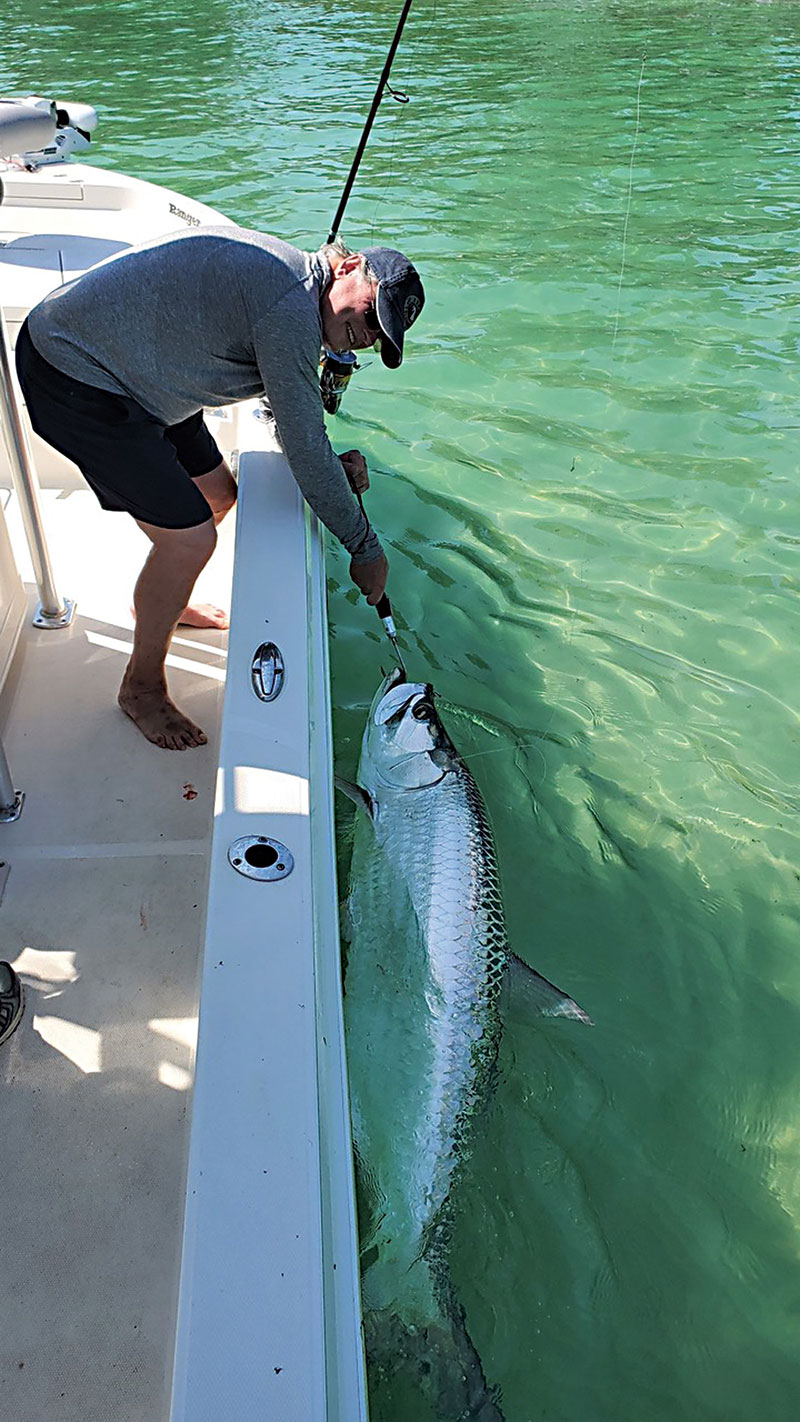
Holding the leader in one hand, you reach into its mouth with the other. You grab onto that bony lower jaw tightly and keep the fish steady. A quick twist of the pliers and the large circle hook comes unbuttoned from the oversized jaw.
As you hold the fish, you make eye contact. That big eye stares back at you, and it’s as if the fish is examining you as much as you are it. It is a profound moment. Something is going on behind that eye.
At this point, there’s time for a quick trophy photo before making sure the fish is revived for release. Slowly, slowly moving the boat forward and holding the fish aids in flushing water through its gills.
A few moments more, the fish shakes its head and it’s ready to be released.
Drenched in sweat with arms shaking from fatigue, you watch the fish slowly swim back to the depths.
A memory is etched. You matched wits and strength with the silver king and you came out on top.
Yes, it’s that good.
When will you go hunting?
Capt. David White says fishing in the Gulf of Mexico is “off the chain” right now. Limits of yellowtail and mangrove snapper are being caught daily, as well as numerous red grouper.
Blackfin tuna and cobia are making their presence known while fishing around offshore wrecks.
Moving inshore, he’s finding catch-and-release snook fishing is going strong. Those anglers wishing to catch something they can eat, mangrove snapper are being found around structure in Tampa Bay — within a few miles of shore— in the Gulf of Mexico.
Lastly, the highlight of the inshore bite for White is tarpon. He’s seeing kings 80-120 pounds.
Capt. Warren Girle is targeting tarpon along the beaches of Anna Maria Island and Longboat Key. Casting live threadfin herring to schooling fish is resulting in hookups with these legendary fish. Fishing outgoing tides in the passes of Bean Point and Egmont Key is producing action. For this bite, live pass crabs are the ticket, according to Girle.
On the flats, Girle is finding action on catch-and-release snook. Casting live shiners around mangrove shorelines is working well. Fishing deep grass flats in Sarasota Bay is producing action, especially for spotted seatrout. Mixed in with the trout are Spanish mackerel, bluefish and ladyfish.
Capt. Aaron Lowman also is targeting tarpon around the Gulf beaches and in the passes around Egmont Key and Bean Point. Casting live threadfin hearing or live crabs to rolling fish is resulting in hookups. Early morning tides and late evening tides are producing the best action.
Lowman is working the flats in Sarasota and Tampa bays for catch-and-release snook, redfish and trout. All three species are being caught with some regularity —especially the trout. Swift-moving tides are working best when targeting these inshore species.
Jim Malfese at the Rod & Reel Pier says he’s seeing various species being caught by pier fishers using live shrimp as bait. Anglers are finding mangrove snapper, as well as a few black drum and catch-and-release redfish. Pier fishers using pinfish as bait are hooking into some slot-size catch-and-release snook, as well as some under-slot fish.
Casting jigs or silver spoons is resulting in Spanish mackerel and Jack crevalle hookups.
Capt. Jason Stock is finding plenty of action while working offshore in the Gulf of Mexico. Blackfin tuna and cobia are being found over offshore wrecks and live baits —such as shiners — are working well for both species.
Bottom fishing also is producing action offshore. Mangrove and yellowtail snapper are the most consistent, with some hefty red grouper and African pompano in the mix.
On days when he’s not offshore fishing, you can bet that Stock is chasing tarpon along the Gulf beaches. He says casting live threadfin herring is attracting the most attention from the silver kings.
Remember, new regulations for the inshore trio — snook, redfish and trout — started June 1. For Tampa Bay and any waters north of Manatee Avenue, normal regulations will resume for snook and redfish. For the spotted seatrout: The daily bag limit is three trout per person and the slot is 15-19 inches.
For waters south of State Road 64/Manatee Avenue, snook and redfish will remain closed to harvest through May 31, 2022. If you catch fish north of Manatee Avenue and transport them south, you violate these new regulations. Spotted seatrout harvest will resume with a six fish recreational vessel limit. These fish must fall 15-19 inches. Captain and crew are not included in the bag limit.
Send photos and reports to fish@islander.org.