






Don’t feed the algae.
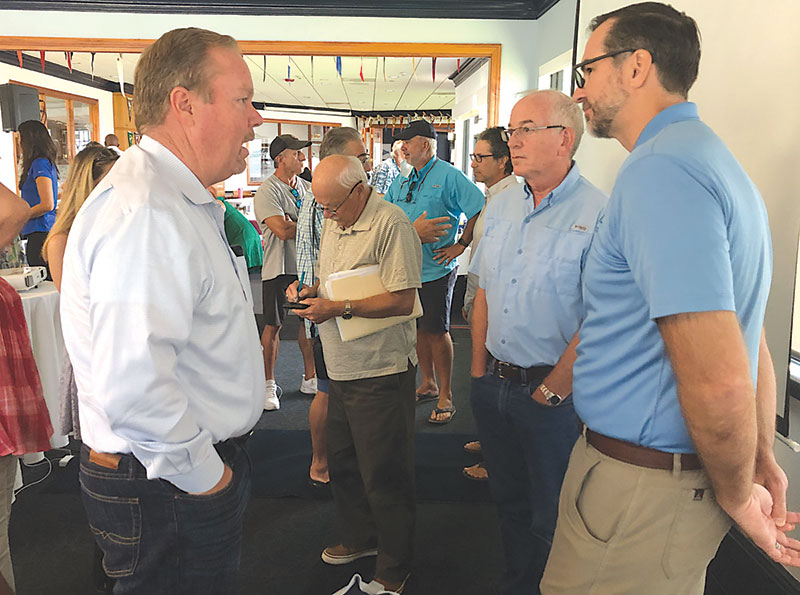
More than 100 people filled the Bradenton Yacht Club dining room in Palmetto July 23 to participate in a scientific forum on the algal blooms plaguing local waters.
The event was coordinated by Suncoast Waterkeeper and Tampa Bay Waterkeeper, and notable attendees included Bradenton Mayor Gene Brown, Manatee County administrator Dr. Scott Hopes and six Manatee County commissioners.
Suncoast Waterkeeper chair Joe McClash opened the gathering by stating the forum’s purpose: To inform the public about what can be done to mitigate annual algal blooms that kill wildlife and devastate local economies.
Ed Sherwood and Dr. David Tomasko, executive directors of the Tampa Bay Estuary Program and the Sarasota Bay Estuary Program, endeavored to answer the question in back-to-back scientific presentations.
Sherwood described the causes of the current algal blooms, notably the April discharge of more than 200 million gallons of nutrient-rich water into Tampa Bay from Piney Point.
“Over an entire year, we expect about 200 tons of nitrogen going into lower Tampa Bay. The bay got that same amount in about a 9-10 day period as a result of the emergency discharges,” Sherwood said.
He likened the ammonium-rich water to “liquid fertilizer,” and said that — coupled with increased water salinity, a lack of spring rain and high temperatures — the discharge led to the most intense concentrations of algae in middle and lower Tampa Bay since the early 1970s.
Sherwood said we cannot let the phosphate storage stack closures linger.
Closing Piney Point in an ecologically safe manner before the emergency discharge would have cost taxpayers $10 million-20 million — $80 million-180 million less than the current price tag, he said.
Those resources could have been directed toward algal bloom mitigation projects, especially in areas where seagrass — which provides food and shelter for marine life, as well as filters the water — has become sparse, he added.
In the long term, “there’s not one solution to fix our problems; there’s really a host of investments that are needed,” Sherwood advised.
Those investments hinge on reducing nutrient flow into the waterways.
On the individual level, people should be conscious of their ecological footprint and how they manage their yards, he said.
On the community level, investments should be made in shoring up aging infrastructure and establishing the most ecologically friendly methods of managing and treating wastewater and stormwater.
Tomasko described the plight of manatees in the Indian River Lagoon, on Florida’s east coast, where algal blooms have led to significant seagrass losses.
According to Tomasko, in the first six
months of 2021, 800 manatees died statewide but most deaths occurred in the Indian River Lagoon, where a lack of seagrass — food for manatees — led to starvation.
“What we’re going to talk about in Sarasota and Tampa Bay is really important because we do not want our systems to look like the Indian River Lagoon,” Tomasko said. “And it happened quickly in that system, and that may not be recoverable.”
The most efficient way for local officials to prevent a reduction in water quality is to focus on nutrient management regulation compliance, he said.
“It makes no sense to spend dollars on public outreach, stormwater retrofits and people putting oysters in the Bay if, two miles down the road, someone’s not abiding by their permit for their wastewater treatment plant,” he said.
According to Tomasko, wastewater treatment improvements led to a 57% nitrogen load reduction in Tampa Bay from the 1970s to the 1990s, and Manatee County achieved a 50% reduction from about 2016-20.
Less fuel for algal growth is the key to a healthier bay and seagrass recovery, he said.
“Our bays are not in great shape right now, but we’re still healthier than we were in the 1970s and 1980s,” he said. “Look at the recovery we brought about back then — we just have to do it again.”