





With a blast of cooler weather, fishing might have its ups and downs.
Cooler water temps and rough seas alter fishing patterns but, as good fishers know, you only need to adapt to the conditions to find success on the water.
For the most part, catching live shiners for bait is a cinch. You may not find shiners where you’ve been catching them but they’re around.
You also may find the fish you’re targeting are changing locations. But patience and use of the old noggin’ should lead you to the fish.
For example, you’re probably not going to find many snook on shallow flats when a front comes through and chills the water. So you might try fishing the deeper areas — near the flats they normally inhabit. The snook probably didn’t go far, needing only to find a slightly more consistent water temp.
And after the front is gone, when the flats heat up, you should see the snook back on the shallows.
With the cooler water temps in November, we also should start seeing kingfish, mackerel, bonito and sharks along the beach. These are popular bites in the fall, providing nonstop action and enabling anglers to catch fairly large fish while not venturing more than a couple of miles offshore in the Gulf of Mexico.
The bites are definitely for anglers who enjoy the thrill of fighting big fish when there is potential for that fish to get eaten by an even bigger fish.
Typically, this occurs while reeling in macks and bonito. The fighting fish send distress signals intercepted by blacktip and spinner sharks. Then it becomes a race to see if you can land your fish before it gets devoured by a shark.
And, if you’re a glutton for punishment, you can cast a chunk of bonito on a shark rig and hook into the sharks.
So with the cold fronts comes the good and the bad. Some fishing will be more challenging, while other methods of fishing will come easy. Just be flexible and follow the bite.
On my Just Reel fishing charters, I’m seeing plenty of action on the flats for snook, reds and trout.
The spotted seatrout are the most abundant catch, although some days I’m seeing just as many snook being reeled up.
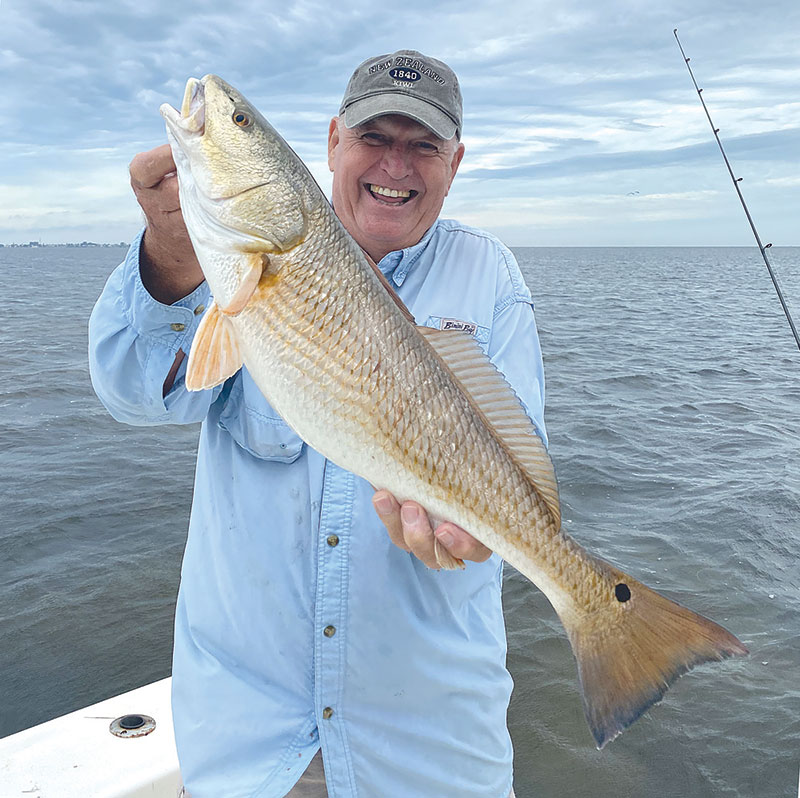
The redfish are around some days and not others. Most redfish catches are over the maximum size limit of 27 inches.
While fishing deeper grass flats, I’m seeing an increasing frequency of Spanish mackerel and ladyfish — both provide good action on light spinning gear.
Capt. David White is spending most days inshore due to strong winds and choppy water in the Gulf. Targeting snook and redfish on the flats of Tampa Bay is producing good action for White’s anglers. Free-lining live shiners along mangrove shorelines is proving to be productive when targeting snook and reds. And an occasional spotted seatrout is coming to the boat.
Along coastal shorelines where good total tidal flow exists, White is targeting black drum and sheepshead — both are responding to live shrimp as bait.
Capt. Jason Stock is venturing offshore in search of American red snapper when the seas are calm and the winds are light. In depths of 100 feet or more, Stock is finding plenty of action on the sought-after snappers and some weigh up to 22 pounds — that’s a big snapper.
Other catches while offshore include mangrove and yellowtail snapper, as well as gag grouper.
In the immediate future, Stock anticipates the blackfin tuna and kingfish bite to really turn on. A slight drop in the water temp should get these fish on the move.
Jim Malfese at the Rod & Reel Pier says pier fishers using live shrimp as bait are catching a variety of species.
Casting live shrimp under the pier on a bottom rig is resulting in numerous redfish and black drum.
Most reds being caught are falling in the slot of 18-27 inches, although there are some larger ones in the mix.
Malfese suggests using stout gear when targeting these fish, as you never know when you’re going to hook into a monster.
The black drum are following suit, most catches are between the slot of 14 inches and 24 inches.
Anglers using lighter tackle are opting to free-line their shrimp under the pier, which is working quite well for mangrove snapper.
Snapper 10-14 inches are the norm, so lighter tackle is efficient at reeling these fish up to the deck.
Although this method is working well for the snapper, there is one downfall. Snook also like eating the free-lined shrimp and when a large snook is on the end of your line, a light-spinning setup is futile — especially around the barnacle-encrusted pier pilings.
Send high-resolution photos and fishing reports to fish@islander.org.