






They’re still playing for a draw.
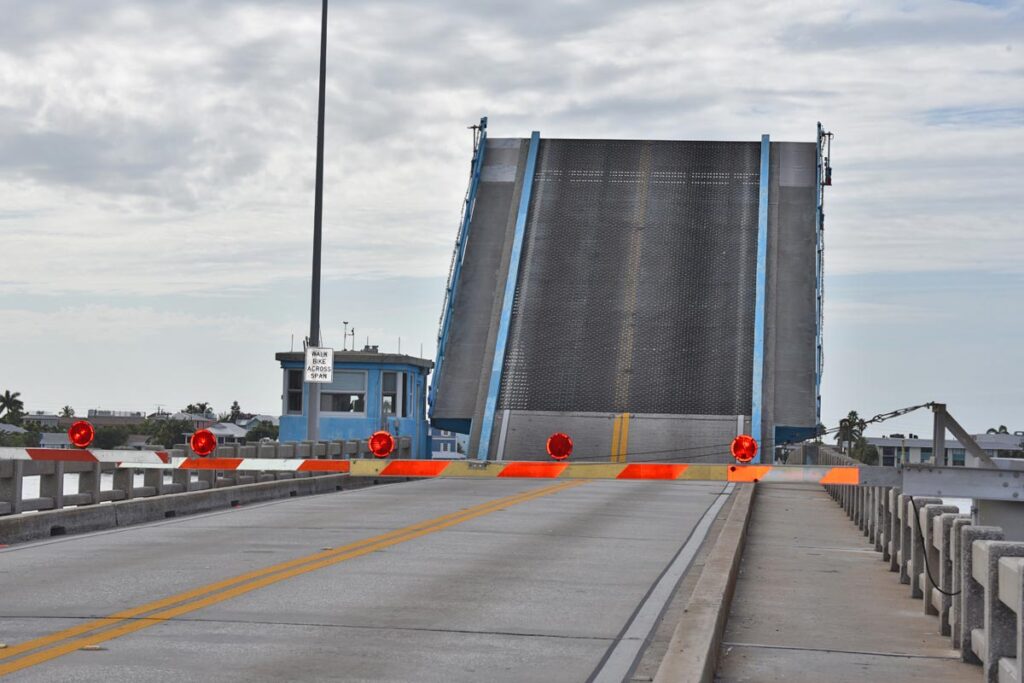
Four complainants challenging in federal court the DOT’s decision to replace the 17-foot-clearance Cortez drawbridge with a 65-foot-clearance fixed-span bridge in 2026-27 filed a motion for summary judgment Dec. 1, ushering in the final phase of a lawsuit that began in March 2020.
The complainants — former County Commissioner Joe McClash and Cortez resident Jane von Hahmann, also a former county commissioner, and Cortez residents Linda Molto and Joe Kane — maintain the retaining walls that carry the tall bridge onto Cortez Road — 20-feet tall at their peak — would destroy the character of Cortez, a historic fishing village at the bridge’s eastern terminus, and advocate instead the construction of a 35-foot drawbridge.
In 2019, the agency selected the 65-foot bridge over a mid-level drawbridge replacement and existing drawbridge maintenance alternatives.
The 17-page motion — one of the last filings U.S. Magistrate Judge Anthony E. Porcelli will review before deciding the case — outlines the plaintiffs’ argument that during the bridge alternative selection process, the DOT violated the National Environmental Protection Act by “arbitrarily and capriciously” utilizing an inapplicable categorical exclusion to bypass the agency’s obligation to perform studies on the environmental impacts of a high bridge.
According to the Code of Federal Regulations, “categorical exclusions are actions that, based on the Federal Highway Administration’s past experience with similar actions, do not involve significant environmental impacts.”
They are actions that do not have a significant impact on any natural, cultural, recreational, historic or other resource and do not involve significant air, noise or water-quality impacts.
Within the motion, the plaintiffs contend the administrative record — a collection of documents detailing how the DOT came to its decision to build the high bridge — “reflects the failure of defendants to demonstrate that the bridge replacement project qualifies for a categorical exemption.”
According to the plaintiffs, the DOT failed to:
- Demonstrate that the proposed project does not have a significant impact on a floodplain, which the plaintiffs maintain is a natural resource that has water-quality impact;
- Demonstrate past experience with similar projects, per the definition of a categorical exclusion;
- Demonstrate that the project does not have a significant impact on cultural and historic resources;
- Demonstrate that the project does not have a significant impact on noise levels.
The eastern abutment of the high bridge and the structure’s 20-foot-tall retaining walls would be constructed in a coastal flood zone where wave action — storm surge bouncing off solid structure — is a hazard.
The plaintiffs argue the DOT violated the Code of Federal Regulations by failing to conduct a study on the impacts the high bridge would have on the floodplain and maintain the agency was only allowed to select a bridge alternative that impacted the floodplain if it was the “only practicable alternative.”
According to the plaintiffs, documentation of the DOT’s experience with similar projects that did not involve significant environmental impacts is not included in the administrative record.
At its eastern terminus, the high bridge’s walls would extend inland about 700 feet, dividing Cortez east to west along Cortez Road.
The southern half of the 130-year-old fishing village has been listed on the National Register of Historic Places since 1995.
The plaintiffs maintain there has been vocal opposition to the construction of the high bridge from the Cortez community and that “the local preference is for a low-level drawbridge.”
According to the motion, the DOT predicted 41 residences near the high bridge would experience traffic noise levels around 66 decibels, the noise abatement threshold for residential areas and, when the DOT conducted the studies, the agency included a noise wall that has not been represented in schematics presented to the public.
With the construction of a high bridge, traffic noise levels are expected to increase as high as 4.2 decibels compared to current conditions, the document states.
Attorney Ralf Brookes, representing the anti-megabridge group, told The Islander via text message Dec. 9 that he expects the DOT to file a response and cross motion for summary judgment by Jan. 10.
Thereafter, the parties can file shorter reply briefs within a week of receiving the opposing party’s responses in opposition.
“We are hopeful that our motion will be granted. If we win our motion for summary judgment, the case will essentially be over in the federal district court,” Brookes said.
The Cortez Bridge project is in the design phase. The megabridge design, a $6.7 million undertaking, began Oct. 2019 and is expected to conclude in the spring of 2025.