






DOT: You won’t even notice it.
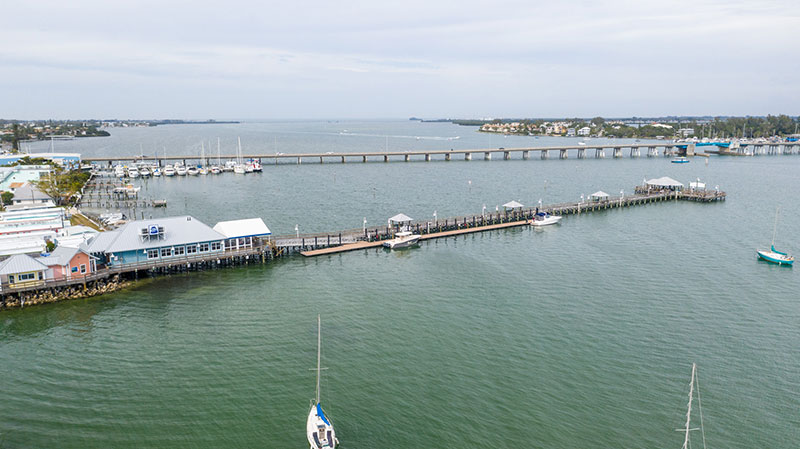
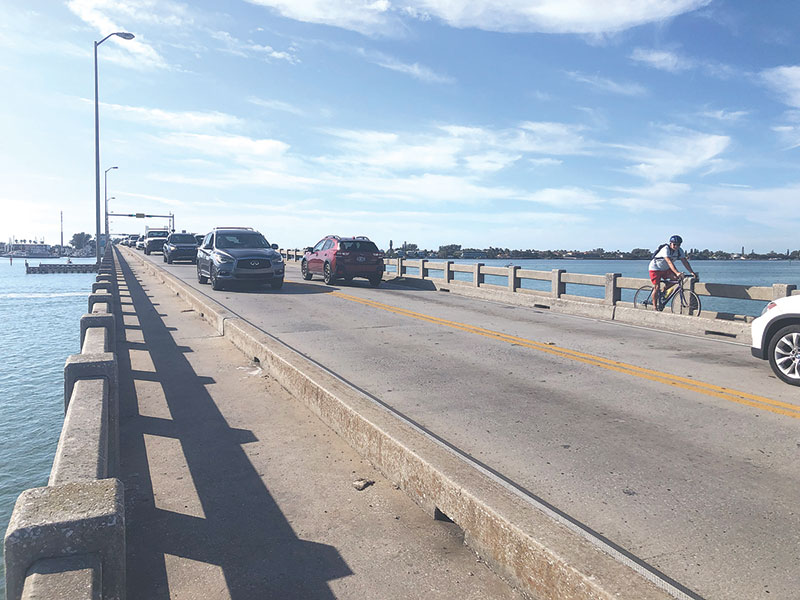
The Florida Department of Transportation responded to a Dec. 1, 2021, motion for summary judgment filed in federal court by four complainants challenging the agency’s decision to replace the 17-foot-clearance Cortez Bridge with a 65-foot-clearance fixed-span bridge in 2026-27.
The DOT opted to replace the 65-year-old drawbridge with a megabridge in 2019.
The complainants, who advocate compromise with the construction of a 35-foot drawbridge replacement, maintain the megabridge would destroy the character of Cortez, a fishing village at the bridge’s eastern terminus. They filed their challenge in March 2020.
On Jan. 10, Tallahassee attorney George Reynolds filed a combined cross-motion for summary judgment and response brief on behalf of the agency that refutes the complainants’ argument that the DOT violated the National Environmental Protection Act during its bridge selection process.
According to the Code of Federal Regulations, a federal agency — or a state agency acting on behalf of a federal agency — can categorically exclude projects from more extensive environmental impact studies required under NEPA if the agency can demonstrate through a preliminary analysis that the undertaking will not have significant environmental impacts.
The complainants assert the administrative record — a collection of documents detailing how the DOT came to its decision to build the high bridge — fails to demonstrate how the proposed project would not have a significant impact on a floodplain, a cultural and historic resource — namely the historic fishing village of Cortez — and noise levels.
At its eastern terminus, the new bridge — spanning the Intracoastal Waterway and linking Bradenton Beach on the island to Cortez on the mainland — would feature retaining walls that peak at 20 feet on land, extending into Cortez about 700 feet along Cortez Road.
While the complainants maintain the DOT failed to perform a study on the high bridge’s impact on a floodplain and raised concerns about wave action off the structure’s walls, which would be built near residences, the agency asserts the bridge would not have a significant impact on a floodplain because:
- The bridge would be built in approximately the same alignment as the existing bridge;
- It would feature high-performance drainage systems;
- It would be designed in accordance with federal and state agency guidelines that prevent significant changes in base flood elevations.
Currently, motorists and pedestrians can cross Cortez Road from 127th Street West to Central Avenue on the mainland. The high bridge’s walls would limit crossings in that stretch to an access road that would stem off Cortez Road to the north near 125th Street West and loop back beneath the bridge along 127th Street West.
According to the complainants, the bridge’s walls would divide Cortez along Cortez Road and negatively impact the character of the fishing village, bounded by Cortez Road to the north, 124th Street Court West to the west, Sarasota Bay to the south and 119th Street West to the east.
The village was designated a U.S. historic district in 1995.
The DOT maintains the bridge would not have a significant impact on the historic district because:
- The bridge’s walls, which would end before 125th Street West, would not extend as far as the border of the historic district;
- The bridge would not be visible from the historic district except at its northern edge along Cortez Road;
- The bridge would not create a perceptible increase in traffic noise in the district, nor would it alter automobile access to the area.
According to the motion, the agency provided three written analyses of the structure’s impacts on the district to the Federal Highway Administration and the Florida State Historic Preservation Office, both of which signed off on the reports.
During the bridge selection process, 70% of 1,229 respondents to DOT surveys expressed support for rehabilitating the existing drawbridge or building a 35-foot drawbridge, which would not require the construction of inland retaining walls.
However, the DOT maintains there is no “heckler’s veto” under NEPA.
“The number of public survey responses favoring a different alternative from the Preferred Alternative does not render its impacts ‘highly controversial’ or require further (environmental studies),” the motion reads.
The agency asserts the bridge would not have a significant impact on community aesthetics because the department would dedicate a portion of its budget to landscaping around the structure and has worked with an 11-member aesthetics committee to select the bridge’s ornamental features.
The department also maintains the high bridge will “enhance community cohesion between the north and south sides of the Cortez community by providing a new roadway, sidewalk, and walkable public space along the waterfront under the new bridge at 127th Street West.”
While the complainants maintain the DOT failed to demonstrate that the high bridge would not significantly increase noise levels in the area, the agency asserts it conducted a thorough noise evaluation and is committed to further noise abatement measures during the bridge’s design phase.
Other arguments in the motion include the assertion that a ruling in the complainants’ favor only would remand the decision to build the high bridge back to the DOT for further analysis and that the complainants — former County Commissioner Joe McClash, former County Commissioner and Cortez resident Jane von Hahmann and Cortez residents Linda Molto and Joe Kane — have failed to establish standing because they cannot demonstrate that they’ve suffered a specific “injury in fact” tied to the DOT’s actions.
On Jan. 18, U.S. Magistrate Judge Anthony E. Porcelli granted a motion allowing the complainants an additional four days to file a response brief.
What is NEPA?
Enacted in 1970, the National Environmental Policy Act requires federal agencies to consider the environmental impacts of their proposed actions prior to carrying them out.
Under NEPA, agencies are required to evaluate the environmental, social and economic effects of their undertakings, including the construction of highways and other publicly-owned facilities.
The legislation aims to protect the natural and human environment, including sites listed on the National Register of Historic Places.