





There are pockets of resistance in Cortez.
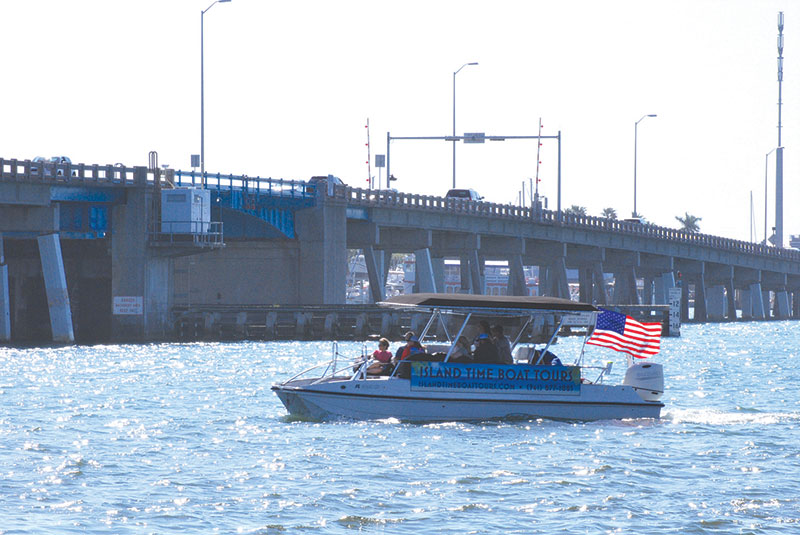
On July 22, 2021, the Florida Institute for Saltwater Heritage — a nonprofit dedicated to preserving Cortez’s commercial fishing legacy — created the “Stop the Mega Bridge from Devastating Cortez” Gofundme page, a fundraiser for legal fees incurred by four complainants challenging in federal court the Florida Department of Transportation’s decision to replace the 17-foot-clearance Cortez drawbridge with a 65-foot-clearance fixed-span bridge.
The bridge is set for replacement in 2026-27.
As of March 17, 130 people and organizations had donated to the initiative, raising $13,575 of FISH’s $25,000 goal.
According to Matthew Farmer, an attorney for the anti-megabridge coalition, there is no deadline for a ruling in the case.
However, neither side has made a filing since March 3. If both parties have concluded their written arguments, U.S. Magistrate Judge Anthony E. Porcelli will begin crafting a decision.
If Porcelli rules in favor of the complainants — former County Commissioner Joe McClash, former County Commissioner and Cortez resident Jane von Hahmann, Cortez resident Linda Molto and Joe Kane — the DOT will be forced to conduct environmental impact studies on the high bridge and any other replacement alternatives, analyses the complainants maintain the department should have carried out in accordance with the National Environmental Protection Act during its replacement selection process.
In 2019, the DOT concluded a study of bridge replacement alternatives and selected the high bridge without conducting a more extensive analysis of the alternative’s environmental impacts by utilizing a categorical exclusion under NEPA.
Top Gofundme donor Clint Burgess, a six-year Bradenton resident who purchased a home in Cortez more than a year ago, said March 16 he donated $1,000 in September 2020 to help the anti-megabridge coalition achieve its goal of influencing the DOT to build a mid-level drawbridge.
Burgess, who maintains the high bridge would change the character of Cortez, said the larger structure would provide no value to the area.
“It’s basically an aerial parking lot. Because you’re still not changing the infrastructure on the beaches. There’s not enough parking as it is now, so where are all these people going to go?” Burgess said.
However, while he hopes Porcelli will force the DOT to do its due diligence, he still sees a high bridge in Cortez’s future regardless of the lawsuit’s outcome.
“I don’t think there’s any stopping it at this point,” Burgess said. “I would like for it to go back to review, but I don’t think there’s any stopping the large bridge, so we might as well get it under construction.”
Throughout the suit, DOT attorney George Reynolds has argued the complainants do not have standing because they seek a substantive remedy — a ruling that would force the DOT to build their preferred alternative, a mid-level drawbridge — when only a procedural remedy — a ruling that would compel the DOT to conduct environmental impact studies on the high bridge — is attainable under NEPA.
The department maintains studies are likely to demonstrate the high bridge has no significant environmental impacts, meaning a ruling in favor of the complainants might only delay the construction of the megabridge and, therefore, isn’t likely to prevent the injuries the complainants seek to avoid.
“They’re almost telling the judge, ‘You can send it back to us, but we’re just going to do the same thing,’ and that would be a knowing violation of NEPA,” Ralf Brookes, another attorney for the complainants, said March 16.
Brookes said his clients do, in fact, seek a procedural remedy and the DOT is mischaracterizing the argument.
“Sometimes what you see, when the agency has a weak case, they’ll characterize your case as something else to try to make their case stronger,” Brookes said. “But I think we have a very strong case that they should have done the environmental analyses. And when I say environment, that also means the human environment, which would include the historical, commercial fishing village of Cortez.”
Wayne and Fran Derr, 38-year Holmes Beach residents, said March 15 they were compelled to donate $500 to FISH’s Gofundme in September 2020 to prevent the high bridge from impacting the Cortez businesses they have frequented for decades.
“The mid-rise bridge, although it’s more expensive than the high-rise, makes more sense as far as the merchants in Cortez go, because it’s probably going to have less impact on their traffic and people’s ability to get to their business,” Wayne Derr said.
While the mid-level bridge would not require retaining walls, the megabridge would feature inland walls that peak at 20 feet near Cortez businesses on the Intracoastal Waterway — including Tide Tables Restaurant, Annie’s Bait Shop and the Seafood Shack — and extend eastward into the community 700 feet along Cortez Road.
If the megabridge is built, motorists seeking to access the businesses will need to travel along a road stemming north off Cortez Road near 125th Street West that loops back beneath the bridge along 127th Street West.
The high walls also will impact Cortez Park, a mobile home community adjacent to the Intracoastal Waterway on Cortez Road’s southern border, where Tide Tables Restaurant sits.
The barriers will block two access points to the park along Cortez Road — Avenue A and Central Avenue — and likely will deprive the community of RV parking spaces it leases along the thoroughfare.
The community donated $1,000 to FISH’s Gofundme in August 2021 and several residents have made individual contributions.
Julie and Jim Smoragiewicz, South Dakota residents who purchased a cottage in the park at the corner of Cortez Road and 125th Street West in June 2021, donated $250 in August 2021.
The Smoragiewicz, nature-lovers who operate a yak farm in South Dakota’s Black Hills, said March 16 that while the economic impacts a high bridge would have on the park and community of Cortez played a role in their decision to donate, the natural consequences of such a large structure were a more important factor.
“From what we’ve read or been told, it’s not clear that the state has really done all the research it probably should in terms of determining environmental impacts,” Julie Smoragiewicz said. “Obviously, any kind of coastal environment is at risk. And there have been plenty of other issues that have impacted the community, from phosphates to red tide.”
Another important factor for the couple was the high bridge’s impact on the human environment, namely pedestrians’ ability to travel over the Intracoastal Waterway between Cortez on the mainland and Bradenton Beach on the island.
“In the time we’ve been here, we see lots and lots of people who either walk or bike, get pulled in a wagon, whatever, across the bridge,” Julie Smoragiewicz said. “And I can’t say that I’ve done the math on it, but even with the prospect of the bridge extending to 125th, I can’t imagine that the new incline is going to be nearly as pedestrian or bike-friendly as it is now.”
“And so I think that maybe the (DOT’s) goal is to reduce traffic congestion and things like that,” she said. “But, I think maybe an unintended consequence will be that there will be more vehicles on the island because there will be fewer people who are in a position to pull their kids in a wagon, or ride their bike or walk across the bridge because of the incline.”
“It won’t be as comfortable, you know, for anybody, even regular walkers, probably. And for a certain segment, it will be downright impossible,” she said.
To contribute to FISH’s anti-megabridge fund, visit gofundme.com/f/stop-the-mega-bridge-from-devastating-cortez.