




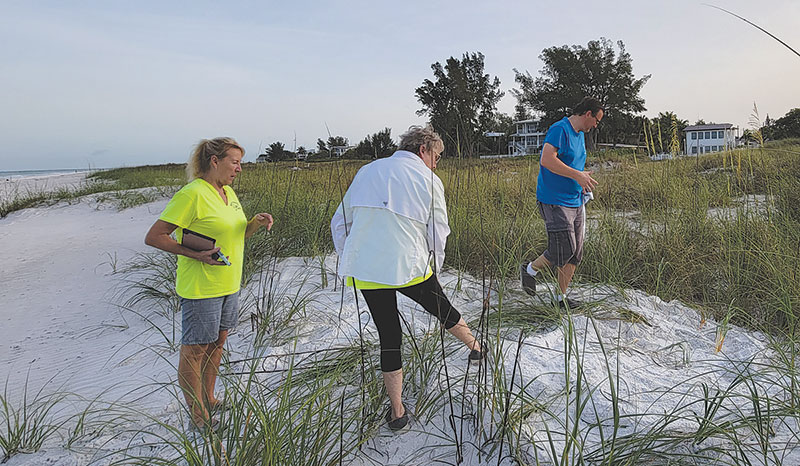
Imagine a hole 4-feet deep on the beach.
No need for AMITW volunteers to imagine.
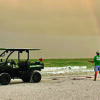
They found just such a sandy pit May 23 near 97 Oak Ave., Anna Maria.
And they know such holes threaten wildlife, especially nesting and hatchling sea turtles.
With nesting active, AMITW’s volunteers say it is important for people to assist by filling in holes.
Nesting sea turtles can fall into a hole and become trapped on their way to lay their clutch of eggs or on their way back to the Gulf of Mexico.
In fact, in June 2020, AMITW volunteer Skip Coyne and a beachgoer created a ramp of sand to enable a trapped female loggerhead to escape a hole.
A loggerhead can weigh 275 pounds and reach 3 feet in length, according to myfwc.com. So creating a ramp was the best option.
When a clutch of sea turtles hatch, they dig their way out of a hole 18-22 inches deep, but they do so as a group, crawling across the eggs and one another.
A single hatchling has the odds stacked against it if it must get out of a deep hole on its own.
This can be why AMITW volunteers sometimes find a hatchling in its nest in the days after a hatch.
In addition to the discovery of the hole May 23, AMITW volunteers staked off 12 nests and identified five false crawls that day.
Some false crawls led to the dunes, quite a distance for a female loggerhead to travel and not lay eggs.
A question is why.
One possible answer is human activity. At a false crawl near the 100 block of 73rd Street in Holmes Beach, volunteers found sets of human footprints.
With the turtle’s tracks obscured by human activity, AMITW volunteer Hans Duerr had to probe a large area of sand to determine if there was a nest.
So, if beachgoers see tracks, it is best to stay away until the volunteers perform their duties.
This allows for proper reporting in the FWC turtle nesting application used by the state to track sea turtle distribution, seasonality and abundance of nests, according to myfwc.com.
In other news, the Mote Marine Laboratory and Aquarium Sea Turtle Rehabilitation Hospital in Sarasota purchased a surgical laser to remove tumors that develop due to fibropapillomatosis.
Since August 2021, a surgical laser has been used to treat seven turtles through 10 surgeries at Mote.
“Tumor removal is essential in treating pap turtles and hopefully leading to their release,” Gretchen Lovewell, program manager of stranding investigations at Mote, said in a news release. “This laser will serve the hospital for years to come.”
Sales of sea turtle license plates provided a portion of the funds needed for the new equipment.
Mote was using a model from 2007 and needed an updated laser.
For more information, visit mote.org.