





Going for an all-American celebration and heading to the beach over the Fourth of July weekend?
Manatee County Beach Patrol Chief Joe Westerman wants people to stay safe on land and in the sea.
He and a team of water rescue professionals are preparing for an increase in visitors for the holiday weekend.
“We have had some rip currents,” Westerman said June 14. “We have had some water rescues, roughly 20-25 in the past few months.”
According to Westerman, the county sees 90-130 rip current rescues in a typical year.
Rip currents are powerful, narrow channels of fast-moving water. They form when waves break near the shore, piling up water between breaking waves and the beach.
Moving at speeds of up to 8 feet per second, rip currents can move faster than an Olympic swimmer, according to weather.gov.
“Our rescues are really based on weather conditions. We don’t typically have waves unless we have some kind of a storm come through,” he said. “In the summer months, if we have some more westerly winds that push those swells in, that’s what generates rip current conditions.”
When caught in a rip current, a swimmer might panic and try to swim to shore, putting themselves at risk of drowning because of fatigue.
If a swimmer is caught in a rip current, they should stay calm. A rip current won’t pull a person under; it will pull them away from shore.
So swimmers should float and wave and yell to get the attention of people on shore.
A good swimmer could swim parallel to shore until they’ve cleared the pull of the rip current. They should swim with the waves, allowing them to push them to shore.
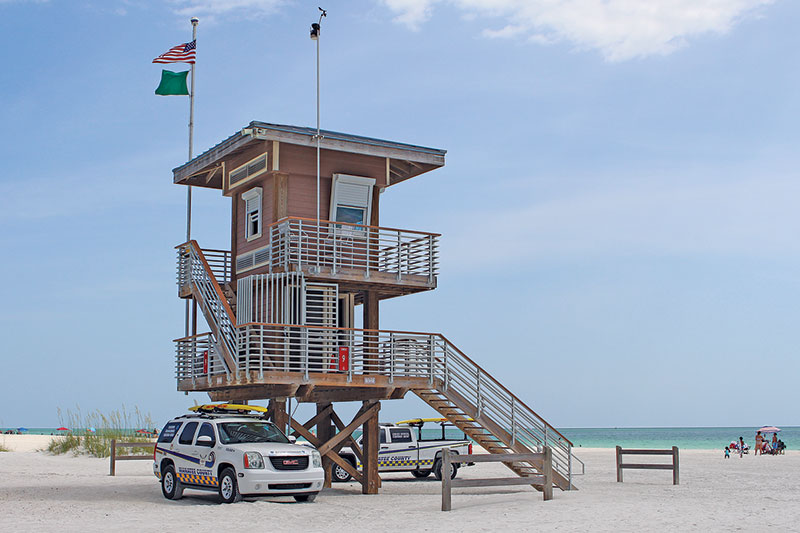
For swimming and other conditions, beachgoers should become familiar with the warning flags that fly from the lifeguard towers at the county beaches.
“Our flags are ultimately like a stop sign,” Westerman said. “Green means the conditions are good, low level and low risk. Yellow means there’s caution, a slight risk. Red is ultimately a stop. If you’re not a strong swimmer you may want to re-think going out into the water. A double red means that we’ve closed the water because it’s just too dangerous. We also have a purple flag that we use if we are seeing stinging sea life. Jellyfish, sea nettles, stingrays, anything that stings in the water warrants a purple flag.”
Westerman had additional guidance for beachgoers.
For one thing, parking is first-come, first-served.
“Like an amusement park, we sometimes meet capacity and there’s no more space for anyone to enjoy,” he said.
“Plan ahead, plan for that weekend because it will be busy and come out with safety in mind,” he continued.
And then there are beach rules:
- No alcohol, or glass containers;
- No pets;
- No drones or other remotely operated vehicles or toys;
- No campfires. Grilling is allowed in locations where grills are provided;
- No fireworks;
- No disturbing wildlife or destruction of habitat by walking on dunes;
- No golf carts, ATVs, bicycles or other vehicles.
The beach patrol is five short of its usual 21-member staff but Westerman said the public beaches would be fully covered for the holiday, when crowds are expected to reach or exceed Memorial Day crowds.
“Moving forward into the July Fourth weekend, we are anticipating the same amount of crowd levels to come to our gorgeous beaches,” Westerman said.