







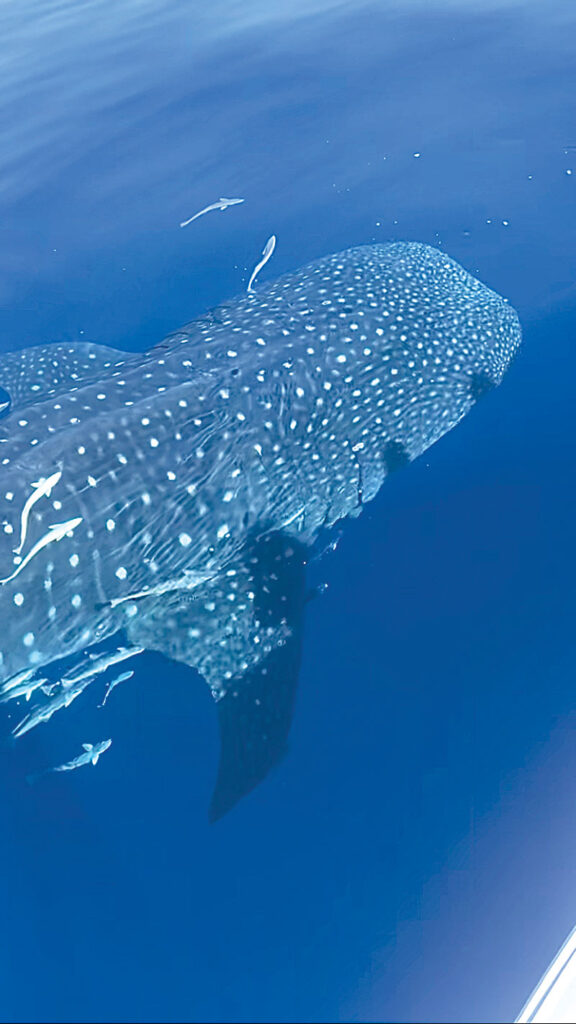
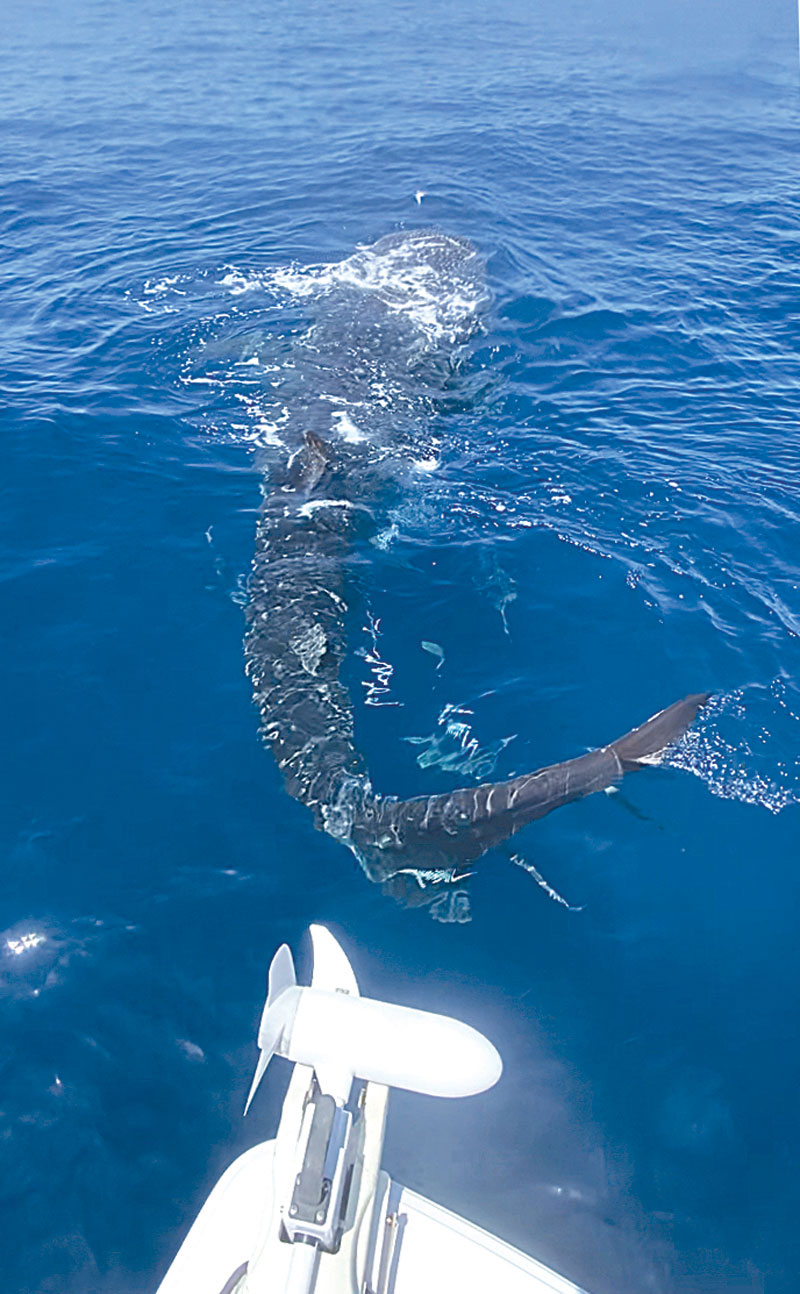
Capt. David White is a whale shark magnet.

Capt. David White shows off an American red snapper he caught July 9 in 170 feet of water on a live pinfish.
The fishing guide has encountered about 20 of the filter-feeding giants in the past seven years.
On June 7, White and five anglers encountered a school of four whale sharks in the Gulf of Mexico about 45 miles west of Anna Maria’s Bean Point.
“It was so cool,” White, operator of Anna Maria Charters, said July 12. “Definitely the coolest feeling that I had this year was when I was standing on the bow and one of them turned and came down the side of the boat and I cast a shadow on its eyeball.”
The giants, each about 30-feet long, spaced some 300 yards apart, were swimming with their mouths open near or slightly above the surface. They occasionally stopped to break water with the tops of their heads before opening and closing their jaws.
Dr. Bob Hueter, a senior scientist emeritus at Mote Marine Laboratory and Aquarium, said the sharks were likely dining on plankton, fish eggs or small fish in three ways:
- Subsurface “ram” feeding, in which the sharks gulp large quantities of water while remaining fully submerged;
- Surface ram feeding, whereby the fish swallow water with about 15% of their heads above the waterline;
- Suction feeding, whereby the fish stop swimming and surface vertically to engulf edible materials.
As the sharks gulp water from a stationary position, they also could have been stopping to swallow a mass of food collected through the ram feeding process, said Hueter, who studied the animals as director of the Center for Shark Research at Mote 2003-18.
In each process, whale sharks open their jaws to collect or draw prey-rich water into their mouths. The water is filtered through the gills while the prey is collected in “gill rakers” — comb-like filters that trap the food before it rolls to the back of the throat.
White is fortunate to have seen the creatures, especially four of them, Hueter said.
“Just to see them once in your lifetime is amazing and not something that happens every day,” he said. “It’s unusual to see more than one or two together up here, that’s fairly rare.”
People encounter Gulf-based whale sharks most frequently off Mexico’s Yucatan Peninsula, but the fish roam massive expanses of the ocean to pursue prey.
“They are plankton feeders, they’re filter feeders and, as such, they can’t just stay in one place,” said Hueter, who currently studies great white sharks as chief scientist for OCEARCH. “It takes them a long time to accumulate enough food to keep them going, so they have to swim, swim, swim their whole lives.”
If White is lucky to have seen so many of the small-toothed, gentle giants, over the past half-decade-plus, a group of his customers from Iowa sharing his good fortune.
In back-to-back years, 2021-22, White took them on May fishing trips where they encountered the spotted leviathans.
“I took them out, they’d never been out here really, and we saw a group of three whale sharks,” White said. “This is last year. And I’m like, ‘Man, you guys got lucky, you’re never going to see that again,’ and this year, they came out and saw three more whale sharks.”
The frequency of White’s sightings raises the question: Is he truly lucky or is the Gulf whale shark population growing larger?
In the past decade, there’s been a perceived uptick in whale shark sightings White and Hueter theorize is likely due to the advent of camera cellphones and social media but Hueter said the population appears healthy at the very least.
“I do think there’s evidence that the population in the Gulf of Mexico is doing pretty well,” Hueter said. “I’m not sure about increasing but I don’t think it’s been threatened as much as other places where the population is declining for various reasons.”
Whale sharks were added to endangered species lists in the early and mid-2000s.
In the Gulf, they face threats from ship strikes and pollution but, unlike other parts of the world, they are not fished.
As to White’s luck, the seven-year guide said he bolsters his whale shark fortune with vigilance.
He leads about 60 offshore charters a year — around 40 during whale shark “season” May-September — and is constantly tuned into the water for signs of aquatic life.
White’s latest encounter with the big fish was well-publicized and has led to numerous calls from potential customers seeking “whale shark tours.”
The Illinois native had to turn down a woman for a trip in May who hoped to treat her mom to a whale shark show as a Mother’s Day gift.
“I was tactful but, of course, realistic. I told them, ‘The odds of you seeing a whale shark tomorrow are extremely unlikely,” White said. “Especially because my wife will not let me fish on Mother’s Day.”