






Anna Maria’s budget process just rounded second base and is heading to third.
City commissioners voted unanimously July 28 to set a maximum millage rate of 2.05 for the 2022-23 fiscal year, which begins Oct. 1.
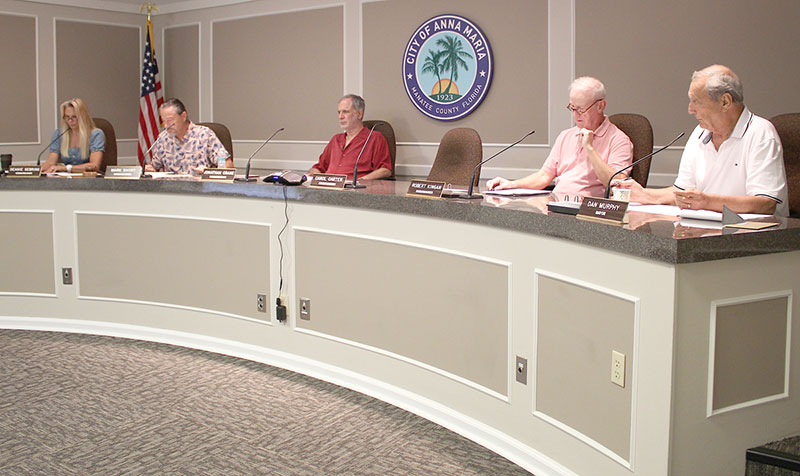
Commission Chair Carol Carter attended via Zoom and was authorized via unanimous vote to participate remotely.
The millage rate is the amount per $1,000 of property value used to calculate property taxes. The owner of a property appraised at $500,000 with a 2.05 millage rate would pay $1,025 in property taxes.
The rate is tax increase for property owners who have seen a $298,003,387 increase in total taxable property value in the city over the past year, according to the Manatee County property appraiser.
To avoid a tax increase, the city must adopt a rollback rate, which would net the same ad valorem income as the current budget.
City clerk and treasurer Leanne Addy said July 28 she had not yet determined the municipality’s rollback rate for 2022-23.
Mayor Dan Murphy said the increased property values, which he mostly attributed to non-homesteaded properties, would lead to a $600,000 “windfall” in ad valorem revenue if the city kept the 2.05 millage rate.
He recommended the commission use the rate as the maximum millage moving forward but, he noted, they could lower it at a future meeting.
Commissioners supported Murphy’s recommendation, including Mark Short, who expressed concern about inflation’s impact on capital expenditures and labor costs.
Commissioner Deanie Sebring moved to set 2.05 as the city’s maximum millage rate.
Commissioner Jonathan Crane seconded the motion, which passed.
Murphy also presented the city’s tentative 2022-23 operating expenses, which are projected to increase by $309,755.59, 7% more than the 2021-22 end-of-year estimate for the same expenses, to $4,853,410.11.
Murphy said two primary drivers in the increase are due to a 5% projected inflation rate on several expenses and a one-time 6% cost-of-living salary increase for city staff.
However, Murphy said the city’s projected operating costs made up about 43% of the projected revenue for next year, compared to 53% for this year, showing the city’s efficiency and leaving a larger chunk of change to make capital improvements and improve residential quality of life.
The city’s projected operating expenses for 2022-23 do not include salary increases for the mayor or city commissioners.
No motion was needed at the workshop to move the budget process forward.
There was no public comment.
The city will hold a third budget workshop on capital expenses at 1:30 p.m. Thursday, Aug. 11, at city hall, 5801 Marina Drive.
Then, a final budget and millage ordinance will go before commissioners for a first reading at 5:30 p.m. Thursday, Sept. 8.
A final hearing and vote will be at 5:30 p.m. Thursday, Sept. 22.
Directions to attend these meetings via Zoom can be found on the city’s website, cityofannamaria.com.
By the numbers…
2022-23 proposed budget
Operating expenses: $4,853,410.11
Administration costs: $948,735
Building department costs: $947,125
Code enforcement costs: $545,447.80
Commission costs: $81,880
Debt service costs: $192,344.04
Parks and recreation costs: $293,329.35
Public safety costs: $1,149,133.92
Public works costs: $695,415
Taxable property value: $1,744,219,939
2021-22 adopted budget
Operating expenses: $4,561,915.83
Administration costs: $899,127
Building department costs: $899,000
Code enforcement costs: $499,900
Commission costs: $81,000
Debt service costs: $192,344.24
Parks and recreation costs: $277,647
Public safety costs: $1,050,457.59
Public works costs: $662,440
Taxable property value: $1,446,216,552
First public hearing for the budget ordinance: 5:30 p.m. Thursday, Sept. 8.
Final budget hearing and vote: 5:30 p.m. Thursday, Sept. 22. — Ryan Paice