






Sea turtle nesting has slowed to a crawl.
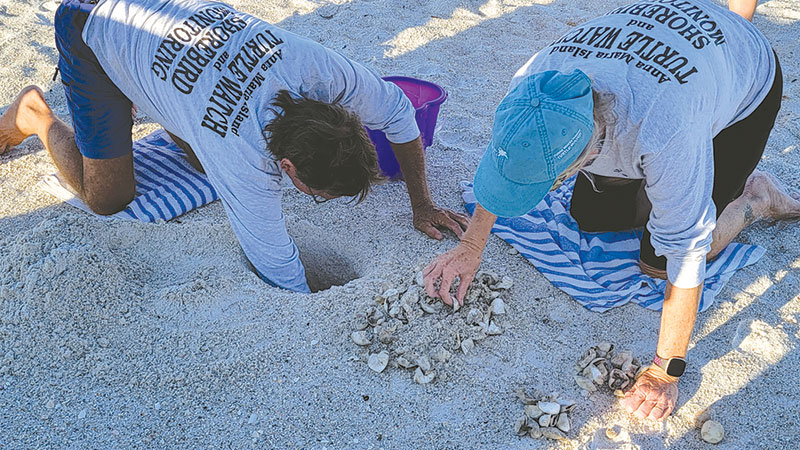
Anna Maria Island Turtle Watch and Shorebird Monitoring volunteers are focused on excavating hatched nests while surveying for new nests.
Beachgoers frequently ask the volunteers what they are doing:
Are you digging up a nest? Yes.
Did the eggs hatch? Yes.
Are you moving the eggs? No.
Are turtles in there? Sometimes.
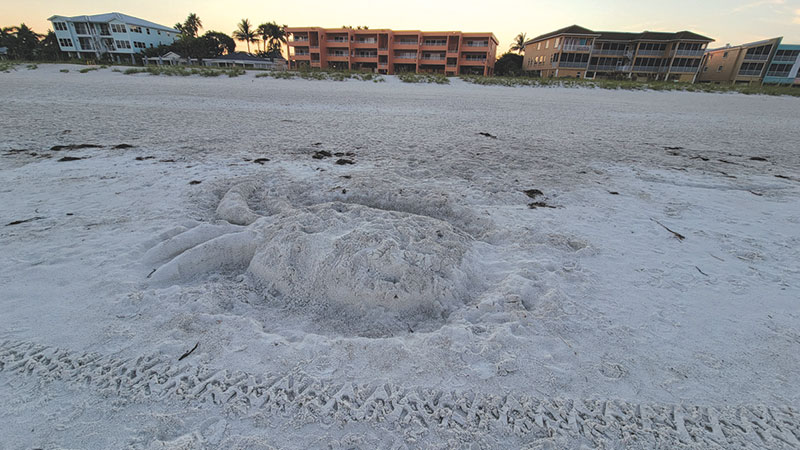
A hatched nest is identified by an indentation in the sand, called a drop, created when together the hatchlings crawl out of the nest.
The hatch is noted and three days later the volunteers dig in to count the eggs — hatched, unhatched, pips and live hatchlings.
The numbers are sent to the Florida Fish and Wildlife Conservation Commission, which uses the data to determine nesting density and trends.
Volunteers Debbie and Bob Haynes excavated four loggerhead nests Aug. 16.
An excavation near Seventh Street South in Bradenton Beach yielded 59 hatched eggs and two unhatched eggs.
Two nests excavated near the 2300 block of Gulf Drive North in Bradenton Beach contained 194 hatched eggs, 19 unhatched and one live loggerhead that was released by the volunteers on the sand to allow imprinting as it crawled to the Gulf.
Imprinting is how female turtles return to the beach where they were born to lay eggs upon reaching adulthood — about 30 years later.
The last excavation Aug. 16, near the 600 block of Sixth Street North in Bradenton Beach, yielded 78 hatched eggs and eight unhatched.
Through mid-August, AMITW’s volunteers counted almost 20,000 hatched eggs.
While that might seem like a significant number, research indicates only 20 of the hatchlings will make it to adulthood.
Odds are not stacked in their favor, which is why AMITW stresses the importance of working together to protect the sea turtles.
Nests hatch out daily — usually at night — and it is possible beachgoers might see hatchlings emerge or on the sand.
So, what should beachgoers do if they see hatchlings?
Stand back. Be quiet. Don’t shine lights, including the light of a smartphone because sea turtles see lights and, disoriented, can head away from the water.
Sea turtles are protected by the U.S. Endangered Species Act of 1973 and Florida’s Marine Turtle Protection Act and these protections include the harassment and handling of sea turtles.
Also, beachgoers should not handle hatchlings unless they are in harm’s way and AMITW volunteers cannot be reached to assist the turtles.
Filling holes, including those created by sand sculptures, is important.
The hole hatchlings crawl from can be shoulder deep and the effort of getting out can deplete the hatchlings of energy.
So falling into a human-made hole on the way to the Gulf of Mexico can be deadly.
Esther holding at 6th place
The Tour de Turtles hard-shell category started Aug. 1 and can be followed at tourdeturtles.org.
Esther, a loggerhead tagged and released June 20 on Coquina Beach in Bradenton Beach, was in sixth place out of 12 turtles Aug. 18.
Esther traveled 131 miles through Aug. 18 and was swimming toward Englewood.
Tour de Turtles is an educational effort led by the Sea Turtle Conservancy. Established in 1959, the organization is dedicated to the research, education and protection of sea turtles around the world. They started Tour de Turtles in 2008.
The Waterline Resort, Mainsail Vacation Rentals, both located on Marina Drive in Holmes Beach, and AMITW worked with the conservancy to make the tagging of Esther possible.
Each turtle has a cause: Esther’s is light pollution.
— Samara Paice